
For the final edition of this free newsletter, we have a great line-up of experts and articles:
Read MoreShould we welcome the nanocams?
I’m reading a short story by Ian Creasey called “The Edge of the Map”. In the world depicted by Creasey, automated cameras called “nanocams” take photos and newspapers (and other media, presumably) source their illustrations from the pool created by them. In other words, there is no need for specialist photographers.
This raises a number of interesting questions.
Awarding Levels in Computing for the purpose of number-crunching
It’s all very well coming up with weird and wonderful ways of acknowledging students’ achievement, but at some point somebody, unfortunately, is going to ask you for a number. The number is important to them because they can enter it into spreadsheet and show, hopefully, that the numbers go up over time.
Read MoreA is for Assessing Computing: 16 criteria and 5 considerations
A student writes a program. What are you going to assess it on? There are at least 16 criteria you could take into account. Not all of these will be apposite – it depends on what you’re teaching and who you’re teaching. Also, I’ve framed the list below in teacher language; it’s up to you to adapt it into language that is more appropriate for your students.
Read MoreThe 6 Fundamental Computing Assessment Scheme Questions
Whether you decide to create your own assessment scheme from a blank sheet of paper, so to speak, use a ready-made scheme created by someone else, or do a bit of both, there are 6 questions you need to ask:
Read MoreDigital Education Coding Resources Special
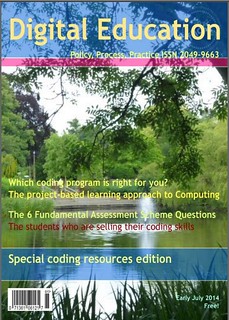 The new edition of Digital Education, the free newsletter for those with a professional interest in educational ICT and Computing, has a special focus on resources you can use to teach coding. Here’s what it contains:
Digital Education–Latest Edition
 This is what the latest version of Digital Education contains, with guest articles by Professor Paul Curzon, Sal McKeown, Geoff Jones and Crispin Weston
TrilbyTV inspires children to achieve life-long success at Stanhope School
 Stanhope Primary School in South Shields has been using TrilbyTV as much more than a teaching aid in their school. It has been used as a tool to inspire their children to believe in themselves and the goals they want to achieve throughout life.
Set in a deprived part of the UK, Stanhope School has to work exceptionally hard to ensure each of their pupils
The Magic of Human-Computer Communication
 Magicians demonstrate that some kinds of human mistake are not down to stupidity or negligence but about how our brains are wired. Computer Scientists have to understand this too but instead engineer systems so no one makes mistakes – especially in critical situations like a hospital. The machines need to help not hinder. Professor Paul Curzon explains...
From FELTAG to ETAG
In principle, these are exciting times, writes Crispin Weston. Having spent the first three years of its administration backing away from any active involvement in ed-tech, the government now appears to recognise not only that ed-tech has an important part to play in improving educational provision, but also that the government has an important part to play in making that happen.
In practice, I do not believe that the ed-tech community has yet taken advantage of the opportunity it has been given.
Read MoreReview of Teacher’s Pet
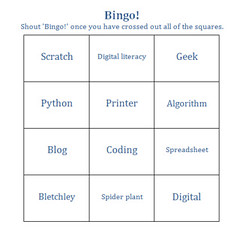 Go on, admit it: you still create worksheets, right? If you do, and you use Microsoft Word or OpenOffice to do so, you’ll find Teacher’s Pet very handy. It’s basically a set of macros that can transform lists of words into several different types of puzzle or test item.
The (digital) revolution comes to the London Barbican
 Digital Revolution explores and celebrates the transformation of the arts through digital technology since the 1970s. The exhibition brings together for the first time a range of artists, filmmakers, architects, designers, musicians and game developers pushing the boundaries of their fields using digital media. It also looks to the future considering the impact of creative coding, DIY culture, digital communities and the creative possibilities offered by technologies including augmented reality, artificial intelligence, wearable technologies, robotics and 3D printing.
Digital Education June Edition out now!
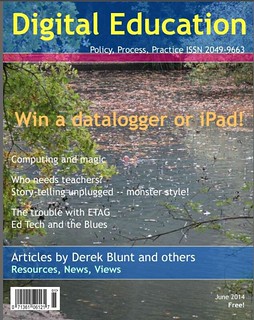 The latest edition of Digital Education is bursting at the seems. There is, I hope, something for everybody. As well as news and commentary, there are lists of resources, evaluated. Plus, guest articles: Professor Paul Curzon considers what programmers can learn from magicians, Sal McKeown asks whether we really need teachers, Crispin Weston suggests what is wrong with the Education Technology Action Group, Geoff Jones points out the dangers of some forms of data collection from parents, and Derek Blunt has a (mild) rant about the demise of the term “teaching”.
There are other articles too, plus a chance to win a Labquest datalogger, and a chance to win a break in Germany, an iPad and other goodies, free entry to an event called Digital Summer Trip, access to a growing list of very useful resources, including the collated articles about the recently-announced Department for Education assessment innovations.
The full list of contents is given below.
9 Approaches to assessing Computing and ICT–#9: Cognitive Development
The DfE recently announced the winners of its Assessment Innovation Fund. I’ve been reporting on the winners and the descriptions of their approach. These descriptions are more like thumbnail sketches at the moment. I have used them to suggest ways in which they might be adapted for use in assessing ICT and Computing. I hope you find these suggestions useful, or at least a good starting point for your own further work.
Read MoreIn each case I have kept the text of the DfE’s announcement, and then added my thoughts under the heading “Applying this to Computing and ICT”.
Today: Cognitive Development.
Update on the Computer Education Project
 A couple of months ago I invited people to contribute to a survey about what they were doing to prepare for the new Computing curriculum. About 75% of my motivation for doing so was to help to spread ideas. I believe in the grass roots sort of approach to such things, as opposed to the ‘great and the good’ declaring what the rest of should be doing. Actually, to clarify, I don’t mind if the great and the good are doing it or have done it themselves. I find it tedious when people who have never been a teacher and/or had little contact with schools start issuing advice. OK, rant over!
9 Approaches to assessing Computing and ICT–#8: An Iterative Approach
 The DfE recently announced the winners of its Assessment Innovation Fund.Over the next week or so I will report on the winners and the descriptions of their approach. These descriptions are more like thumbnail sketches at the moment. I have used them to suggest ways in which they might be adapted for use in assessing ICT and Computing. I hope you find these suggestions useful, or at least a good starting point for your own further work.
In each case I have kept the text of the DfE’s announcement, and then added my thoughts under the heading “Applying this to Computing and ICT”.
Today: Progression planners.
Magic, Monsters and Music
 The forthcoming edition of Digital Education contains articles about magic, monsters and music. See? Computing is not all about coding!
Driverless cars: technology trumps experience - again

Digital Education
 The latest edition of this wonderful publication is out now!
9 Approaches to assessing Computing and ICT–#7: An Iterative Approach
The DfE recently announced the winners of its Assessment Innovation Fund.Over the next week or so I will report on the winners and the descriptions of their approach. These descriptions are more like thumbnail sketches at the moment. I have used them to suggest ways in which they might be adapted for use in assessing ICT and Computing. I hope you find these suggestions useful, or at least a good starting point for your own further work.
Read MoreIn each case I have kept the text of the DfE’s announcement, and then added my thoughts under the heading “Applying this to Computing and ICT”.
Today: An iterative approach.