• Front Page
    • Digital Education
    • Terry Freedman's Books Bulletin
  • RSS
  • Search
    • Welcome
    • The "About" Page
    • Testimonials
    • CV/Resumé
    • My Writing
    • Published articles
  • Corrections Policy
Menu

ICT & Computing in Education

Articles on education technology and related topics
  • Front Page
  • Newsletters
    • Digital Education
    • Terry Freedman's Books Bulletin
  • RSS
  • Search
  • Info
    • Welcome
    • The "About" Page
    • Testimonials
    • CV/Resumé
    • My Writing
    • Published articles
  • Corrections Policy
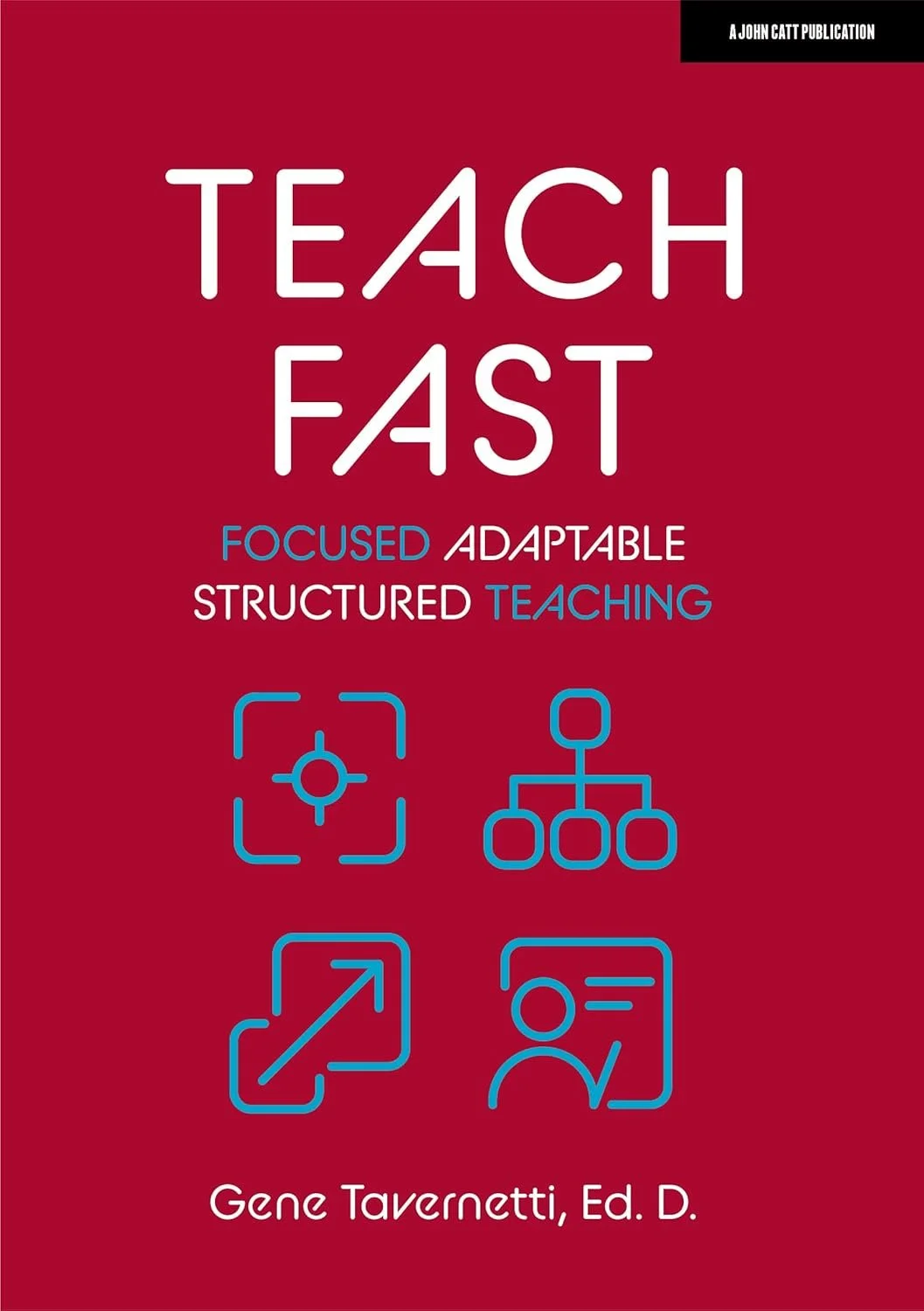
cover of Teach Fast

Click the pic to see this book on Amazon (affiliate link)

Review: Teach Fast

June 5, 2026

The FAST in the title stands for Focused Adaptable Structured Teaching. The book contains some interesting ideas. One of the things it doeasn’t agree with is when learning objectives are put on the screen at the start of the lesson, in the form “Students will be able to…” — though for different reasons from myself. The author writes:

“It is distracting to students when this information is presented at the beginning of the lesson. It does not add anything. Who do we think will be doing the work?”
— From Teach FAST

When I was observing a lesson once the teacher displayed:

“By the end of this lesson, some of you will have achieved X, Y and Z, some of you will achieve X and Y, and some of you will achieve X.”

As I said to the teacher afterwards, I don’t think that sort of formulation is helpful because some students, perhaps even most of them, will think they’re probably going to be in the least-achieved category, and that lack of self-confidence will probably end up being a self-fulfilling prophecy.

Let’s put it this way. I am trying to lern how to play the saxophone at the moment, and I am pretty sure that if the teacher began the lesson by stating that some of us will be able to play the F#Major scale and some won’t, most of us will think we are going to be the failures!

This book is full of useful techniques, logically set out, but in my experience there needs to be a certain degree of flexibility. For example, telling students that for the next 5 minutes they must be absolutely silent while you explain or demonstrate something is an excellent idea — but what do you do when it doesn’t quite work out that way.

The author recommends chunking: breaking up concepts into smaller learning objectives. That sounds like common sense, but how does a new teacher know or work out how small the chunks should be? This is one of the objections I have to Cognitive Load Theory.

The author also distinguishes between declarative and procedural lessons. I had not come across these terms before. Apparently, the former focus on learning a new concept while the latter focus on learning a new skill. There is a table showing the differences between these in practial terms.

There are plenty of diagrams to help the reader understand the concepts introduced. There is also a lot of focus on the nitty gritty, even down to details such as how students should hold up their individual whiteboards.
There are many good ideas here, and it would be worth using this book as a means of adding to your teacher toolkit, so to speak.


classroom.jpg
20240525_160520.jpg
20240922_130541.jpg
IMAG0485.jpg
IMAG0529_ZOE007.jpg
In Backlist, Bookshelf, News & views, Reviews Tags reviews, teaching ideas
← Following instructions is usually a good ideaA question of leadership →
Recent book reviews
Teach Fast.jpg
Review: Teach Fast

The book contains some interesting ideas.

Read more →
profits, prophets.jpg
A question of leadership

I have somewhat dichotomous views of this question of whether leaders make a difference, or much of a difference. I think my views can be classified as macro and micro.

Read more →
Making good progress.jpg
Review: Making Good Progress?

Daisy Christodoulou carefully picks apart the pitfalls of various kinds of assessment, drawing on different subject areas to do so.

Read more →
principles and practice of assessment.jpg
Review: Principles and Practices of Assessment

There is plenty in this book to like.

Read more →
effective teaching.jpg
Review: Effective Teaching: Evidence and Practice

Although this is a few years old now (2018), it has stood the test of time.

Read more →
maths library.jpg
Review: One for maths teachers

This wide-ranging book takes in probability, fractals, astronomy, Babbage, Lovelace and a host of other areas and people.

Read more →
Weimar.jpg
Reviews: Two for History teachers

Two books on the Nazi era.

Read more →
verb yr enthusiasm.jpg
Review: One for English teachers

No book about the craft of writing seems complete without a stern chapter on the importance of eschewing adverbs and adjectives - but what to put in their place?

Read more →
formal theory.jpg
Review: The Great Formal Machinery Works: Theories of Deduction and Computation at the Origins of the Digital Age

If you’re of a mathematical bent this could be just the book to delve into.

Read more →
How+to+lie+with+statistics.jpg
Review: How to lie with statistics

Although this book is over 60 years old, it is remarkably apposite for our times -- and especially in the fields of educational research and assessing pupils' understanding and progress.

Read more →
Dig+Ed+Banner.jpg

Contact us

Privacy

Cookies

Terms and conditions

This website is powered by Squarespace

(c) Terry Freedman All Rights Reserved