With that in mind, have you ever researched your own area
Tablets for Schools Conference
How to collaborate with other schools when you're not allowed to
Who cares about WALT and WILF?
I have a confession to make. You see, it’s like this, officer. I can never remember what WALT and WILF stand for. I know they’re acronyms to do with assessment for learning, but I can never recall what the letters stand for.
But it’s worse than that, your honour. I don’t even care.
11 Reasons to collaborate with other schools in implementing the new Computing Programme of Study
John Donne wrote that no man is an island; he might have said the same thing about schools. Many schools have a mindset perhaps best described as “splendid isolation” – except that there is nothing splendid about it. In fact, in many cases it is just plain daft. Here are my reasons for saying so.5 reasons schools need computing teachers with expertise in the subject
The beauty of expertise
This article considers the need for computing and ICT to be taught by experts in those subjects. Anything less simply will not do.Preparing for the new Computing curriculum: what if #3
Preparing for the new curriculum doesn’t have to be as difficult as it might look. Here’s a suggestion that you may like to consider, although it won’t be appropriate if you teach very young children.Preparing for the new Computing curriculum: what if #2
I am a member of Computing At School, and every day someone uploads a new scheme of work for the new programme of study. IT’s fantastic to have so much good stuff to choose from. It’s also a bit overwhelming if you’re not sure where to start in the first place.Preparing for the new Computing curriculum: what if #1
I believe a lot of people are worried by the forthcoming Computing Programme of Study, judging by the number of people I’ve spoken to who say they have not yet begun to think about it. And that is quite understandable. Although looked at from one point of view it is more of a change in emphasis from the old one, there is also a lot more required in terms of computer programming and related matters. Schemes of work will need to be modified – I don’t think they should need to be completely rewritten if you have been teaching to the old ICT programme of study properly. This is the first in a series of posts that aim to encourage you to think about the new programme of study, perhaps in a new way. It is based around a keynote talk I gave a short while ago.Getting permission to go on an ICT or Computing course
On this date 4 years ago I published an article that I think is still relevant today.
It strikes me that, what with a new Computing Programme of Study coming into effect in September 2014, ie under a year’s time, Getting permission to go on an ICT course or to a conference is rather timely. Teachers of ICT having to become
Report from the 3D print show
Hi, Richard Smith here from Igloo in Education. I am delighted to have been asked by Terry to do a guest blog post on the 3D print show that took place in London from 7-9th November.
The venue of the event, the Business Design Centre in Islington, sent out a clear message out to visitors: 3D printing should be about innovative design and the encouragement of original business ideas. Of
To be an ed tech maverick, you need to be sensible
What does it mean to be a maverick? To me, it means not going along with the general consensus about something, just because it’s a consensus. There is always a natural tendency to think “all those people can’t be wrong”, or “there’s no smoke without fire”, but in fact all those people could be wrong and there could be smoke without fire. (Think, for a moment, of all the vilified minority groups throughout history and throughout the world about whom all sorts of ridiculous and terribel things were believed by the majority.)My analogue program
When, on my teacher training course, I was told I had create a resource to be used in school, I thought it would be fun to devise a programmed learning guide to the economic concepts of absolute and comparative advantages. Unfortunately, that was in 1974. Word processors were not yet ubiquitous, and home computers had not yet been invented. That came a year or two later. In any case, when I finally did get my hands on a word processor, courtesy of a friend of mine on my MA course, it was slo-o-o-o-o-w.The Barefoot Ed Tech Expert: TeachMeet Takeover 2014
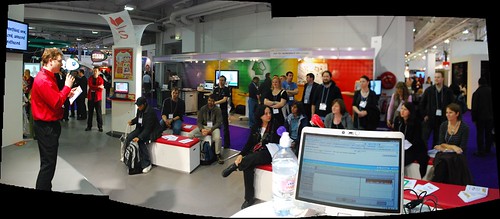
One of the features of BETT over the last few years has been TeachMeet Takeover. This is where teachers and other people involved in ed tech “take over” a company’s exhibition stand for between 15 and 30 minutes to give a talk, presentation or demonstration to anyone who happens to be interested in what the topic happens to be.A history of data storage and recovery
I once mentioned to the kids I was teaching how useful I found having CD-ROMs to store stuff on. “What?!”, they said. “You had CDs back then?”
Young people always seem to have a working assumption in life that the technology they use only came into existence when they did. Anything else is ancient history. With that in mind, perhaps your pupils will find the infographic below useful and interesting. It charts the development of data storage and recovery from the time of Babbage, in 1834. Along the way there are interesting articles, photos and videos.
Report on RM Apple Seminar
EdExec Live - ICT Matters: A conference worth going to
- Good topics, by which I mean not only ones about the latest fad but useful, down-to-earth ones too, and ones that make you think and reflect
- Good speakers, by which I mean people who are experts in their field, and not merely good entertainers
- An opportunity to meet and network with others
10 reasons to attend BETT
It’s that time of year again. No, I don’t mean the Christmas lights and shopping, but starting to think about BETT in January. If you’re serious about educational technology you really must try to get there, even if you can only manage a day: you’re bound to see something that you find interesting and useful.Computational thinking and spreadsheets
One way you can “get into” computational thinking is through spreadsheets. Taking a practical view of what “computational thinking” means (see What is Computational Thinking?), I’d say that spreadsheets definitely fit the bill. In order to try to solve a problem using a spreadsheet, which is a tool for modelling or simulation, you have to do the following things: