
Here’s a new blog to start looking at and to put into your RSS reader*: the BETT 2014 blog. So, the first thing I’ll do is declare an interest: I’ve been asked to contribute to it, which is quite flattering, but that’s not the reason I’m writing about it. I think the important thing about the blog is that it provides a variety of views and suggestions from different people
Read MoreEd Tech is fast, but education policy is faster
 What’s this? A new education policy? Oh, it must be Tuesday.
EdExec Live ICT Matters Conference coming soon
Look, I know this is short notice, but I’ve only just found this out for myself. The EdExec people, who produce a very good magazine with a section called ICT Matters, is having a live event on the 6th November.
Read MoreWhat is Computational Thinking?
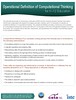 There is quite a bit of information on the web about computational thinking. Some very deep and learned stuff too. But I am very much a “one side of A4” kind of guy, so I was very pleased to discover this one page flyer about it.
British Gas and the Internet of Things
 British Gas and I go back a long way. For years they have provided me with heating and hot water, and until relatively recently with energy for cooking too. I won’t say it’s all been smooth running. For example, there was the time when they threatened to get the bailiffs round to my flat in order to read the meter that they had removed the week before. But on the whole they’ve been alright. I daresay were it not for the customary British reserve we’d be on first name terms by now. I’d write letters beginning,
“Dear British”
and go on to say how pleased I am to receive the latest bill and how much pleasure I have in enclosing payment.
Blog Review: nhowie
 I’ve been thinking for some time that I really ought to write an article every so often about blogs I like reading, or that have recently sprung up or come to my attention. I thought I’d get the ball rolling with “nhowie: Musing mainly about ICT in K-12 education”.
Conference catch-up
It's been a busy period conference-wise. In the near future I hope to report on all of them: dealing with the new Computing Programme of Study, dealing with data and Ofsted, an RM Apple day and the awe-inspiring Apps World 2013.
A self-marking spreadsheet
I like a challenge so I thought I’d try to create a self-marking spreadsheet in Excel. (Look, some men like fast cars, some like sport, and some like womanising. Me? I like spreadsheets. OK?)
I was inspired to have a go at this by someone called Lee Rymill, who uploaded a self-marking spreadsheet to the CAS resources area. However, I wanted to take it a few steps further…
Read MoreWe don’t need no official scheme of work for Computing
It is my fervent hope that Computing At School (CAS) does not update its Computing scheme of work, that Naace does not update its own scheme of work, and that the two organisations do not produce a joint scheme of work. This is not to disparage the work they have done so far, including a very useful document giving joint CAS-Naace guidance on dealing with the new Programme of Study. Indeed, it’s my belief that between them they will produce an excellent scheme of work which raises my concerns.
Read MoreGood riddance to levels in ICT and Computing
 Who’s afraid of life without Levels? Quite a few people if the number of schemes of work and assessment grids being developed that incorporate levels are anything to go by. Working without levels is clearly very hard: it is almost impossible to think, much less talk, about pupils’ progress without mentioning levels at some stage.
Yet this is precisely what the government expects.
9 Challenges of Project-Based Learning
Although I am an advocate of project-based learning, I am not unaware of its challenges. As the old military adage has it, failure to prepare is preparation to fail, so here is a list of what I consider to be the main issues you need to be aware of. Many of them may be subsumed under the general heading “management”, but I believe it’s worth itemising them all nonetheless.
Read MoreWriting a book as a blog
 It is almost a year since I suggested 7 Reasons educators should blog. I’ve recently discovered another one.
More unintended uses of “Smart Glasses”
 A number of people have told me they enjoyed the cartoon I linked to in the post entitled An unintended use of “Smart glasses”?. Well, here are a few more. Enjoy!
Running a successful Education Technology Project

It ain’t what you do, it’s the way that you do it.
That well-known expression applies as much to running an ed tech project successfully as to anything else. In other words, for an ed tech project to succeed, you need to think about more than just the technology, or even the pedagogy. You have to think about management as well.
7 Reasons to use project-based learning in computing
 I’ve long been an advocate of project-based learning, or PBL. Done properly, it can be much richer in terms of learning opportunities, and more fun. I believe it is entirely applicable to the teaching of the new Computing Programme of Study, for the following reasons.
7 ways to make IT real
A short while ago I published 8 articles under the heading “7 ways to make IT real”. (OK, so it looks as if I am numerically-challenged, but I'm not, as you will see!).
Well, here are the links to them, all in one place. Who says I don’t think of you!
An unintended use of “Smart glasses”?
I quite like this cartoon, which appeared in today’s paper.
A nice way to end the week!
Preparing for the new Computing Curriculum
Please note: the Westminster Forum Conference on Preparing for the new Computing Curriculum
listed in the post entitled Some useful-looking conferences takes place on the 26th February, and not the 14th as originally stated. Apologies!
The agenda and other details of the conference may be found here.
Two more conferences
I hope you found my recent post Some useful-looking conferences erm, useful. Here are a couple more. One takes place online, and the other in a physical location. Both look very promising.
Read MoreSome useful-looking conferences
Here are a few conferences coming up which you might find useful. The first one is next week! A couple of them will attract a 15% discount for some subscribers to our newsletter. Look out for announcements soon-ish!
Here are the conferences in chronological order: