
Do advertisers know something we don’t?
Read MoreUsing spreadsheets or Python to process words
A couple of people and I started to discuss how we might use technology to process a block of text.
Read MoreUse a spreadsheet for literary criticism: it's more accurate (Updated)
It seems to me that if you’re going to encourage students to use computer programming in literature studies, one very worthwhile project would be to get them to create a random book review or literary essay generator.
Read MoreUse a spreadsheet for literary criticism: it's more accurate
If book blurb writers had any sense, they wouldn’t put wordy descriptions on the back cover of books. They would put a graph there instead.
Read MoreIntroducing kids to programming via a spreadsheet sweet shop
Spreadsheets are dead, right? Wrong! Not only are they a great tool for teaching programming concepts, they can easily be addressed under the Computing programme of study.
Read MoreBook review: 100 Top Tips - Microsoft Excel, by Sean McManus
Could this book of 100 top tips for using Excel benefit heads of department or subject leaders?
Read MoreHow to see the trend in students' grades at a glance
Updated! Here’s a little-known function in Google Sheets which gives you an in-cell graph. Handy for displaying trends in students' grades at a glance.
Read More
Tick box, by Terry Freedman
How teachers can use the tick box in Google Sheets
Google sheets has a tick box feature. Here are some ways you can make use of it.
Read MoreA self-marking spreadsheet UPDATED
I like a challenge so I thought I’d try to create a self-marking spreadsheet in Excel. I was inspired to have a go at this by someone called Lee Rymill, who uploaded a self-marking spreadsheet to the CAS resources area. However, I wanted to take it a few steps further, using the Visual Basic for Applications programming language.
Read More
The UserID interface, by Terry Freedman
Useless utilities, pointless programs -- and why we should encourage kids to create them
We should encourage pupils to write useless bits of code. Here’s why.
Read More
What?! by Terry Freedman
A spreadsheet moment
A girl had been made to leave her lesson, and wanted to help me teach spreadsheets. My mind said “No way”, my intuition said “Why not?”
Read More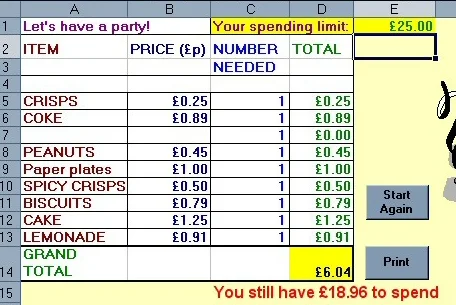
Spending checker, by Terry Freedman
How to introduce primary school pupils to the basics of programming -- using spreadsheets
Spreadsheets have been dismissed by some people as boring, old hat, and about “only” office skills. Those people are wrong! In this article I look at how you can use spreadsheets to start teaching children about some programming concepts.
Read MoreMy best IT training days #1: The Science Department
As a complement to my series of articles about my worst training days, I’ve started a series about my best ones. I believe we can learn from both sorts. In this article, I relate an experience of running a twilight training session for a secondary school science department.
Read More
Reading list! by Terry Freedman
Spreadsheet special, analysis and a prize draw
Read on for a heads-up about what's coming up in the next issue of Digital Education, our free newsletter.
Read More
Review of ASAP Utilities for Excel
A program to put Excel on steroids. Loads of utilities that can be applied straight away, no programming involved, and it's free!
Read MoreRandomised lesson activities in Computing and ICT
Why not introduce a bit of unexpectedness into your lessons -- by selecting exercises at random?
Read More
Suspicious enthusiasm? Picture from www.pixabay.com CC0
My best and worst IT lessons #6: Adorable spreadsheets
Why a lesson on spreadsheets became the highlight of the kids' day, and a nightmare to haunt me forever.
Read MoreSpreadsheets: vindicated at last!
 I’ve long been an ardent advocate of spreadsheets. They can be an invaluable tool in business, education or any other field in which planning, cost or both are paramount. As far as Computing and ICT is concerned, they can be used for teaching modelling and computational thinking. However, they have been denigrated as being “just” an office tool, far removed from the exciting world of coding or robotics.
Computational thinking and spreadsheets
In order to try to solve a problem using a spreadsheet, which is a tool for modelling or simulation, you have to do the following things:
Read MoreComputational thinking and spreadsheets
 One way you can “get into” computational thinking is through spreadsheets. Taking a practical view of what “computational thinking” means (see What is Computational Thinking?), I’d say that spreadsheets definitely fit the bill. In order to try to solve a problem using a spreadsheet, which is a tool for modelling or simulation, you have to do the following things: