
"Until adults move on from the dismissive and patronising position of ‘the online world isn’t real or valid’ we will continue to fail in the quality of the support we offer our children."
Simon Finch suggests a much more useful approach.

"Until adults move on from the dismissive and patronising position of ‘the online world isn’t real or valid’ we will continue to fail in the quality of the support we offer our children."
Simon Finch suggests a much more useful approach.

Being safe on the internet is vital. If you’re concerned about being safe on the internet or just want a few ideas of how to be safe you have come to the right place!
 Whether you're a newly qualified teacher starting out on your career, an experienced classroom practitioner, or somewhere in between, you will find something to take away from Terry Freedman's digital publication Go On Bore ‘Em, says Ben Davies.
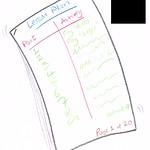 Every so often there comes along a new daft idea (or a newly-packaged old idea that has been mangled out of recognition (and thereby rendered useless) so that its “inventor” can be designated as a guru. Me? Cynical? Never!) One of the more unfortunate manifestations of this phenomenon was the three part lesson. It sounds good and logical, but then the thing that usually happens happened: Ofsted started insisting on it, and Headteachers demanded to witness it in every lesson. Woe betide the brilliant but hapless teacher whose lesson plans failed to include the three parts.
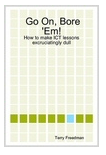 Mr. Freedman uses his extensive experience to write a clear and concise booklet on the different ways he has observed teachers instructing their students straight into boredom purgatory. But, he also explains how the lesson could have been changed to make it more interesting.
 I thought it would be interesting to dig out my scheme of work for Information Technology – as it was then then – from 1997. It was based on the Informatics scheme of work published by the now defunct organisation Acitt. Acitt was a subject association for ICT Co-ordinators. I helped to shape the Acitt scheme of work, but the one I used myself was a variation, adjusted to meet the circumstances pertaining to my school. I’ve reproduced it below.
 When I was in my teens I wanted desperately to get involved in television production, especially the filming and editing side. So I was delighted when one day there was a the start of a new behind-the-scenes series about how television studios operate. Well, the presenter started off by saying, “This looks boring, all these cables and wires everywhere, but…”. Then, a few minutes later, “This is a boring part, but…”. After 15 minutes I switched channels. I’m not even sure that the series was completed. Who wants to be told that the thing they have given up their time to watch is ‘'”boring”?
 There's no point in just starting to write a load of code. You should at least have some idea of what you want to achieve.
 Today I published a short, one page newsletter. It’s a great read (he says modestly), with some interesting links and free resources. Here’s what it contains:
 I received a very nice review from Jacqui Wilson, a classroom teacher in Tasmania. Is a book about what made ICT boring still relevant if the focus is on Computing? Well I think so, because the issues I highlighted with respect to ICT are in danger of arising again with respect to Computing. Anyway, read what Jacqui says about the book.
The Spectator does it. The Economist does it. Even children’s comics do it. So I thought: Let’s do it. Let’s make a Christmas double issue of the Digital Education newsletter.
I’d like to be able to say I’d planned it that way right from the start, but that would be something of (to use Winston Churchill’s wonderful expression) a terminological inexactitude. In truth, the November edition was delayed due to a family illness, so it made sense to bring out a bumper edition now so people who subscribe have plenty to keep them going until January! I’ve included articles on a wide variety of topics:
 The more students read, the higher their reading scores, according to the U.S. Department of Education. Unfortunately, with iPads, cell phones and computers, it’s harder than ever for them to sit down with a book—so old fashioned, right?—and take a few minutes to read.
 According to the 2014 Horizon Report for K-12 education (ie Kindergarten to 18 years old), big data and analytics will be adopted by education within the next two to three years. Big data. It’s the current buzzword in education (one of several, at least), but what exactly is it? And is it really of any practical use? And should we be using it anyway?
 In theory, setting yourself up to sell products on the internet is the easiest thing in the world. Once you’ve created the product, you upload it to a 3rd party platform that will handle all the sales and deliveries automatically, and you just sit back and watch the money roll in. If only it were as simple as that. But why would a school want to do something like that anyway
 Can eBay teach us anything about assessment? At the Naace 2009 conference, John Davitt made an interesting point. As I recall, he said that when he started selling stuff on eBay he received more feedback on his performance than he’d ever seen in a school.
 Are your students yawning, checking their email, launching paper aeroplanes in your lessons? Perhaps you’re making one of these mistakes.
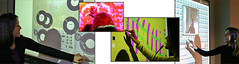 I heard an interesting snippet from Mike Cladingbowl, National Director at Ofsted, recently. He said that when interactive whiteboards were first introduced, Ofsted inspectors saw an increase in “chalk and talk”. Hardly surprising, because interactive whiteboards made chalk and talk, ie teaching from the front, easier.
 Trawling through the articles published on my original website, I came across this one about vocabulary. Happily, the “new” publication it refers to is still available. Incidentally, I’m a great believer in paying attention to vocabulary and the correct use of correct terminology, so at the end of this “reprint” I’ve inserted a couple of references to other articles I’ve penned on this subject. The original article was published in 2008, and is shown in a different font, below.
 In this series I’m going to be making some suggestions, putting out some ideas. These are based on presentations I’ve given. I can think of how these ideas, or their implications, might be applied in the classroom. However, I think it better if I stand back and let you do that part of the work!
(c) Terry Freedman All Rights Reserved