
• Front Page
    • Digital Education
    • Terry Freedman's Books Bulletin
  • RSS
  • Search
    • Welcome
    • The "About" Page
    • Testimonials
    • CV/Resumé
    • My Writing
    • Published articles
  • Corrections Policy
Menu

ICT & Computing in Education

Articles on education technology and related topics
  • Front Page
  • Newsletters
    • Digital Education
    • Terry Freedman's Books Bulletin
  • RSS
  • Search
  • Info
    • Welcome
    • The "About" Page
    • Testimonials
    • CV/Resumé
    • My Writing
    • Published articles
  • Corrections Policy
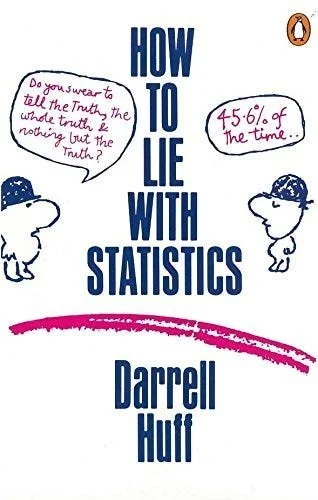
How to lie with statistics

Click the pic to see this book on Amazon (affiliate link)

Review: How to lie with statistics

May 6, 2026

Although this book is over 60 years old, it is remarkably apposite for our times -- and especially in the fields of educational research and assessing pupils' understanding and progress.

I first read this book at university, where I was studying statistics as part of my degree. However, it has been in the context of other subjects and, indeed, life in general that this book has proven most useful.

The odd-sounding title is easily explained by the author himself. He says he wrote the book much in the same spirit as a burglar might write an instruction manual on how to break into people’s houses — not so much to make it easier for burglars to do so, but so that home-owners can see where their vulnerabilities lie.

These days, the book seems to be even more relevant. Not only are research findings reported in the papers virtually every day, but in education in particular there are quite a few articles of faith that are based on shaky, and sometimes non-existent, foundations.

With chapters like “The well-chosen average”, “The little figures that are not there” and “The semi-attached figure”, the book makes you look at statistics in a different way.

For example, if you were to read a report that tells us that research has shown that 98% of students derive no benefit whatsoever from using technology, you may have a vague feeling of unease about such a finding. However, having read this book you should be able to re-read the report and spot where the statistical sleight of hand occurred (assuming it did occur, of course).

Then again, there are the endless announcements telling us that eating X wards off cancer, causes cancer, is dangerous for people over 40, is only dangerous if you eat more than one a day etc etc ad nauseous. Again, an insight into how some of the figures cited were derived would be immensely helpful in your decision-making.

Illustrated with cartoons by Mel Calman, this light-hearted and slim volume punches way above its weight. Although it was first published over 60 years ago, in 1954, it is still relevant. It should be on every teacher’s shelf and in every school library.

5/5

How to Lie with Statistics (affiliate link)

This review first appeared in Digital Education, the free newsletter for all those with a professional interest in educational ICT and Computing.

In Bookshelf, Reviews Tags reviews, statistics
← AI Cynicism #1Using fiction as a vehicle for discussing technology →
Recent book reviews
When.jpg
Review: When: The Scientific Secrets of Perfect Timing

Hopefully, neither you nor I will ever find ourselves in court, undergoing a medical procedure, or taking an important exam.

Read more →
finding fibonacci.jpg
Review: Finding Fibonacci: The Quest to Rediscover the Forgotten Mathematical Genius Who Changed the World

Finding Fibonacci is a memoir of the authors’ quest to find out about Fibonacci.

Read more →
The Teachers' Standards in Primary Schools.jpg
Quick look: The Teachers' Standards in Primary Schools

This is very well set out. It takes each standard, and gives you ideas on how to achieve it, and what success in this context looks like.

Read more →
How Computer Games Help Children learn.jpg
Quick look: How Computer Games Help Children learn

When I was teaching Econnures I realised that I could have taught quite a chunk of the synabus if I'd been able to run Sim City on the school network.

Read more →
Reinventing Project-Based learning.jpg
Quick look: Reinventing Project-Based Learning

I can verify from first hand experience that PBL kept students highly engaged, and helped them to develop skills such as working with others and independent research.

Read more →
The human touch.jpg
Quick look: The Human Touch

Although this book is published by the BCS, the Chartered Institute for IT, the focus is not on IT at all.

Read more →
Better Living through science.jpg
Quick look: Better Living through science

I have often thought that I would have been much more interested in science at school, and been much more successful at it, had the teachers taught us anything of practical value.

Read more →
Tubes.jpg
Quick look: Tubes: Behind the scenes at the internet

We are all so accustomed to using the internet, searching the world wide web — "going online" — that most of us most of the time probably do not stop to consider the question: yes, but where exactly is it?

Read more →
profits, prophets.jpg
Quick look: Profits, Prophets, Coaches and Kings: (When) do leaders make a difference?

I have somewhat dichotomous views of this question of whether leaders make a difference, or much of a difference.

Read more →
power up.jpg
Review: Power Up, by Matthew Lane

This book looks at the maths concepts — and, to some extent, the physics concepts — hidden in popular video games.

Read more →
Dig+Ed+Banner.jpg

Contact us

Privacy

Cookies

Terms and conditions

This website is powered by Squarespace

(c) Terry Freedman All Rights Reserved