
The sign-up buttons for the Digital Education newsletter have been in place for ages. So why was there a sudden drop in subscriptions?
Read MoreA too-robust approach to spam
 I was reading recently that something like 47% of emails are spam. I can believe it. I get the whole range: offers of Russian brides, Viagra, genie bras, news that a previously unknown relative has left me tons of money and messages exhorting me to open the attached document or confirm my security details. All this would be quite funny on one level, but it makes downloading and then sifting through email that much more difficult.
So I decided to do something about it.
Big ideas for ed tech leaders: What’s your self-talk?
 When I was in my teens I wanted desperately to get involved in television production, especially the filming and editing side. So I was delighted when one day there was a the start of a new behind-the-scenes series about how television studios operate. Well, the presenter started off by saying, “This looks boring, all these cables and wires everywhere, but…”. Then, a few minutes later, “This is a boring part, but…”. After 15 minutes I switched channels. I’m not even sure that the series was completed. Who wants to be told that the thing they have given up their time to watch is ‘'”boring”?
Our ebooks may be discontinued
 New EU rules on VAT (value-added tax) come into force on 1st January 2015. At present, the tax applied is the rate prevailing in the country of supply. Thus my ebooks are taxed at the rate of 20%. From the beginning of next year, this will change, and the rate of tax applied will be according to the place of purchase.
There are technical difficulties associated with the administration of this approach.
Whiteboards: not dead yet
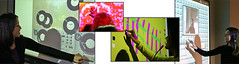 I heard an interesting snippet from Mike Cladingbowl, National Director at Ofsted, recently. He said that when interactive whiteboards were first introduced, Ofsted inspectors saw an increase in “chalk and talk”. Hardly surprising, because interactive whiteboards made chalk and talk, ie teaching from the front, easier.
Should we welcome the nanocams?
I’m reading a short story by Ian Creasey called “The Edge of the Map”. In the world depicted by Creasey, automated cameras called “nanocams” take photos and newspapers (and other media, presumably) source their illustrations from the pool created by them. In other words, there is no need for specialist photographers.
This raises a number of interesting questions.
Driverless cars: technology trumps experience - again
Safer Internet Day: Time to turn to pawnography?
Today I sent out my newsletter, Digital Education, and because today is Safer Internet Day the word “pornography” appeared. And guess what? The newsletter was blocked by a Local Authority’s filtering system. I’m not sure whether or not this is worse than the time I was told my website was blocked – because it featured an article about social networking.
Read MoreBusiness emails to inspire confidence (not)
 There must be a whole generation of people who know the mechanics of using technology, but have no idea of how to take charge of it. I am thinking in particular of the ridiculous marketing messages I receive, that advertise targeted marketing services. I mention this because, despite all the lambasting of “Office skills”, it is demonstrably clear that people need them. I could even make a case for this being related to digital safety. How? Reputation is important, and marketing messages that have “schoolboy errors” do nothing to enhance one’s credibility. Consider the following examples:
Assessing “soft” skills
Do you have anything you’d like to add to the discussion, Terry?
The scene was a meeting at the Edusummit conference at UNESCO in Paris in 2011. The question came from the Chair.
Thank you, but no: everything I was going to say has already been said.
That was my response, because I didn’t see any purpose in repeating points that had not only been made, but also generally agreed upon. In fact, my contributions to many meetings are based on Salvator Rosa’s, dictum:
Be silent, unless what you have to say is better than silence.
The question is: does that make me a good collaborator, or not so good? How do we measure such things? And does any of it matter anyway?
5 reasons schools need computing teachers with expertise in the subject
Some Principals and Headteachers think that a good way around the problem of teaching computing is to not worry about whether teachers have subject knowledge at all. “All we need are facilitators”, they say, “while the kids can teach themselves and each other.” This is, as any teacher knows (or should know), easy to say, less easy to do, and not altogether the most desirable thing to do even if you can do it. However, just in case your school happens to be “led” by one of the aforementioned Headteachers, here are some arguments you may want to use. I think that any one of them should suffice, and all of them together make for a cast-iron case.
Read MoreAn unintended use of “Smart glasses”?
I quite like this cartoon, which appeared in today’s paper.
A nice way to end the week!
An unfortunate side effect of Linked-In?
I quite enjoyed this cartoon in yesterday’s Daily Telegraph. It pokes a bit of gentle fun at ‘consultants’, and
Read MoreTwo effects of new technology
 Here are a couple of interesting cartoon strips about the (possible) effects of new technology. Yesterday’s one is more about unintended consequences, while today’s is really about how apparently intelligent software and monitoring systems might be fooled.
Computer help is not always helpful
 It’s very tempting to try to make life as easy as possible for end users by being proactive, ie anticipating what is likely to be useful to them, and then implementing that as a default option (or possibly not even an option, but compulsory).
Perhaps some of your students will be tempted, when designing a computer program for use by non-technical people, to make it as ‘proactively helpful’ as possible. If so, they should beware. A good idea would be to undertake some market research, if only of a rudimentary nature, to avoid the pitfall of merely annoying people.
E-safety: Knowing your digital rights
 The place: A classroom
The time: Now
Teacher: So, class, that’s your homework for today.
Boy at the back: You can’t do that, Sir. I know my rights.
T: Er, sorry, I can’t do what exactly?
BATB: Set us that homework, Sir.
T: Why not?
BATB: ‘Cos it will take about half an hour, Sir, and you’re only allowed to give us 20 minutes. I know my rights.
T: OK, do 20 minutes this evening, and 10 minutes tomorrow evening.
BATB: You can’t tell me that, Sir.
T: OK, and why not?
BATB: Cos I have a right to a private life under Article 8 of the European Convention of Human Rights, Sir. I know my rights.
Lights dim as the characters continue arguing. Exeunt.
An example of how technology changes things
 I have found the Never Seconds debacle quite interesting. Story in a nutshell, in case you missed it: nine-year-old Martha Payne writes a daily blog in which she uploads a picture of her school lunch and reviews it. Argylle and Bute Council has some sort of nervous breakdown and issues an edict telling Martha that she isn’t allowed to take photos of her lunch, because catering staff are now in fear of their jobs. As a consequence, Martha’s blog gets over 5 million page views in just a few days, the number of comments on her posts soars from around 30 to over 2,300 in two days, and Argyll and Bute rescind the ban.
“I’m on the tube!”
 People travelling on the London Underground (known as ‘the tube’) will soon be able to obtain a wi-fi signal on their phone or other electronic device.
What might be the benefits and costs of this?
Some notes on failing with ICT
 Failure seems to be the zeitgeist at the moment. At several conferences I’ve attended recently at least one of the presenters has displayed the Samuel Beckett quotation:
Ever tried. Ever failed. No matter. Try Again. Fail again. Fail better.
At the Pelecon 12 conference there was even a “Confessional”, in which delegates could go in and record themselves talking about one of their mistakes. Here are a few of my thoughts on failure, especially as it pertains to ICT.
11 predictions concerning technology in education
 Here is a list of predictions I made in 2001 about the classroom of the future. I’m pleasantly surprised about how accurate it has turned out to be – but I think it will be even more challenging to predict the next ten years because there are so many options opening up. What are your predictions for the next ten years? And is it worth bothering to make such predictions anyway?