Updated! Discounts, competitions, news of events coming up, commentary, and advice about internet safety! And it's completely free!
Here’s what this issue contains:

Updated! Discounts, competitions, news of events coming up, commentary, and advice about internet safety! And it's completely free!
Here’s what this issue contains:
 I had the pleasure of attending a summit at the Royal Society of Arts last week. Entitled Skills for the 21st Century Summit, the event was designed to launch the “Year of Code” with as much razzmatazz as could be mustered.
And it worked. There was a great buzz throughout the day, and I came away buzzing and full of enthusiasm – though I suspect not for reasons that the organisers had in mind.
 Sponsored article
Seating charts make a real difference to the classroom learning environment in terms of teacher effectiveness and student attainment. Through using a seating chart, the teacher is imposing their authority before the lesson has even begun and making it clear to the students that the classroom is the teacher’s territory and they are in control of it. By using their knowledge of students and putting careful thought into the design of the seating chart the teacher can minimise negative interactions between students and take advantage of peer-to-peer learning strategies.
 In 1981 the then Conservative government announced that the Department of Trade and Industry would provide funding for one microcomputer in every school. Throughout the ensuing three decades there has hardly ever been a year when there has not been some earmarked or ring-fenced funding for ICT in schools in England. But in 2014 we are in new territory. The Harnessing Technology Grant, which for several years was the main source of devolved funding to support ICT in schools, is no more and many schools will have to make do with the ICT equipment they already have rather than spending on the latest technology. Yet teachers should still aim to make the very best use of the resources available to them and aspire to excellent teaching with ICT.
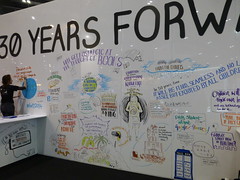 If you look at the list of suggestions in my “Getting the Best out of Bett” guide, some of which I reproduced in 5 Things to do after attending Bett, nothing leaps out as being “strategic”. But there are a couple of things, as I’ll explain in a moment. And that is tremendously important.
It would be very easy indeed to spend a day or two after an event, especially a long one like Bett, just dealing with the backlog of emails and work, but not actually doing anything that will help future growth. I suppose it’s a bit like clearing a financial debt: very important to do, but it’s putting some money into an interest-bearing account that will reap benefits in the longer term.
 There is always a danger that no matter how good an event is, it will turn out to have very little impact in the longer term, as you forget what you saw and more pressing concerns vie for your attention. Here are 5 suggestions for preventing that from happening. There are more suggestions in the free guide, Getting the Best out of Bett.
 Our newsletter Computers in Classrooms has been folded up, put away in a drawer and replaced by another one. Welcome to Digital Education!
 Over 170 hints and tips from a Bett veteran! Yes, this is my UNOFFICIAL guide. Feel free to download it or share it, via an embed code.
Now includes a floor plan!
If you have already downloaded it, you may wish to download it again, as this is a revised edition containing extra information.
With that in mind, have you ever researched your own area
 John Donne wrote that no man is an island; he might have said the same thing about schools. Many schools have a mindset perhaps best described as “splendid isolation” – except that there is nothing splendid about it. In fact, in many cases it is just plain daft. Here are my reasons for saying so.
 This article considers the need for computing and ICT to be taught by experts in those subjects. Anything less simply will not do.
 Preparing for the new curriculum doesn’t have to be as difficult as it might look. Here’s a suggestion that you may like to consider, although it won’t be appropriate if you teach very young children.
 I am a member of Computing At School, and every day someone uploads a new scheme of work for the new programme of study. IT’s fantastic to have so much good stuff to choose from. It’s also a bit overwhelming if you’re not sure where to start in the first place.I believe a lot of people are worried by the forthcoming Computing Programme of Study, judging by the number of people I’ve spoken to who say they have not yet begun to think about it. And that is quite understandable. Although looked at from one point of view it is more of a change in emphasis from the old one, there is also a lot more required in terms of computer programming and related matters. Schemes of work will need to be modified – I don’t think they should need to be completely rewritten if you have been teaching to the old ICT programme of study properly. This is the first in a series of posts that aim to encourage you to think about the new programme of study, perhaps in a new way. It is based around a keynote talk I gave a short while ago.
(c) Terry Freedman All Rights Reserved