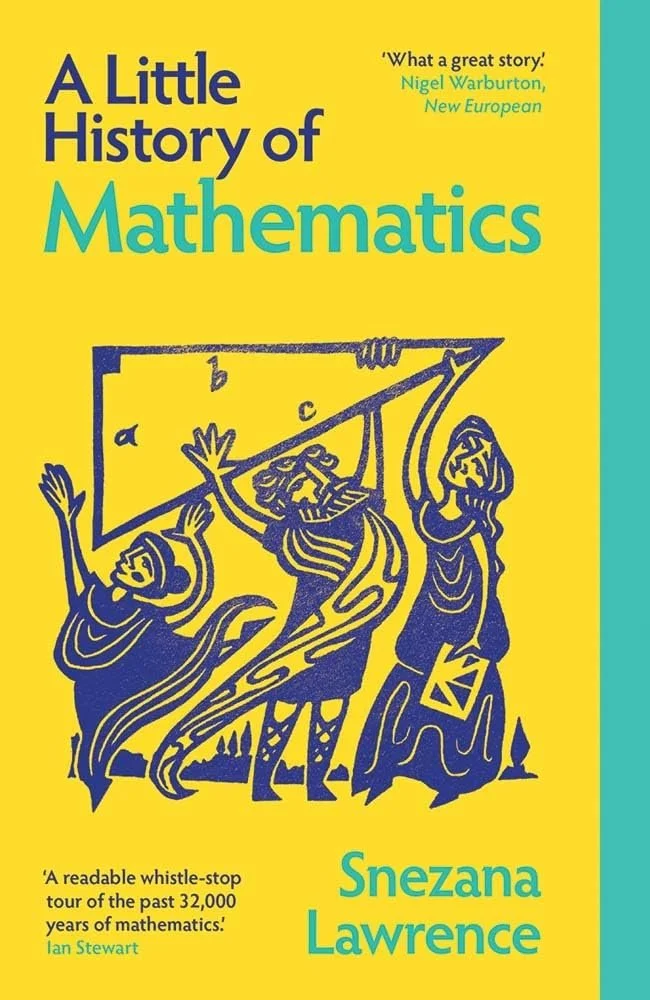
A Little History of Mathematics
(Snezana Lawrence, YUP, £16.99)
I submitted my review of this book to Teach Secondary magazine, an educational magazine in the UK. The first review below is what the magazine published. The second one is what I actually wrote! In substantive terms there is little difference between the two, but you may find it interesting to see what the editor altered.
The published review
The history of maths is really a history of ideas and problem-solving. I'm not sure I necessarily understand maths any more than I did after reading A Little History of Mathematics, but Lawrence writes about the subject so engagingly and effectively that this could certainly be a possibility for someone else. She makes many intriguing connections between different mathematical fields (and even the literary tradition) over the course of the book, in a way that I believe maths teachers will find useful to draw on when trying to enthuse their students.
If I have one criticism, it's that the book covers so much history — from Mesopotamian clay tablets to artificial intelligence— that some topics inevitably receive rather more attention than others. The end result resembles a whistle-stop tour of how various mathematical theories were developed, complete with guest appearances from Lewis Carroll, MC Escher, Babbage and others.
My original review
I wish this had been around years ago. The history of maths is really a history of ideas and problem-solving. I am not entirely sure that I understand maths any more than I did, but Lawrence has made the subject interesting enough for that to be a possibility. She writes engagingly, and very effectively makes the connections between different fields within the subject. I think teachers of mathematics will find it useful to draw on in order to enthuse their students.
My only criticism is that because the book covers so much history, from Mesopotamian clay tablets to artificial intelligence, some topics receive little attention. For example, Alice in Wonderland is mentioned, but its underlying mathematical ideas are not. The result is a whistle-stop tour of how mathematical theories have developed, with guest appearances from Lewis Caroll, Escher, Babbage, and others.