
This book looks at the benefits of writing in order to reflect on and improve your practice, and suggests numerous exercises for doing so.
Read MoreWhat I've been reading: Reflective Practice, Technically Wrong and Bad Algorithms
I’ve started to read this book, and so far it’s very interesting. I’ll be reviewing this and several others in my newsletter, Digital Education. I’ll also be running a prize draw to win a copy of Reflective Practice. Read on for more information.
Read More
Cover picture: from pixabay.com. Licence: CC0
What I've been reading: Closing the Vocabulary Gap
UPDATED!
What does a book on vocabulary have to do with teaching Computing? Believe it or not, Closing the Vocabulary Gap has some useful information and insights for the ed tech teacher. Read on for the review, and how you can enter a prize draw to win a copy of the book.
Read More
A session in full swing at the London Book Fair -- photo by Terry Freedman
The London Book Fair 2018, and why you should be interested
The seminar sessions at this year's London Book Fair look great. Here are three reasons I think the London Book Fair is a great event, and a link to my top 11 seminar sessions (so far).
Read More
Review of Enhancing Learning and Teaching with Technology
David J Longman reviews this new collection of essays on the theme of what the research says about using technology to enhance learning and teaching.
Read More
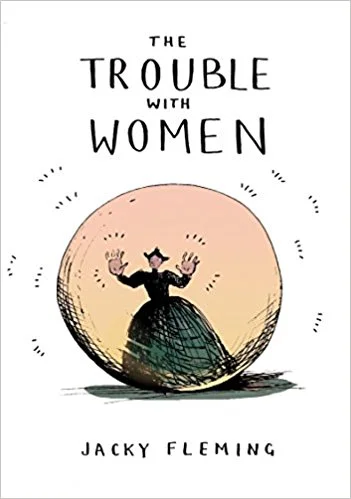
What I've been reading: The Trouble With Women
You would hardly believe the ridiculous things that 'genius' men have said about women's capabilities. I can't help thinking that if Ada Lovelace had been a man we'd have had computers at least one generation before we did. Anyway, here are my views on a book that deals with the issue.
Read MoreQuick look: Baking with Kafka, by Tom Gauld
A great sideways glance at modern life, including our relationships with technnology.
Read MoreThumbnail sketch of The Secret Teacher
Here's an insider's view of what it's like to be a newly qualified teacher in an inner city school.
Read More
The Raspberry Pi User Guide 4th Edition
Thumbnail sketch of the Raspberry Pi User Guide
I always dread having to open any kind of manual. For a start, it’s against the natural order of things. (I don’t ask for directions either, even when I’m hopelessly lost.) Secondly, they usually seem to be written for people for whom they are superfluous.
Imagine, then, what a pleasant surprise it was to open this book and discover that it is not only well-structured, but an enjoyable read.
I wouldn’t say it is bedtime reading exactly (mind you, I used to read books on Excel functions and VBA before retiring for the night). However, it is very comprehensive.
For example, if you are interested in setting up your Pi to take time-lapse video, this book takes you step by step through the process.
If you’re serious about pushing your Raspberry Pi to its limits, and even if you’re already pretty familiar with what it can do, this book is a must-have for your bookshelf or workbench.
Raspberry PI User Guide (Amazon affiliate link)
This review was first published in Digital Education, our free newsletter. To find out more, and to sign up, please visit the newsletter page. We use a double opt-in system, and you won't be spammed.
Coming soon in Digital Education
I'm in the process of planning a few themed issues of my newsletter, Digital Education. Read on for the low-down.
Read More
What I've been reading: Weapons of Math Destruction
What's worse than being governed by algorithms? Not even knowing what the algorithm is doing. This very timely and readable book lifts the lid of what goes on in many walks of life.
Read MoreGetting the most out of education conferences
This book has received 22 five star reviews in total so far, and is the TESOL Institute's featured book. Read on for more information, and for details on how you can buy a personalised version.
Read MoreWhat I've been reading: The Art of People
One of the most fundamental of so-called '21st century skills' is surely knowing how to interact with other people. This book contains some interesting strategies, though I am not sure all of them will work in the UK!
Read MoreFake news, the great training robbery and a bunch of other stuff
The next issue of the Digital Education will soon be out. Here's a brief guide to what's in it.
Read MoreDroning on: Review of Drones in Education
What a fascinating idea: using drones as part of the curriculum. This book tells you much of what you need to know.
Read MoreHow to get the most out of ISTE17 (and other conferences)
Listen to my interview with Vicki Davis about how to get the most out of #iste17 and other conferences -- and grab my book for £0.99/$0.99 or equivalent (plus VAT if applicable) -- a third of its usual price.
Read MoreWhat I've been reading: Everyday Sexism

I’ve just read Everyday Sexism [Amazon affiliate link] by Laura Bates. Before I go any further, I suppose I ought to explain why. What does this subject matter have to do with teaching computing and ICT?
Well, I don't think there can be any doubt about the fact that a lot of girls are put off going into computing, whether as a course in school or in their career choices. So I wondered how far the kinds of issues girls face in school, especially in subjects like computing which are seen by too many people as a male preserve, are part of a wider picture.
In many respects this book is pretty depressing. It's bad enough that grown women have to put up with unwanted attention, but children?!
I think girls and women would find the book useful, to help them realise that lots of others experience the same kind of thing. I think boys and men should read it too, to find out how it must feel to be on the receiving end of sexist comments.
One of the things that struck me was the complaint that male teachers say things like, "Come on, you don't want to be beaten by a girl do you?". I can see why girls would feel belittled by that sort of remark, even if it was intended as a lighthearted means of galvanising the boys into making a greater effort.
I remember doing the opposite: saying to the boys in my Computing class that I'd like them to be quiet and let the girls answer, as I'd rather listen to a well-thought out response than some half-baked comment shouted across the room. Was that unacceptable too, do you think?
Most of the book might be described as 'relentless': wave after wave of intrusive and even threatening comments. For me, the best chapter is the last one, because it portrays women as strong and powerful rather than as almost powerless victims.
In this context you might like to read my article, Where are the girls in ICT and Computing?
Related articles

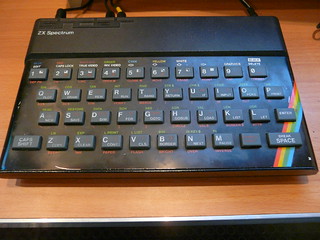 In this, the last of a three-part series on girls and women in computing, PhD student and Further Education lecturer Amanda Wilson describes how an early interest in computing followed by picking up everything she could while working led to a dream job.
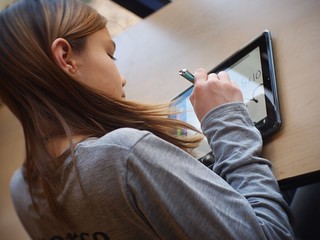 In this, the second of a three-part series about girls and women in Computing, school student Ellie Gregson suggests why girls tend not to choose STEM subjects.
Young people love to use technology. In school, we jump at the opportunity to use the iPads for research, or to use laptops for typing up essays or creating PowerPoints in class. In my school, when an iPad trolley is dragged into the classroom at the start of a lesson, there is always a race between the students to the front of the classroom, desperate not to have to share it with others, or be stuck with a tablet with a 10% battery life remaining.
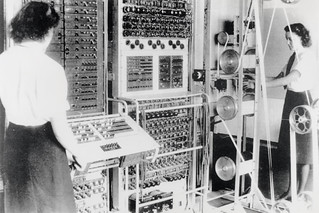 This is the first of three articles about girls and women in Computing.
On March 8th it was International Women's Day.

The book reviewer's desk, by Terry Freedman. For more book reviews, sign up to Digital Education, where this review first appeared.
Like to receive information about my newly-published books, and occasional special offers? Just sign up to my newsletter, Digital Education:
The importance of reading in education technology: 3 books to read and recommend
Why background reading and reading around the subject are good things to do, plus three books I recommend for students (and teachers).
Read MoreGetting the most out of Education Conferences -- now available on Kobo!
Information about my ebook, Education Conferences, plus where to buy it on Kobo.
Read More
The Editor at work
Digital Education: what's in the latest issue?
Assessment, Book reviews, Ofsted: just three of the topics covered in the latest issue of our newsletter, Digital Education.
Read More
I wrote and published this more than ten years ago (in 2014). Apart from the fact that some terminology has changed and some resources are no longer available, it is still relevant. What a sad situation.