
Should websites have tip jars?

Tip jar at La Di Da cafe in Half Moon BayIn case you’re unfamiliar with the term, a tip jar is a device whereby people can contribute a donation to a website – a bit like the jars in cafes in which customers can drop a few coins by way of a tip to staff. Indeed, the websites I’ve come across that have tip jars tend to ask visitors to help them buy their next coffee in Starbucks.

Before we can go any further, is this an educational issue? I believe it is, or could be, for the following reasons


Read More

When it comes to mobile learning, timing is everything

TimeI was discussing with a colleague the fact that some of us were trying years ago to introduce mobile technology into education. I can’t speak for others, but certainly for me it was an insight into how Sisyphus must have felt. He, as you may know, was the hapless guy who was condemned to push a huge rock to the top of a hill, only to see it roll all the way down again within inches of reaching the top. Doing that once would have been bad enough, but he was sentenced to do it forever.
Read More

Why not experiment when teaching ICT?

1953_beakersIt’s amazing what you can achieve with a paintbrush and a fork. Yesterday morning I watched in helpless horror as the lid of something fell down the plug hole in the bathroom sink. I could see it, just about, using the flashlight app on my smartphone (I knew there was more to smartphones than just being connected), but couldn’t reach it.
Read More

Two effects of new technology

1961... 'Gorgo'Here are a couple of interesting cartoon strips about the (possible) effects of new technology. Yesterday’s one is more about unintended consequences, while today’s is really about how apparently intelligent software and monitoring systems might be fooled.
Read More

ICT and computing lessons should be organic

"Green Bar" Computer PaperStephen King, in his book ‘On Writing’, makes a very interesting point. Going against just about all the advice proffered in books and magazine articles, he says:

Plot is, I think, the good writer’s last resort and the dullard’s first choice.

You might be inclined to dismiss that as hogwash, but given King’s phenomenal success as a writer I’d suggest that would be unwise.

Read More

Stop Press! The machines have taken over!

the screamKevin Hodgson has written a make-believe article about technology taking over from humans. The theme is a well-known one in science fiction circles, of course, but what I especially like about Kevin’s article is that he has written in the form of a newspaper article. To do so he has used a fake headline generator, for which he provides a link in the story.
Read More

An Interview with Dominic Savage

In this interview, Dominic Savage OBE discusses, amongst other things, the purpose of the Education World Forum, the effect of increasing access to devices, and what schools need to do as far as investing in ICT is concerned. Mr Savage has been the Director General of BESA since 1984. The following is not a verbatim account, but has been checked by Mr Savage before being published.
Read More

Computer help is not always helpful

Help PointIt’s very tempting to try to make life as easy as possible for end users by being proactive, ie anticipating what is likely to be useful to them, and then implementing that as a default option (or possibly not even an option, but compulsory).

Perhaps some of your students will be tempted, when designing a computer program for use by non-technical people, to make it as ‘proactively helpful’ as possible. If so, they should beware. A good idea would be to undertake some market research, if only of a rudimentary nature, to avoid the pitfall of merely annoying people.

Read More

The internet in a day

Here is an infographic that depicts what happens in an internet day. It goes through what happens in one second, one minute, one hour and then calculates the statistics for a day.

It’s interesting, though not – in my opinion – for the statistics in themselves. If big numbers impress you, then you will be impressed. Indeed, those whose mission it is to promote so-called 21st century skills and to prove that the current education system cannot cope with the new reality tend to use statistics like this to prove their point.

Read More

My response to the ICT/Computing consultation

Here is the comment I made near the end of the online form. I decided to take the opportunity to speak my mind about the whole process of consultation, right from the beginning. Unfortunately, I referred to the Royal Society of Engineers by mistake rather than the Royal Academy of Engineering. It was a simple mistake which I hope won’t undermine the legitimacy of my statement.

I also took the opportunity to say what I think about the constant messages from ‘on high’ about ICT being ‘boring’. I think it undermines teachers, and from that point of view is unforgivable. 

Read More

Learning tools over the years

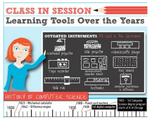
Here’s an interesting infographic which looks at how the technology used in the classroom has changed over the years (or remained pretty much the same!). The only one of the “outdated instruments” I never used was a slide rule! How many of these do you remember? And please don’t send me messages along the lines of “Before my time, Terry.” I feel ancient enough when I look at things like this already!  The infographic includes the history of Computer Science.
Read More

We need ICT teachers, not facilitators

Teaching the youngster to feedWhen did ICT teachers stop becoming teachers and become ‘facilitators’ instead? I’ve largely managed to ignore this sort of nonsense but now it’s getting out of hand. The other day someone said on Twitter or Facebook that he is an ‘active facilitator’, while someone else shared a sign which read “I am not a teacher; I am an activator.”
Read More

An Interview with Naace ICT Impact Lifetime Achievement Award Winner Dr Christina Preston

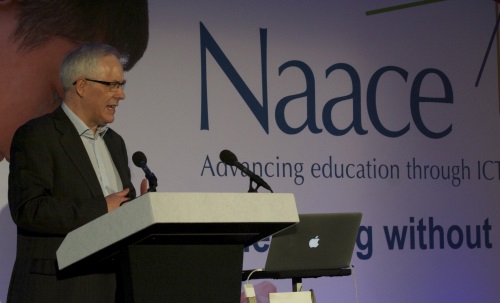
Christina Preston was one of two people given the Lifetime Achievement Award at the 2013 Conference of Naace, the subject association for ICT. I interviewed her to find out about her and her work.

Read More

Naace ICT Impact Awards - A Profile of Penny Patterson

Penny Patterson is on Twitter, but prefers to listen rather than talk, unless she has something of value to add to the conversation. She is active in ICT circles, though doesn’t have her own blog. And if you visit a conference she’s speaking at, you’re likely to chat to her while she serves the tea. She prefers, to use her own words, to be “one of the backroom team”.

Indirect evidence of this was seen in this year’s Naace ICT Impact Awards. When Penny was selected as one of the two people to be given a Lifetime Achievement Award, the look on her face was one of surprise, bordering on shock, and tinged with bewilderment. Typically, she told me that “other people deserve this award far more than I do.”

Read More