The 3,000 Part Computing Lesson

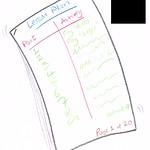
lesson planEvery so often there comes along a new daft idea (or a newly-packaged old idea that has been mangled out of recognition (and thereby rendered useless) so that its “inventor” can be designated as a guru. Me? Cynical? Never!) One of the more unfortunate manifestations of this phenomenon was the three part lesson. It sounds good and logical, but then the thing that usually happens happened: Ofsted started insisting on it, and Headteachers demanded to witness it in every lesson. Woe betide the brilliant but hapless teacher whose lesson plans failed to include the three parts.


Read More

An article that I suppose might be called an infomercial

Self-portrait with coloured pencils"Erm, tell me, Terry. How do you actually earn money?" This is a question that I am constantly asked because, I think, I don't do a lot of self-promotion as far as drumming up work is concerned. I've tended to rely on word of mouth referrals, but in order to pre-empt the question I quoted at the start of this paragraph, and because I think I ought to be a bit more overt in my approach, I thought I'd write some articles about what I do for a living.
Read More

Send in the e-Cadets! Making kids responsible for e-safety

I came across the eCadets scheme recently, and mentioned it in the special e-safety edition of Digital Education. I thought it sounded very interesting. With schools looking for more sustainable eSafety solutions I caught up with the co-founder of the innovative eCadet scheme, Henry Platten, to find out how to create a lasting eSafety legacy in your school. Ever come across those schools where the e-safety “policy” consists of a Local Authority template with the blanks filled in with the school’s name, and stuck in the bottom of a filing cabinet in the headteacher’s office? Well, the e-Cadets scheme aims to change all that by giving the children themselves responsibility.
Read More

Taking stock of the new Computer curriculum: 5 key questions

Fall 2011 Student Hackathon CodingNow that the new Computing curriculum in England has been running for nearly a term, it's a great time to stand back and take stock. Actually, I recommend doing that even if you are not in England and/or have not needed to change anything. Here's a list of 5 questions you might care to ask yourself:
Read More

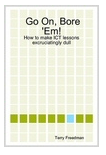
Book review: Go on, bore ‘em: how to make ICT lessons excruciatingly dull

Michelle Liga writes...

boremMr. Freedman uses his extensive experience to write a clear and concise booklet on the different ways he has observed teachers instructing  their students straight into boredom purgatory.  But, he also explains how the lesson could have been changed to make it more interesting. 

Read More

A surprise in the world of educational computing that was rather pleasant (for a change)

Terry Freedman Teach Secondary Award Bett 2015Over the years I’ve become almost inured to the inanities of the online world, and especially their manifestations in the world of education. So when I received an email declaring “Congratulations, you have won an award!” my first thought was “Oh yeah? I suppose all I have to do is submit my bank details and complete a 38 page questionnaire over a premium telephone line.”
Read More

My Informatics scheme of work part 1

Social computingI thought it would be interesting to dig out my scheme of work for Information Technology – as it was then then – from 1997. It was based on the Informatics scheme of work published by the now defunct organisation Acitt. Acitt was a subject association for ICT Co-ordinators. I helped to shape the Acitt scheme of work, but the one I used myself was a variation, adjusted to meet the circumstances pertaining to my school. I’ve reproduced it below.
Read More

Assessing Computing: the need for a manual override option

caution: uneven stepsWhen I was crazy about film-making as a teenager (see I was a teenage geek) I never liked using fully automated cameras. Yes, they were convenient, and they saved you the bother of having to think too much, and the results were passable. But they left no room for exercising one’s professional judgement. Using a camera with a manual override button enabled you to find out what the camera “thought” the aperture and other settings should be, and then use them as a basis for your own decision.
Read More

Big ideas for ed tech leaders: Know your data, part 2

I have already looked at the data you need in your role as leader of the subject Computing or ICT or similar. What sort of data do you need as e-learning co-ordinator or similar? Here’s what I think. Not every item on the list will be applicable to everyone’s situation, so take the bits that work for you and ignore the rest. I hope you find this list useful.
Read More

Big ideas for ed tech leaders: What’s your self-talk?

HiatusWhen I was in my teens I wanted desperately to get involved in television production, especially the filming and editing side. So I was delighted when one day there was a the start of a new behind-the-scenes series about how television studios operate. Well, the presenter started off by saying, “This looks boring, all these cables and wires everywhere, but…”. Then, a few minutes later, “This is a boring part, but…”. After 15 minutes I switched channels. I’m not even sure that the series was completed. Who wants to be told that the thing they have given up their time to watch is ‘'”boring”?
Read More

Getting the Best out of Bett 2015: a reminder

Too late for Terry Freedman's  Bett2015 GuideBett 2015 kicks off in a few hours' time, so this is just a reminder that my guide to Bett 2015 is now available. It contains over 200 hints, tips, suggestions and opinions. It even contains a detailed floor plan -- the first such guide to do so! It's in pdf format, but as it's quite hefty I suggest you download it onto your phone or tablet and read it on the screen.
Read More