
The term “guru” is bandied about all too often these days. But how apt is the term? I think for a person to be described as an education technology guru, the following criteria have to be satisfied. I’m basing these on my understanding of the role of a guru in traditional meditation practices. The guru there is an enlightened person who is helping others to achieve the same state of consciousness. So here is my set of criteria of ed tech gurudom.
Read MoreDigital Education: the first edition of the year is now available!
 We’re in the first couple of weeks of the new school year here in England, and the first edition of Digital Education, our free newsletter, is now available! Pardon the exclamation mark, but the fact that it has now been published is a minor miracle. Right at the very last minute, I tried to delete a letter, and Microsoft Word went insane. It reform mated the whole document into just three pages, and hid most of it. I managed to retrieve it though — by selecting it all and then copying and pasting it into a new document. So, given that I almost threw the newsletter, my computer and the cat out of the window in frustration, I think an exclamation mark is more than justified!
Digital Education: Getting the year started
 Now that we’ve have had a week or so to get settled in to the new school year, I thought a short edition of the Digital Education newsletter would not come amiss. That will be published tomorrow, and here’s what it will contain:
Become an expert Google educator
Ed tech heroes get nervous too
I was struck by a comment made my Steve Dembo on Facebook recently. He said:
“I imagine that some day I'll stop getting nervous before presentations. But today is not that day”
I’ve met Steve: passionate, enthusiastic, a great speaker. I came across him via his blog and podcasts some years ago. I found him to be really inspirational, and was delighted to meet him at a conference a few years ago. So I was shocked to read his comment, though not surprised.
Girls cram for exams using a mobile app
Everyone goes on about “boys and their toys”, but according to research carried out by a revision app company, more girls than boys are using the app to help them revise.
Read MoreThe usefulness of technology in education
 Strangely enough, the most popular blog post on this website is 13 reasons to use educational technology in lessons. Why strange? Because I wrote it over three years ago. I re-read it recently, and (thank goodness!) I still agree with what I wrote all that time ago. I’d like to add more to it, but rather than do that I thought I would contribute to Mark Anderson’s series on this subject.
three cheers for antiplagiarism software
 I like to think that had there been anti-plagiarism software around when I was at school, and had my English teacher used it, I’d have been saved years of wasting time looking for ways to make money. I’d have enjoyed more sleep too.
Digital Education latest edition!
For the final edition of this free newsletter, we have a great line-up of experts and articles:
Read MoreShould we welcome the nanocams?
I’m reading a short story by Ian Creasey called “The Edge of the Map”. In the world depicted by Creasey, automated cameras called “nanocams” take photos and newspapers (and other media, presumably) source their illustrations from the pool created by them. In other words, there is no need for specialist photographers.
This raises a number of interesting questions.
Digital Education Coding Resources Special
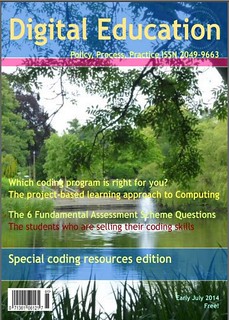 The new edition of Digital Education, the free newsletter for those with a professional interest in educational ICT and Computing, has a special focus on resources you can use to teach coding. Here’s what it contains:
Digital Education–Latest Edition
 This is what the latest version of Digital Education contains, with guest articles by Professor Paul Curzon, Sal McKeown, Geoff Jones and Crispin Weston
From FELTAG to ETAG
In principle, these are exciting times, writes Crispin Weston. Having spent the first three years of its administration backing away from any active involvement in ed-tech, the government now appears to recognise not only that ed-tech has an important part to play in improving educational provision, but also that the government has an important part to play in making that happen.
In practice, I do not believe that the ed-tech community has yet taken advantage of the opportunity it has been given.
Read MoreThe (digital) revolution comes to the London Barbican
 Digital Revolution explores and celebrates the transformation of the arts through digital technology since the 1970s. The exhibition brings together for the first time a range of artists, filmmakers, architects, designers, musicians and game developers pushing the boundaries of their fields using digital media. It also looks to the future considering the impact of creative coding, DIY culture, digital communities and the creative possibilities offered by technologies including augmented reality, artificial intelligence, wearable technologies, robotics and 3D printing.
Digital Education June Edition out now!
 The latest edition of Digital Education is bursting at the seems. There is, I hope, something for everybody. As well as news and commentary, there are lists of resources, evaluated. Plus, guest articles: Professor Paul Curzon considers what programmers can learn from magicians, Sal McKeown asks whether we really need teachers, Crispin Weston suggests what is wrong with the Education Technology Action Group, Geoff Jones points out the dangers of some forms of data collection from parents, and Derek Blunt has a (mild) rant about the demise of the term “teaching”.
There are other articles too, plus a chance to win a Labquest datalogger, and a chance to win a break in Germany, an iPad and other goodies, free entry to an event called Digital Summer Trip, access to a growing list of very useful resources, including the collated articles about the recently-announced Department for Education assessment innovations.
The full list of contents is given below.
Update on the Computer Education Project
 A couple of months ago I invited people to contribute to a survey about what they were doing to prepare for the new Computing curriculum. About 75% of my motivation for doing so was to help to spread ideas. I believe in the grass roots sort of approach to such things, as opposed to the ‘great and the good’ declaring what the rest of should be doing. Actually, to clarify, I don’t mind if the great and the good are doing it or have done it themselves. I find it tedious when people who have never been a teacher and/or had little contact with schools start issuing advice. OK, rant over!
Magic, Monsters and Music
 The forthcoming edition of Digital Education contains articles about magic, monsters and music. See? Computing is not all about coding!
Driverless cars: technology trumps experience - again

Digital Education
 The latest edition of this wonderful publication is out now!
Computer Education Projects Book Update
 How are teachers preparing for the new Computing curriculum, which is due to start being taught in September 2014? Some time ago I created an online survey in order to ascertain the answer to this question. Although there have been fewer respondents than I’d hoped for (though probably more than I’d expected), the results are quite interesting. Here is a very brief summary.