Computers in Classrooms July Edition Out Now!

Because of pressures of work, together with wanting to make sure that contributors' articles were read by as many people as possible, I decided to defer the special games-based learning issue and bring out a short newsletter to give people something to read quickly as they're winding down for the summer.

Unfortunately, one of the links given is incorrect. It worked for me, but that's because, I realise now, I was logged in to the website. The mobile phones article is here. Thanks to Jonathan Thomson of BLI Education for emailing me about the broken link.

Here is what was covered in this issue:

Ed Tech Leadership Issues

Symposium Online Conference

Facebook Stories

Marxio Out, TimeLeft In (Maybe)

Teen contributions

Battlefront

Northern Grid wins award

Those links will take you to the individual articles, but if you wish to read the whole newsletter, you'll find it here. You can also subscribe, by going to the newsletter page -- it's free! -- where you will also find an archive of past issues.

Please feel free to pass on this information to your friends and colleagues. Thank you.

It’s About The Kids, Isn’t It?

GraphicaGirl is absolutely right when she says, referring to my article about Mission Statements (or see this Anglicised version):

We, in education, are in the kid business, and too often we get caught up in the day-to-day operations of the school and forget that bit.

They're what it's all about!She goes on to say:

Our business is kids, no matter how trite that may sound!

Exactly right: it is true (and it does sound trite, but what can one do?)

If you ever have occasion to visit a great bastion of education, not necessarily a school, have a look at the displays. Are there any pictures of youngsters? I think the answer can tell you quite a lot about the organisation.

See also:

What I look for in a conference


7 Tips for Planning an ICT Lesson with One or Two Computers


What if you can only have access to one or two computers for the whole class for much of the time. Does that mean you cannot do anything of any value? Not at all. Here are seven suggestions for how to make the best of the situation.

Draw up a class rota of who will be using the computer(s), and in which lesson. Your planning may not entirely work out in practice, because of factors like absences and power cuts and so on. However, it is easier to ensure that all pupils have been given the same opportunities to use the computers if you have a rota than if you don’t.

With the ICT co-ordinator or other teachers, identify the areas of the ICT Programme of Study (PoS) -- or your own scheme of work -- that you will be able to cover. This is not to say that the ICT PoS is a sort of pick-’n’-mix, but that it may be possible for different teachers to cover different aspects of the PoS in order to ensure that it is completely covered.

Devise generic activities that can be applied to a variety of situations, such as internet research skills and copy/paste.

Devise activities that require pupils to share a computer. Computers are excellent for encouraging collaborative learning and higher-order skills such as modelling.

Adopt the approach of showing the pupils as a class how to do something on the computer, and then practising it in that lesson and subsequent lessons.

Plan your lessons in a way that computer-based work and non-computer-based work are similar in terms of intended learning outcomes. For example, to take the copying and pasting idea again, all pupils could be engaged in finding suitable pictures and pasting them into their written work, whether they are working at a computer or not.

If you are in the fortunate position of having a computer suite and computers in classrooms, it may be possible to teach the whole class a computer skill all at once, which they can subsequently practice in the context of other subjects and/or lessons.

Did you find this article helpful or useful? It was first published on 15th February 2008.


Let Them Ask

Doug Woods looks at how technology can help learners ask questions.


Asking questions is very much a part of the learning process and there are ways in which we can use educational technology to support this. It is surprising therefore to see that the way questioning is handled in schools and colleges seems to have changed little in the last fifty years. Up and down the country, you will still see learners asking questions by first raising their hand and waiting for the teacher to acknowledge them. Is this the best way?

The first problem with having to raise your hand to ask a question is that you have to be physically present and make yourself visible to the professional (teacher, lecturer, etc.) leading the session. So what happens if the question occurs to you when doing homework or revising? What happens if you are absent and/or accessing the session remotely? In such circumstances, simply raising your hand is not an option and the ability to ask your question could be lost.

Then there are some sessions or lessons where you feel you can only ask questions at a certain time; usually at the end. A question may occur to you during a session but, when the lecturer finishes by asking ‘does anyone have any questions?' you find you've forgotten what it was! Or maybe you can remember it but there are so many other people asking questions that you do not get time to ask yours. Then, of course, there are those times when you want to ask your question at the end but you know that you, and everyone else, are simply dying to get away, so you stay quiet.

There are also times when a question occurs to you after the session. Perhaps you've been thinking about the session afterwards and something occurs to you, or maybe you read something elsewhere, which leads you to question something you heard, or thought you heard, during the session. How then could you ask your question? Maybe you experience something, perhaps from some practical work related to the session, which doesn't quite fit with what was mentioned in the session, how can you raise this?

Then there are those times when you want to ask a question of one of your fellow learners. How can you do that in a session if all your attention is directed toward the teacher/lecturer?

I daresay we can all relate to instances such as these, or we can recall times when we were dying to ask a question and, for some reason, didn't. Speaking for myself, I know that I cannot put my hand on my heart and say that every question I didn't ask would have been a serious one.  Furthermore, I cannot be certain that, by not asking the question, I missed out on some new information or level of understanding. There is always the possibility, though, that had I asked the question(s) I wanted to, my level of attainment could have been better.

Having established the importance of asking questions and set out some of the traditional difficulties of doing so, we have to ask ‘how can educational technology help learners ask their questions?'

Ideally, I suppose we could be looking for a piece of technology, which could be used during a session and afterwards, for a piece of technology that can be used equally by those attending the session as well as those absent or accessing the session remotely. This piece of technology would need to be accessible and available to all, so that questions and answers can be shared and so that no advantage is given to certain users but not others.

There could be several possible solutions but one which I'd like to put forward is the use of online discussion forums. What I'd like to suggest is that every subject, every project or topic, should have a forum associated with it. I'd like to think that this could work at Higher, Further and Secondary school level (Key stage 3 onwards, ie 11 years old +) and increasingly also at Key stage two (7 to 11 years of age).

So, what advantages would having an online discussion forum bring? First of all, the discussion forum would be open to all learners, including those who might be absent at the time of the actual session and any who needed to access the session remotely. This would mean that all learners could pose their questions on the forum and feel disadvantaged because they might have been unable to attend the session.

Questions can be posted to the forum at any time, so learners doing homework, coursework or revision could pose questions as and when they occur.

Questions and answers can be shared among all learners. In a lesson, a teacher might respond to an inbridual learner's question singly (i.e. giving only that learner a response) not knowing that others may also require the same answer, on a discussion board the response is available for all who need it.

A question need not be only asked of the teacher/lecturer but can also be asked of other learners. Other learners can also give their response to questions; this might have some appeal as it could mean that the teacher does not always have to be on hand to supply the answers. It also affords an opportunity for other learners to demonstrate their learning.

There is an added bonus in that each time the forum is added to; it becomes a resource which can be used in follow up sessions this year or in subsequent years.

We have to acknowledge that discussion forums are not perfect. They can be abused, some people may tend to dominate discussions and some are reluctant to make posts. However with only a simple level of monitoring, moderation and encouragement, an online forum can become a very effective tool and future learning resource.

Doug Woods http://dougwoods.co.uk/blog says:

I'm a former teacher who's always been passionate and enthusiastic about ICT in education. I now style myself as an ICT in Education Consultant and Trainer, a role has afforded me opportunities to work in new areas of educational ICT for both public and commercial sectors. I have a keen interest in ICT for SEN learning, inclusion and for transforming learning.

This article first appeared in Computers in Classrooms, the free e-newsletter for ICT/ed tech teachers and subject leaders. Please see this article for details of three great prizes to be given away to subscribers. The next issue will be a games-based learning special.

Games-Based Learning Newsletter: 2 Great Prizes

Thanks to the generosity of Immersion and SeriousGames, I am able to offer two wonderful prizes to subscribers of Computers in Classrooms. The prizes on offer are a copy of Immersion’s MissionMaker, the games authoring software, and a one year school license for SeriousGames Global Conflicts: portal. The two winners will be chosen in a random draw on Thursday 11pm UK time. For terms and conditions please see the newsletter page, where you can sign up too if you wish (it’s free!). In this case, each prize is available to non-UK residents as well as Brits!

MissionMaker

Global Conflicts

More information on the contents of the games education special issue will be posted here as soon as I’ve finalised the list of articles that will be included.

Unfair Copyright Clauses

With any luck and a fair wind, unfair copyright clauses could one day be a thing of the past -- in the UK at least. One thing which especially galls me is the insertion of a clause which deprives authors of their moral right to be identified as the author of the work.

Interestingly enough, I was looking at one of these only a couple of days ago. It was one of these article repositories that pay you a proportion of the advertising revenue  of the ads which appear on your article page. I have grave doubts about all that, which I'll write about separately, but for now the issue is as follows.

When I delved into the "small print" there was not only the usual clause which states that you hand over the copyright in your work -- which is an insane thing for anyone to do voluntarily in my opinion -- but also one which stated that they reserve the right to continue to use your work ad infinitum without having to give you credit as the author. Um, no thanks.

A recently-published report (which I haven't read yet) apparently calls for a review of contract law in this respect. It states:

Contractual waivers of moral rights are inserted frequently into copyright contracts. If these rights were made unwaivable by statute, such a persisting link between author and work might improve the author’s bargaining power.

At first glance it sounds like a reasonable idea to me, although, of course, a change in UK contract law would have no "clout" outside the UK. Still, it would put down a marker, as it were, about what is, and is not, morally acceptable in this complex area.

Reference 

Academics must check contracts' effects on user rights

The Importance of Mobile Phones in Education

Teenager Ethan Davids describes how essential his phone is to him.

EthanFrom listening to music, to taking and editing pictures of teachers, the young community have found various ways to misuse the new technology being made available to them in such small and compact mobile phones. Obviously, anything that can disrupt learning, or teaching, cannot be accepted in a classroom environment and should be dealt with accordingly. It is my opinion that as technology advances at such a blistering pace, policies such as ‘mobile phones should be switched off and in your bag’, can be modified to benefit not only students, but teachers and schools alike.

As a student who has experienced some very rowdy and distracting classes, I know that mobile phones can cause huge distractions for not only students, but teachers as well. I am also aware that mobile phones can be a danger to the school environment; however I believe they can still have their benefits in the classroom.

As a very proud owner of an Apple iPhone 3G, I could rave all day about the importance of my mobile phone. It keeps me in contact wherever I go, which not only gives me peace of mind, but also my parents! An argument I have never understood is that youngsters have become too reliant on their mobiles. Nowadays mobile phones can be as useful to people as a pencil and paper, and I have never come across an argument that adults have become too reliant on those!

The ability to download ‘apps’ to phones such as the iPhone can also make it not only personalised, but useful for people in most situations. From word processing software to a program that keeps an eye on the stock market, the range of potential uses can just not be argued with. For example, instead of waking up tired and grumpy, I use an advanced alarm clock to measure my sleeping patterns which also wakes me up when I am sleeping at my lightest. Not entirely necessary, but this could still be beneficial to anybody!

So if this level of technology can benefit from city workers to journalists, why can it not be taken advantage of at school? I have numerously thought to myself in lessons such as Spanish and English that if it was accepted for me to use my phone, my learning could be improved. Instead of taking out a dictionary, I could simply use my translator, and instead of trawling through books for a piece of literature, I could find the book online and be directed to a specific word, and so on. The fact is that these phones are really just computers, yet I am unaware of a school that is reluctant to allow the use of these.

I'm not naïve; firstly not everybody has such an advanced phone and secondly, there are bound to be people who will take advantage. But as technology becomes cheaper, more people will invest in this equipment, and surely the people who take advantage of the leniency would use their phone regardless of new measures?

Schools themselves are modernising greatly. My present school, for instance, is in the process of becoming an academy. This means that from September 2010 it will no longer be classed as a ‘school’, and by 2013 it hopes to have established completely new buildings. I am part of a group of students who have listened to the new plans, and I was impressed with the new technology being considered. Ideas such as giving each student a laptop and registering attendance online are being planned already. I think it is fantastic that schools are finally ‘getting with the times’ and are understanding the importance of ICT in education! Eventually I hope mobile phones will be looked upon in a much more reasonable way and take a more important role in education. After all, there’s only so much fun you can have with editing teachers’ faces!

Ethan is a Year 11 (17 years old) student who is currently preparing for his final GCSE (High School graduation) exams. He is a huge lover of football, and Manchester United. He hopes to carry on his education to university where he hopes to study Law and French.

This is a slightly amended version of an article which first appeared in Computers in Classrooms, the free e-newsletter. The next issue is a games-based learning special, and we're running a prize draw to give away 2 marvellous prizes. More on that later today.

Paperless office?

Your newsletter editor is hard at work sifting through the submissions for Digital Education, the free newsletter for education professionals. Have you subscribed yet?

Read more about it, and subscribe, on the Newsletter page of the ICT in Education website.

We use a double opt-in system, and you won’t get spammed.

ICT: A Whole New World

It is so unusual to find a young person who not only likes ICT lessons but will actually admit to it, that when I heard that Maddi fell into that category, I just had to ask her to write about it for me. Here’s what she says…


Maddi
Hi, I am Maddi, a Year 10 student from Australia. I am 15 and really enjoy ICT. I am currently considering a career requiring ICT skills. Apart from ICT, I enjoy sport, playing and listening to music, writing songs, drawing and dancing.

When I finish school I plan to study to be a journalist or magazine editor. My dream goal is to own my own magazine that supports my own charity – big goals I know but better a big goal than no goal! As I said I have a passion for ICT and this article explains why everyone should learn at least the basics of ICT.

The  internet, something one could have lived without many, many years ago but now one can really only just last a week without somehow using or coming into contact with it. I hear people say technology such as computers has destroyed society or is killing normal communication. But I consider these comments as naive sniggers, for I believe that anyone who has discovered the incredible uses for the internet would not say such a thing. The web is an extraordinary invention and has given me the chance to communicate with people and civilisations that pen and paper could never offer me.

Last year with video link up, I and three fellow class mates were able to give a presentation to thousands of teachers, students and educators who attended the Flat Classroom Conference in Qatar. This was an unreal experience and it was one of the first times I realised how phenomenal the internet is.

I was also a participant in a large international project which helped me learn that understanding the internet isn't just about learning what buttons to press or how to navigate through it. I learnt how to behave on the web, how to be safe, the manners and language that are appropriate and many other social and cultural aspects of the internet. On the internet you really have to watch what you say because something 'funny' you say could be offensive or misinterpreted by other people. To me, talking to someone face to face is a lot easier and quicker, but I find talking to people over the internet is an adventure in itself.  I think it is a great way for school students to make friends.

I guess there is more to ICT than just internet though. I would confidently say that I would use my laptop everyday to type up school work or edit photos. I think one of the reasons ICT is so appealing to me is because you can take something simple like a photo and transform it into something beautiful in seconds, and it is so easy and the programs available today open so many doors for your creative minds to step right into.

I would definitely encourage ICT as a compulsory subject up to at least year 9 because ICT is a subject just waiting to be truly discovered and explored. As I write this I know that the internet is continuing to grow in fabulous ways and I really want people my age to go and explore.

This is a slightly amended version of an article which first appeared in Computers in Classrooms, the free e-newsletter. The next issue is a games-based learning special, and we're running a prize draw to give away 2 marvellous prizes. More on that tomorrow.

Review of Marxio

Update: Marxio appears to be no longer available, and I am trying TimeLeft instead (see bottom of article for link). You may, of course, wish to read this review anyway for its erudition and general insightfulness :-)

If you're anything like me, time is always at a premium. But relying on the clock in the toolbar isn't always effective as a way of keeping you on track. There’s a pretty good timer from Marxio. I set it to remind me to take a break every 20 minutes. (I often ignore it, but that’s another matter.) Obviously, you could use it to set a time limit for reading, or writing, or anything else.

Timely reminders

As you can probably tell from the screenshot, there’s a wealth of options. And it’s free! Download it from the Marxio website, where you can see a list of features.

I quite like it, although I haven't used it for a while. I especially like the fact that you can configure your own settings, such as the text of the reminder and when it appears, and save them as a "schema". Why not give it a whirl?

This is a slightly amended version of an article that first appeared in Computers in Classrooms, the free newsletter about educational ICT.

What Are The Big Issues for Ed Tech Leaders?

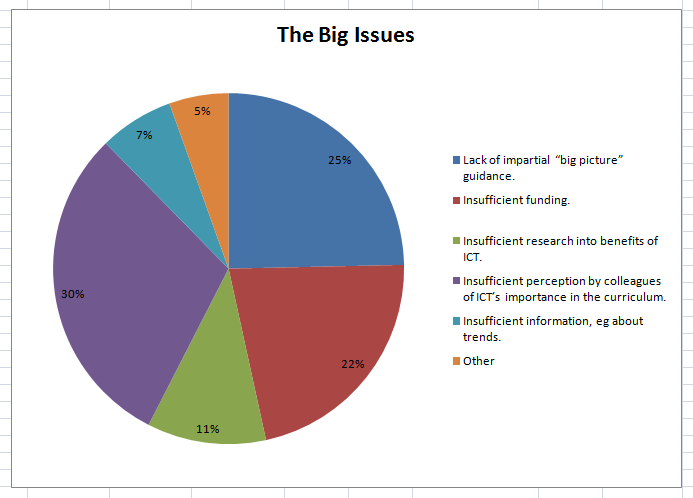
I’ve done a quick analysis of the entries received so far to my Issues for Ed Tech Leadership survey, and here are the results.

Initial findings

As you can see, top of the list is a lack of perception by colleagues of ICT’s importance in the curriculum. So, after all these years, we don’t seem to have an unequivocally wonderful job of convincing others of how technology can be beneficial in the curriculum. It’s interesting to note that the solutions proposed to address this (not shown here) tend to be divided between those who think we should make more training available, and those who think it’s a leadership issue.

I have to say, I’m in the latter camp, and I am tempted to agree with UK ICT consultant Bill Gibbon when he says we should have compulsory courses like SLICT (Strategic Leadership in ICT) courses for senior leadership teams.

Could it be, perhaps, that there is insufficient research into the benefits of ICT? Well, a sizeable minority apparently thinks so, but I agree with ICT consultant Doug Woods’ view:

Actually NO there is plenty of evidence and research into benefits but it is generally not readily available to edtech leaders in school. We need a central resource to collate this research findings, even where contradictory, and make them easily available.

Perhaps not surprisingly, given that most of the respondents hail from the UK, where Becta and the QDCA have been given notice to close down, a lack of impartial big picture guidance is the second-most frequently cited issue facing ICT leaders. I think a lot of people will agree with ICT Co-ordinator Steff Rooney that the Becta self-review framework can (should?) be used to highlight weaknesses in a school’s ICT provision. Let’s hope it’s eventually mothballed rather than disposed of altogether.

This is literally just a quick snapshot. I’ll spend more time on it over the summer break. That gives you time to complete the Issues for Ed Tech Leadership survey if you haven’t already done so Open-mouthed -- it should take you only a few minutes.

How To Start Blogging

Get writing!You know when a theme is developing in your life when the same sort of thing keeps cropping up. Well, I don’t know if twice in succession qualifies, but I’m going to go with it anyway. Yesterday I was catching up on my podcasts, and listened to a Grammar Girl episode entitled “How to get started blogging”. Then today I ran my blogarizer spreadsheet and was directed to an article entitled “10 must-use tips for beginning bloggers”. OK, enough already: I can take a hint.

Both articles are pretty good, in a general sense. Mignon Fogarty, the “Grammar Girl”, deals with knowing your audience, finding good, and reliable, information, and how to build your audience. Melissa Tamura, author of the 10 tips post, also talks about knowing your audience and, in essence, how to grow it.

I’d like to come at this from a different angle or, to be more precise, to emphasise different aspects of blogging. Here goes:

  1. Start blogging. That’s right, just start. Stop navel-gazing, second-guessing the universe and playing “what-if?” games. Just start. Creating a new blog in something like Blogger takes all of five minutes. In fact, the most difficult part is thinking of a witty and memorable name.
  2. Definitely define your audience, but start with yourself. What I mean by that is, write the kind of articles that you would find most interesting/enjoyable/useful to read. Then your blog will probably go one of two ways: either extremely eclectic, which stands a good chance of attracting a wide variety of people, or extremely focussed. Those two are not mutually exclusive, by the way. I think that latter possibility warrants a bullet point of its own…
  3. Be extremely focussed. I mean extremely focussed. From time to time I receive comments from people along the lines of they have nothing unique to blog about. That’s plain wrong, because everyone is unique in some way. For example, you might be the only art teacher in your town who takes their class on a virtual art gallery tour every week. How does that work? How does a virtual gallery visit stack up against a real life one? I don’t know from first-hand experience what the answers to these questions are. But you do.
  4. Put your audience first. I think if you’re going to write for an audience, you should at least try to make reading your work a pleasant experience. This is all highly personal and subjective, of course, but for me the two things I really can’t abide is swearing or implied swearing, and writing which is about as interesting as the list of ingredients on a packet of cornflakes. There’s no need for the former, and you can improve on the latter by analysing what it is you like about the writing of the blogs, magazines, newspapers, authors you read on a regular basis.

But the most important one of these, if you’ve decided or almost decided to start your own blog is the first one: just do it!

Related articles by Zemanta

Mission Statement

I don’t have too much time for mission statements. To be honest, I regard them as being unnecessary. Actually, I’d go further: if an organisation is so hung up on its image that it wastes time and resources on thrashing out a mission statement, what does that tell you about its priorities? More to the point, why should any organisation even need a mission statement? Its mission statement should be implicit in the way it goes about its business.

How about this as an example. A couple of months ago my computer started playing up. Unfortunately, it started to get really bad about two days after the year’s money-back guarantee had run out. Fortunately, there was a free maintenance package thrown in, which meant that for two years I could get it repaired free of charge, on a return to base basis. Not ideal, but still, better than nothing. So I decided to avail myself of this service, and the retailer I purchased the computer from arranged for a courier company to pick it up the next day. The following conversation ensued when the courier arrived:

Me: Ah, I think there’s going to be a problem because --

Courier: Look, mate, I’m not here to repair it, I’m just the courier. Just give me the computer.

Me: Well, what I was about to say, was that I don’t think it’s going to fit into that container you’ve brought.

Courier: OK I’ll be off then.

Me: Wait a minute, let me just measure it. Come in for a cup of tea while I do that.

Courier: I don’t want a cup of tea, I’ve got to get on.

Me: Well let me just measure the container you’ve brought.

Courier: I ain’t got time for that. Phone the company.

Me: Can’t you just hang on for two minutes? I need this computer for my work.

Courier (driving off): That ain’t my problem, mate.

I think that statement, “That ain’t my problem, mate”, sounded like the company’s mission statement. Was I right?

Well, I phoned the company up right away, having to use an 0845 number which, here in the UK, is charged for at a premium rate. I was then subjected to 12 minutes of awful music, and advertisements. When I finally managed to speak to someone, she said she’d try and arrange collection for the following afternoon.

“I’ll let you know if that’s not possible”, she said.

“No, could you let me know either way, please?”

“OK”.

When, by 4 pm, I had heard nothing, I phoned the company again, and spent 8 minutes listening to “music” and advertisements. The girl I finally managed to speak to was not the same one as I’d spoken to in the morning. There was no record of my phone call, and no collection booked in. She assured me that she would call me to let me know what was happening. (Incidentally, that was 2 months ago. I am still waiting.)

I phoned the company I bought the computer from to see if they could help, and they told me they would phone the courier company. Fifteen minutes later, she phoned back to say that she hadn’t managed to speak to anyone yet, because she’d been listening to music and advertisements, but would try again.

A few minutes later she phoned me back, and told me that she’d spoken to her manager, and he decided I’d been treated so badly that I could bring the computer in and obtain a full refund. (What do you think that retailer’s mission statement is?) I did so, and immediately purchased a new one, of a different manufacturer.

There have been several outcomes of this episode:

  • That was the first time I had any dealings with that courier company. It will be the last.
  • So committed am I to that last statement that, having found out that the manufacturer of my original computer uses that courier exclusively, I have decided to never buy that make again, so I never have to deal with that courier company again.
  • I got a new computer out of it.

Just to finish the story, the following morning (not afternoon, as requested) there was a ring at the door. A (different) courier had come to collect my computer.

If you think about the behaviour of the courier company, what conclusion could you draw other than that the leadership must be at best incompetent, and at worst actively contemptuous of its customers? Because this is my contention: that the service an organisation provides –- whether it’s a corner store, a department store, a government department or an ICT department in a school – is a direct reflection on the quality and priorities of its leadership. How else could an organisation provide such appalling service, at various levels?

The story also illustrates another point which for some reason is often not as obvious to service providers as it should be: everyone in the organisation is a representative of the organisation. They may not think of themselves in that way, but the bottom line is that if they upset enough people to the extent that the organisation has to reduce its operations or even fold altogether, their jobs could be on the line.

But in that case, all I have to say is: it ain’t my problem, mate.

E Is For Everything -- But Why?

Is the 'E' necessary?There is an unfortunate tendency for e-learning evangelists to try and come up with as many e-words as possible when promoting the benefits of e-learning. Why?

I suppose the idea is to generate excitement, and to energise one’s colleagues. But to my mind, this is mere gimmickry.

I’ve seen it done with the 'C' in ICT as well. That stands for 'communication' or 'communications', but I’ve known people to embellish and complement it with 'collaborate', 'co-operation' and the like.

(Curiously, I have never seen it done with 'd', as in 'digital', or any other letter.)

If that is all there was to it, this tendency would be merely annoying. However, I believe it has a subtle -- but real – derogatory effect, in two ways.

Firstly, just as it is often the case that a piece of writing is diminished in direct proportion to the number of adjectives used, so is the authority of a discipline lessened as more and more attributes are generated for it. It seems to denote a certain lack of confidence: you don't see geography teachers babbling on about how good, great or gritty their subject is; you don't hear historians trying to convince people that their area of study brings happiness, or that it reduces harm or hubris.

To quote from Hamlet, "The lady doth protest too much, methinks".

Secondly, and worse, it can actually do some positive harm. As long as the myth is propagated that e-learning is different to learning, or that an e-portfolio is fundamentally different to a portfolio, some teachers and their principals will quite happily continue as if the e-revolution has nothing to do with them. Worse, concerns over e-safety could easily mask the fact that all teachers should feel responsible for children’s safety, and that there is not a subset of safety that can be delegated to the ICT staff.

As far as I am concerned, the sooner we drop the 'e' from everything, the better.

Reblog this post [with Zemanta]

An earlier version of this article first appeared on 29 July 2009.

Upcoming Article on Mission Statements

I have a thing about mission statements: basically, I think they're a waste of time, effort and resources. But there's always an implied mission statement, which is always a reflection on leadership in my opinion.

An article will be appearing about this tomorrow morning at 8 am, but if you want to read it now, you can, at the Technology and Learning Blog, where there's a slightly different version of it.

If you're an ICT or Ed Tech Leader, do take a few minutes (literally, just around five minutes) to complete a survey on what issues ICT leaders face today. The initial results will be published soon. Thanks.

Personal Learning Networks

A couple of recent posts by Miguel Guhlin -- see Vastness of You - Plurk Me No More and To PLN or Not -- and a comment on the latter by Paula Nagle, made me think about personal learning networks, or PLNs.

What IS a PLN?

A PLN can be great for supportClearly, it’s the group of people with whom one interacts, online in the first instance. I have to say I have a bit of an objection to the term, because it gives the impression of being rather self-centred, as though everyone in your learning network is there to help you learn. Help you learn. What about them?

We learn most when we’re discussing or teaching, and although that’s what goes on in PLNs, it’s not exactly explicit from the name. Perhaps Personal Interaction Network (PIN) would be better (which would no doubt lead some people to talk about their PIN numbers…).

Can your PLN be too large ?

I wonder if this term, “too large”, has any real meaning in an asynchronous world? I can put out a message on Twitter this morning, and have a response from someone over the other side of the world this evening. In that sense, is there such a thing as “too big”?

Can anyone join?

What is the qualification for becoming a member of someone’s PLN? For me, it’s having something useful and relevant to say. I don’t care if someone has been blogging for only five minutes: if their first few blog posts are interesting, I’ll follow them. I find it embarrassing, though obviously flattering, when people follow me by saying they really look forward to reading even more wisdom, or who, when I follow them in Twitter, express the hope that I’ll find it worth my while. We should try to get away from this sort of hero worship: it’s not healthy. It’s not even accurate: someone who has been active in the “edublogosphere” for five minutes can be just as “wise” as someone who has been here for years. Perhaps even more so, because they come to it all with fresh eyes. In fact, a member of your PLN could be the guy who runs the café down the road!

What other value of PLNs are there, apart from learning?

As Paula has pointed out (see post and comment referred to earlier), it’s wonderful when people in your PLN make themselves known to you – and vice versa – at conferences. A PLN can also be a great source of support, especially when the trolls are having a feeding frenzy.

So what are your thoughts on PLNs?

The Big Issues for ICT Leaders Forthcoming Initial Results Announcement

This is just a quick heads-up to say that in the next day or so I aim to publish a snapshot of the results so far of a survey I set up about a week ago. If you haven't already done so, take the survey now -- it takes only about 5 minutes.

Read the original article about it if you missed it: The Big Issues for ICT Leaders

If Your ICT Provision Were a Restaurant...


Presentation is important tooA lot of restaurants provide free 'extras' that help to make the experience enjoyable. So, as an interesting little exercise, if you're an ICT co-ordinator or ICT subject leader, what do you do to make people's experience of ICT more pleasant?

The kind of things restaurants do, depending on the type of cuisine, and the individuality of the owner, include:

  • Placing fresh iced water on the table without your having to ask for it.
  • Placing bread on the table.
  • Placing bread sticks on the table.
  • Putting a plate of olives on the table.
  • Supplying you with 'bottomless' coffee.
  • Supplying you with 'bottomless' fresh orange juice.
  • Giving you a square of chocolate when the bill is presented (as a sweetener?).
  • Giving you a complementary drink along with your bill.
  • Opening the door for you as you leave.
  • Shaking hands with you as you leave.
  • Presenting ladies with a rose.

What do all of these have in common?

  • They are 'extras'. One could argue that good food and service are to be expected and therefore, in a sense, need not be commented upon. However, extras are, by definition, things you were not expecting, and therefore nice to receive.
  • They do not involve huge effort or cost on the part of staff.
  • They are the kinds of thing that are most likely to generate word-of-mouth recommendations.

So, if you were to adopt this philosophy, what kind of 'extras' might you provide to other teachers wanting to make use of the educational technology facilities? Remember, this could be quite important in encouraging reluctant teachers to use the technology in the future. Here are a few of my suggestions.My philosophy is that someone ought to be able to use the facilities from scratch, and walk out with a print-out of their work five minutes later. Therefore, these first suggestions are all geared towards that (although that is not the only consideration).

  • There should be guest log-ins available, with the details on a card that is attached to the computer or laptop.
  • Printing should be easy: no need to have to think about which printer to use, for instance, unless the choice is blindingly simple, eg between monochrome and colour.
  • Instructions should be available -- on the walls, on the desks, perhaps even on the computer itself.
  • Assistance should be available if needed, perhaps from a classroom assistant or a technician.

I also believe that your working environment should be pleasant and welcoming, so I should recommend one or more of the following:

  • Get rid of all those notices telling people what they can't do. It just creates a depressing, negative atmosphere.
  • Make sure the keyboards are clean. When I use the tech facilities in a school, I don't expect to have to use an alcohol-based hand wash afterwards.
  • Make sure the monitors are dust-free, as far as they can be. Why should people have to risk eye or skin irritation?
  • Make sure the environment is clean and pleasant. When I work at home I am not surrounded by screwed up print-outs on my desk and floor, so why should I have to be in that environment in a school?

You might say that these things aren't your job, and I'd agree. But I'd argue that it is your job to make sure they get done. Your role may be that of a 'technology evangelist', working alongside teachers and encouraging them to use the technology rather than having a direct part to play in the provision of such facilities. Even so, your job is going to be that much harder to do if the physical environment is deeply unpleasant.Incidentally, in case this post seems predicated on the existence of a computer lab, pretty much the same arguments apply in other circumstances. If, for example, you have banks of laptops and no computer room at all, you would still want to make sure that, for example:

  • The laptops are clean.
  • They are fully charged.
  • They come with instructions for using the laptop itself, including log-in details...
  • ... and instructions for using common programs like the word processor on your system.
  • A number to call if assistance is needed.

Of course, none of these are 'extras' as such. So extras might include, say:

  • A private area where staff can work at computers without having to worry about students looking over their shoulder.
  • Providing staff with the most up-to-date and/or advanced facilities.
  • Making tea, coffee and biscuits available.
  • Having USB sticks to give to staff on which to save their work, security considerations permitting.

If none of these appeal, perhaps the 'extra' is simply a pleasant and friendly attitude. If staff feel that they are in a sharing, collegiate environment, rather than invading someone's private domain, they are much more likely to return.

For more ideas, read the series called 31 Days to Become a Better Ed Tech Leader.

An earlier version of this article was originally published on 15 September 2009.

Xobni

I am in love. I wasn’t expecting this to happen, it was just one of those things. I was in my local supermarket, browsing through the latest copy of PC Advisor, just going about my business. Then, one thing led to another and, well, what can I say?

The object of my affections is Outlook. I have used Outlook for my email on and off over the years, but have never really liked it. Over-featured and unwieldy, it’s slow at finding emails and hopeless at finding conversation threads. It has some good features, admittedly, which is why I stick with it, but that slow grinding away of the search function drives me insane.

However, Xobni, which is reviewed in PC Advisor, changes all that, and does so much more. In fact, I don’t think it’s an exaggeration to say that Xobni makes Outlook work as it was meant to; it’s what Microsoft should have done to make Outlook not merely usable, but useful.

What Xobni does is index your emails and analyse them, and places an extra pane in your Outlook view. Searching is incredible, because Xobni works the way people do. Take a typical scenario. I am about to phone you to discuss the ICT Vision document you’ve commissioned me to write. What will I need before I pick up the phone? Your phone number, obviously. The email containing the brief you sent me. The follow-up email you sent clarifying a couple of points. And, for when I send you an email confirming what we end up agreeing in the phone conversation, the name and email address of your colleague to whom you always cc your emails.

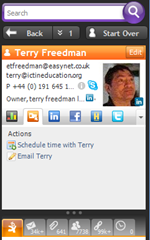
To obtain all this information, I simply type your name into the search box, and I see something like this, virtually instantly most of the time.

Xobni gives you contact info at your fingertips

As you can see, it has collated my contact information so that I have your email address(es), phone number, Skype link, and Twitter, Facebook and Linked-In details (if I’ve added you as a friend in those applications).

A row of icons at the bottom of the panel gives me instant access to our email conversations, attachments sent, and other potentially useful information. As for the name and email address of your colleague, that’s contained further down in the panel shown in the screenshot (which I’ve cropped to avoid giving other people’s details).

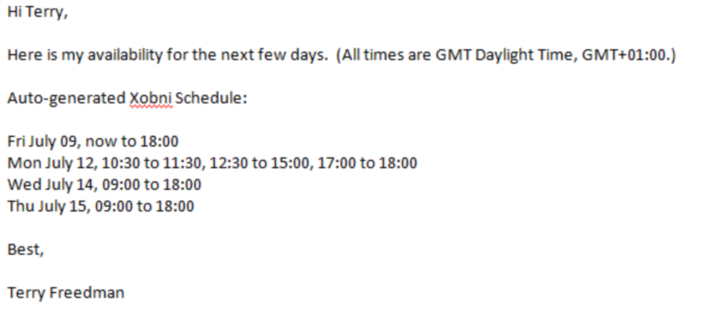
Xobni can also suggest meeting timesThe application is also linked to the Outlook calendar. If I click on “Schedule time with …” an email like the one shown is automatically generated. Xobni has looked at my calendar for the next few days and suggested times when I have no appointments.

Another feature is that it gives you lots of metrics. For example, it will tell you the times of day that people respond to your emails, the purpose being to enable you to call them when they’re most likely to be in the office.

There’s a free version of Xobni that works just fine. The paid-for version costs $29.50 and has an advanced search function and works on more than one .PST file. I tried the free version, and liked it so much I bought the upgrade. I think in terms of time and my blood pressure it paid for itself on the very first use. You can find out more about the program and download it from the Xobni website.


Does ICT Improve Learning?

The intuitive answer to those of us involved in ICT is “of course it does”. However, the evidence from research is not conclusive. I think the reason is that it’s actually very difficult to carry out robust research in this area. As the impact of ICT has been a topic for discussion recently in the Naace and Mirandanet mailing lists, I thought it might be useful to try and clarify the issues as I see them.

The question “Does ICT improve learning?” naturally leads on to a set of other questions that need to be addressed:

What ICT?

The question as stated is too broad. A computer is not the same as a suite of computers. It’s not even the same as a laptop, which is not the same as a handheld device. Software is not the same as hardware, and generic software, such as a spreadsheet, is not the same as specific applications, such as maths tuition software.

What other factors are present?

ICT doesn’t happen in a vacuum. What is the environment in which the technology is being used? How is the lesson being conducted? What is the level of technical expertise of the teacher? What is the level of teaching expertise of the teacher? These and other factors mentioned in this article are not stand-alone either: they interact with each other to produce a complex set of circumstances.

What is the ICT being used for?

What is being taught? There is some evidence to suggest that computers are used for low-level and boring tasks like word processing, in which case comparing technology-“rich” lessons with non-technology-rich lessons is not comparing like with like. On the other hand, technology can be, and often is, used to facilitate exploration and discussion. Since these are educationally-beneficial techniques in their own right, the matter of validity needs to be scrutinised (see below).

How is the impact of the ICT being evaluated?

There are several ways in which this might be done, each with their own advantages and disadvantages. For example, in-depth case studies yield rich data but may be difficult to generalise from. Also, there are three other problems. One is that it is difficult to conduct experiments using a suitable control group, because no teacher wishes to try something which may disadvantage a particular group of students. Another is the so-called “starry night” effect, in which case studies focus (naturally) on the successful projects whilst ignoring all the ones which either failed or were not believed to have deliver the same level of benefits. Finally, there is the danger of all kinds of evaluation study, that the methodology itself may affect the outcome.

What exactly is being measured?

This is the issue of validity, already touched upon. Are we measuring the ability of a teacher to conduct a technology-rich lesson, in which case it’s the effectiveness of the teacher rather than the ICT that is being weighed up? By implication, it may be the quality and quantity of professional development which is being measured. It may be students’ home environments that are inadvertently being evaluated, or student-staff relationships.

How much is ICT being used?

I suggest there may be a difference between schools in which ICT is being used more or less everywhere, and those in which it’s hardly being used at all. In the former, presumably both teachers and students would be accustomed to using it, there would be a good explicit support structure in the form of technical support and professional development, and a sound hidden support structure in the form of being able to discuss ideas with colleagues over lunch or a cup of coffee.

Is there an experimenter effect going on?

This is the phenomenon whereby the results of a study confirm or tie in with the expectations of the people or organisation responsible for the study. This is an unconscious process, not a deliberate attempt to cheat. I’ve explained it in my article called Is Plagiarism Really a Problem?

Conclusion

My own feeling – backed up by experience --  is that in the right set of circumstances, the use of ICT can lead to profound learning gains. However, rather than falling into the trap of arguing whether ICT is “good” or “bad”, we need to move the debate onto a much sounder intellectual basis.

Further reading

I’d highly recommend Rachel M. Pilkington, “Measuring the Impact of Information Technology on Students’ Learning”, in The International Handbook of Information Technology in Primary and Secondary Education, Springer, 2008, USA.

What are the big issues facing ICT (Ed Tech) leaders? Please take a very short survey to help us find out.

A (Hopefully Temporary) Email Problem

One day after telling a colleague that one of my email providers has experienced problems only three times in the last ten years, there was, and still is, what they call a "major outage". What that means is that if you have sent me an email and not received a response, that's because I haven't yet received it. If you resend it to terry[at]terry-freedman.org.uk that should get to me with no trouble (I'm reluctant to say will get to me: look what happened the last time I prasied an email service).