
For the final edition of this free newsletter, we have a great line-up of experts and articles:
Read MoreShould we welcome the nanocams?
I’m reading a short story by Ian Creasey called “The Edge of the Map”. In the world depicted by Creasey, automated cameras called “nanocams” take photos and newspapers (and other media, presumably) source their illustrations from the pool created by them. In other words, there is no need for specialist photographers.
This raises a number of interesting questions.
Awarding Levels in Computing for the purpose of number-crunching
It’s all very well coming up with weird and wonderful ways of acknowledging students’ achievement, but at some point somebody, unfortunately, is going to ask you for a number. The number is important to them because they can enter it into spreadsheet and show, hopefully, that the numbers go up over time.
Read MoreA is for Assessing Computing: 16 criteria and 5 considerations
A student writes a program. What are you going to assess it on? There are at least 16 criteria you could take into account. Not all of these will be apposite – it depends on what you’re teaching and who you’re teaching. Also, I’ve framed the list below in teacher language; it’s up to you to adapt it into language that is more appropriate for your students.
Read MoreThe 6 Fundamental Computing Assessment Scheme Questions
Whether you decide to create your own assessment scheme from a blank sheet of paper, so to speak, use a ready-made scheme created by someone else, or do a bit of both, there are 6 questions you need to ask:
Read MoreDigital Education Coding Resources Special
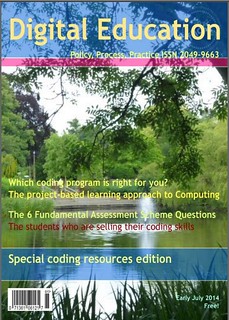 The new edition of Digital Education, the free newsletter for those with a professional interest in educational ICT and Computing, has a special focus on resources you can use to teach coding. Here’s what it contains:
Review of Teacher’s Pet
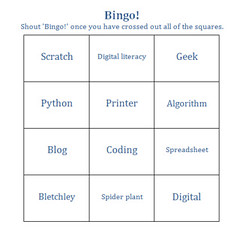 Go on, admit it: you still create worksheets, right? If you do, and you use Microsoft Word or OpenOffice to do so, you’ll find Teacher’s Pet very handy. It’s basically a set of macros that can transform lists of words into several different types of puzzle or test item.
9 Approaches to assessing Computing and ICT–#9: Cognitive Development
The DfE recently announced the winners of its Assessment Innovation Fund. I’ve been reporting on the winners and the descriptions of their approach. These descriptions are more like thumbnail sketches at the moment. I have used them to suggest ways in which they might be adapted for use in assessing ICT and Computing. I hope you find these suggestions useful, or at least a good starting point for your own further work.
Read MoreIn each case I have kept the text of the DfE’s announcement, and then added my thoughts under the heading “Applying this to Computing and ICT”.
Today: Cognitive Development.
Update on the Computer Education Project
 A couple of months ago I invited people to contribute to a survey about what they were doing to prepare for the new Computing curriculum. About 75% of my motivation for doing so was to help to spread ideas. I believe in the grass roots sort of approach to such things, as opposed to the ‘great and the good’ declaring what the rest of should be doing. Actually, to clarify, I don’t mind if the great and the good are doing it or have done it themselves. I find it tedious when people who have never been a teacher and/or had little contact with schools start issuing advice. OK, rant over!
9 Approaches to assessing Computing and ICT–#8: An Iterative Approach
 The DfE recently announced the winners of its Assessment Innovation Fund.Over the next week or so I will report on the winners and the descriptions of their approach. These descriptions are more like thumbnail sketches at the moment. I have used them to suggest ways in which they might be adapted for use in assessing ICT and Computing. I hope you find these suggestions useful, or at least a good starting point for your own further work.
In each case I have kept the text of the DfE’s announcement, and then added my thoughts under the heading “Applying this to Computing and ICT”.
Today: Progression planners.
Driverless cars: technology trumps experience - again

9 Approaches to assessing Computing and ICT–#7: An Iterative Approach
The DfE recently announced the winners of its Assessment Innovation Fund.Over the next week or so I will report on the winners and the descriptions of their approach. These descriptions are more like thumbnail sketches at the moment. I have used them to suggest ways in which they might be adapted for use in assessing ICT and Computing. I hope you find these suggestions useful, or at least a good starting point for your own further work.
Read MoreIn each case I have kept the text of the DfE’s announcement, and then added my thoughts under the heading “Applying this to Computing and ICT”.
Today: An iterative approach.
Computer Education Projects Book Update
 How are teachers preparing for the new Computing curriculum, which is due to start being taught in September 2014? Some time ago I created an online survey in order to ascertain the answer to this question. Although there have been fewer respondents than I’d hoped for (though probably more than I’d expected), the results are quite interesting. Here is a very brief summary.
9 Approaches to assessing Computing and ICT–#6: Another Ladder Approach
The DfE recently announced the winners of its Assessment Innovation Fund.Over the next week or so I will report on the winners and the descriptions of their approach. These descriptions are more like thumbnail sketches at the moment. I have used them to suggest ways in which they might be adapted for use in assessing ICT and Computing. I hope you find these suggestions useful, or at least a good starting point for your own further work.
In each case I have kept the text of the DfE’s announcement, and then added my thoughts under the heading “Applying this to Computing and ICT”.
Today: Another Ladder approach.
A brief update
Do you know, I hate those self-referntial blog posts in which bloggers talk about their own blogs. So I’m not going to do that; I’m going to talk about my newsletter and a survey instead!
Read MoreEd Tech determinism and so-called conventional wisdom
I am always suspicious of things that everyone agrees about – mainly because I usually find myself disagreeing. I would not be so arrogant as to believe that everyone else is wrong and I’m right, but I do often think that it would be good to evaluate what is taken as read in light of our personal experience and pedagogical expertise.
Here are just three examples of what I’m talking about.
9 Approaches to assessing Computing and ICT–#5: A Growth Mindset
The DfE recently announced the winners of its Assessment Innovation Fund.Over the next week or so I will report on the winners and the descriptions of their approach. These descriptions are more like thumbnail sketches at the moment. I have used them to suggest ways in which they might be adapted for use in assessing ICT and Computing. I hope you find these suggestions useful, or at least a good starting point for your own further work.
Read MoreIn each case I have kept the text of the DfE’s announcement, and then added my thoughts under the heading “Applying this to Computing and ICT”.
Today: A Growth Mindset approach.
9 Approaches to assessing Computing and ICT–#4: A Mastery Approach
The DfE recently announced the winners of its Assessment Innovation Fund.Over the next week or so I will report on the winners and the descriptions of their approach. These descriptions are more like thumbnail sketches at the moment. I have used them to suggest ways in which they might be adapted for use in assessing ICT and Computing. I hope you find these suggestions useful, or at least a good starting point for your own further work.
Read MoreIn each case I have kept the text of the DfE’s announcement, and then added my thoughts under the heading “Applying this to Computing and ICT”.
Today: A Mastery approach.
9 Approaches to assessing Computing and ICT–#3: A Scoring System
The DfE recently announced the winners of its Assessment Innovation Fund.Over the next week or so I will report on the winners and the descriptions of their approach. These descriptions are more like thumbnail sketches at the moment. I have used them to suggest ways in which they might be adapted for use in assessing ICT and Computing. I hope you find these suggestions useful, or at least a good starting point for your own further work.
Read MoreIn each case I have kept the text of the DfE’s announcement, and then added my thoughts under the heading “Applying this to Computing and ICT”.
Today: A scoring system.
9 Approaches to assessing Computing and ICT–#2: The ladder
The DfE recently announced the winners of its Assessment Innovation Fund: https://www.gov.uk/government/news/schools-win-funds-to-develop-and-share-new-ways-of-assessing-pupilsOver the next week or so I will report on the winners and the descriptions of their approach. These descriptions are more like thumbnail sketches at the moment. I have used them to suggest ways in which they might be adapted for use in assessing ICT and Computing. I hope you find these suggestions useful, or at least a good starting point for your own further work.
Read MoreIn each case I have kept the text of the DfE’s announcement, and then added my thoughts under the heading “Applying this to Computing and ICT”.
Today: The Ladder.