
 I have found the Never Seconds debacle quite interesting. Story in a nutshell, in case you missed it: nine-year-old Martha Payne writes a daily blog in which she uploads a picture of her school lunch and reviews it. Argylle and Bute Council has some sort of nervous breakdown and issues an edict telling Martha that she isn’t allowed to take photos of her lunch, because catering staff are now in fear of their jobs. As a consequence, Martha’s blog gets over 5 million page views in just a few days, the number of comments on her posts soars from around 30 to over 2,300 in two days, and Argyll and Bute rescind the ban.
“I’m on the tube!”
 People travelling on the London Underground (known as ‘the tube’) will soon be able to obtain a wi-fi signal on their phone or other electronic device.
What might be the benefits and costs of this?
Interesting times in ICT
 The phrase “May you live in interesting times” is usually cited as a sort of curse, but can you imagine the opposite, ie living in boring times? Fortunately, especially here in England there is no danger of that for a while, at least in the world of ICT. Here are a few snippets of news which I won’t comment on at the moment because I like to cogitate, reflect, and then cogitate some more before pontificating. As I said in a previous article (10 Obligations of Bloggers), quoting Salvator Rosa, I believe in the adage “Be silent, unless what you have to say is better than silence”.
Old technology
It’s always fun, as well as informative, to look at photos or videos to check out the technology used, especially if the photo or video is old. In this video of Jimmy Nail’s Ain’t No Doubt, I’ve spotted several examples of “retro” technology. Perhaps you or your students can spot more?
Here’s what struck me:
Read MoreMobile phones in education revisited
 The most popular article on the ICT in Education website is one by a 17 year-old student called The Importance Of Mobile Phones In Education. To give you an idea of its popularity, I would estimate that it has been viewed at least 30,000 times since it was published back in July 2010. So the question is, why is it so popular?
Is it because it was written by a student? Well, there is no doubt that student articles receive a lot of attention, but not usually this much.
Is it because it is about mobile phones? I don’t think so: I have written about mobile phones before, and again, the articles haven’t attracted 30,000 views as far as I know.
I think the answer lies in the combination: an article about mobile phones written by a student who appears to be surgically attached to one.
Computer programming and the trouble with collective nostalgia
 Lord Puttnam said something every interesting at an E-Learning Foundation Conference. Having been a film producer, he said that up to about ten years ago, to be a successful cinematographer you had to be able to take a camera apart and put it together. Now, none of those sort of skills are required: you need a whole different set of skills in order to find employment in that occupation.
I believe a similar thing is true in the realm of “digital education”. Almost nobody needs a gasp of computer programming, and even fewer need to know how computers actually work.
What is the appropriate form of address in email?
 Here is the text of a note from the Post Office, quoted in “Berry and Co”, which was written by Dornford Yates and published in 1920:
Sir
I beg leave to inform you that your telegram handed in at the Grosvenor Street Post Office at 10.2 am on the 26th June addressed to Reply paid Hamilton Smythe Fair Lawns Torquay has not been delivered for the reason indicated below.
ADDRESS NOT KNOWN
I am, Sir, Your obedient servant,
WB
Postmaster
Some notes on failing with ICT
 Failure seems to be the zeitgeist at the moment. At several conferences I’ve attended recently at least one of the presenters has displayed the Samuel Beckett quotation:
Ever tried. Ever failed. No matter. Try Again. Fail again. Fail better.
At the Pelecon 12 conference there was even a “Confessional”, in which delegates could go in and record themselves talking about one of their mistakes. Here are a few of my thoughts on failure, especially as it pertains to ICT.
Apps for Good
Applications for the next year for this innovative initiative are open, but the deadline for applications is imminent . Find out more…
Read MoreWhat makes a good ICT role model?
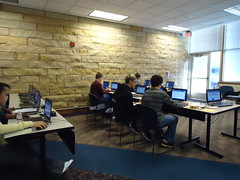 In England we have a weekly soap set in a school called Waterloo Road. This has everything you would hope not to find in a school: inappropriate behaviour, theft, even attempted murder – and that’s just the staff. The kids are pretty OK by comparison: teenaged pregnancy, illegal drug-taking and gangs. Strangely enough, there doesn’t seem to be more than 30 kids on roll, judging by the number of people who attend whole-school assemblies. But my main interest is this: what (good) use of technology is shown in this programme?
A student’s view of ICT
 Back in 2010, Maddison Holt, a student in Australia, gave her view of ICT in ICT: A Whole New World. Eighteen months later, what does she think now?
Audio slides
 One of the things I like about the ICT in Education site (he says modestly) is that you can listen to the articles as well as read them. It means that the articles are accessible to sight-impaired people. But when I upload presentations, that is no longer true. At least, not until now.
7 reasons to incorporate digital photography into your course
 If I were running an educational technology/ICT course now, I’d make taking and sharing at least one photo a week a requirement for remaining on the course. If booting someone off the course was not an option, I’d tie in a significant proportion of the marks to those activities. All this is impractical, of course. Even if I were allowed to get away with such draconian actions, I wouldn’t want to penalise a brilliant student for not taking a few snaps now and again. But think of the benefits to everyone if digital photography were a key component of a course – any course.
Choose your own assessment
 In the changing room where I go swimming, there’s a machine that does everything. It measures your height, weight, Body Mass Index (BMI), and about half a dozen other things. I’m surprised it doesn’t measure my waist and shoe size as well. Yet, after using it twice, I have given up on it.
Don’t blame the technology
Technology can help a good teacher do wondrous and wonderful things – but bad use of technology is worse than no use of technology, in my opinion. There is, possibly, one exception to this general rule, which I will get to in a moment. What has brought on this sudden dazzling insight (well, it isn’t really instant, and it probably isn’t dazzling, but this is my blog so I can say what I like). An anti-ICT dogma diatribe by the behaviour guru, aka Tom Bennett.
Read MoreBring your own technology
 If ever there was an idea whose time has come, it is surely Bring Your Own Device or, to be less restrictive, Bring Your Own Technology. There are at least two comp0elling reasons for this.
ICT and small businesses: the brief
 It is quite understandable that when people talk of the contribution that the business world can make to ICT lessons, they tend to think of big business. And why wouldn’t they? Big companies often have the money to finance the production of nice-looking resources, or even to provide people to spend a day in school running a simulation of some kind. However, my experience of talking to students in lessons is that small businesses, such as mine, have much to offer too. I thought I'd explore some ways in which that can happen, in an occasional series.
Internet addiction: another flawed study
 You’d think people would have better things to do than do pointless surveys from which they then draw unlikely conclusions. Still, it keeps them out of mischief I suppose.
5 ways to develop critical thinking in ICT
 How do you encourage pupils and students to think critically in the context of educational technology? Although we can devote a lot of time and energy to setting up the "right environment", I can't help thinking that really it all comes down to some pretty simple questions, and very straightforward approaches.
Digital Learning Day
Read some of the highlights from the recently-held Digital Learning Day in the USA. I haven’t fully explored all these myself, but they look promising!
Read More