
Believe it or not, I write about other stuff too! In case you’re interested, I’ve just published articles about a conference and a couple of books for authors
Read MoreMoney, Money, Money
This article is not about education technology or related matters as such; it's more about my experience of attitudes to paying for work. It's worth reading, I think, if any of the following applies to you:
- you're thinking of asking a consultant to do some work
- you have some students who are running a business of some kind
- you are thinking of moving into consulting yourself.
An alternative view: Changing Paradigms, by Crispin Weston
Crispin Weston, who describes himself as "a controversialist", suggests that our outlook is not progressive at all. To quote:
Read More"... when we look at education technology, we find that almost nothing has changed at all."
11 criteria for evaluating a school’s education technology
 Whether you are moving to a new school, or staying where you are, it’s good to stand back and try to gauge what the school’s education technology is like. Why you would want to do that if taking up a new post is obvious: you want to see how the land lies so that you can start to identify any improvements that could be made.
Assessing Computing: Grids and Badges
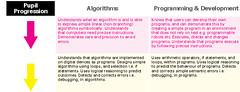 Since Michael Gove, England’s then Education Secretary, announced that Levels were not fit for purpose – the purpose being to assess and describe students’ proficiency in National Curriculum subjects – there has been a proliferation of attempts to assess Computing without using Levels. Many of these have taken the approach, quite naturally, of devising a progression grid of some sort. All the ones I’ve seen break the grid down into the Computing Programme of Study’s component parts
Digital Education new edition out now!
Did you know that today is International Ada Lovelace Day? Information about this, online poetry, journalism and novel writing, may be found in our latest newsletter. It’s a relatively short “interim” edition, but it’s still packed with lots of wholesome goodness!
Here’s the full list of contents:
Digital Education Out Now!
 Some news from Terry Feedman...
The October 2014 edition of Digital Education, the free ezine for those with a professional interest in educational ICT and Computing, was published a few days ago.
There are articles on research, a couple of cynical articles (Ambrose Bierce said that a cynic is someone who sees things as they are, and not as they ought to be!), and much more, covering digital literacy, computing, assessment and management stuff. Here’s the full list:
A rights rip-off
 In his newsletter OLDaily, Stephen Downes has drawn attention to a blog post by Paul Bradshaw, entitled “The Great British Bake Off copyright grab: We can use your #ExtraSlice Twitter images but not give you credit”.
Digital Education “Interim” Edition Out Now!
I’ve just published an ‘interim’ edition of Digital Education, the free newsletter for people with a professional interest in educational ICT and Computing. Here’s what it contains:
Read MoreThe Education Technology Guru test
The term “guru” is bandied about all too often these days. But how apt is the term? I think for a person to be described as an education technology guru, the following criteria have to be satisfied. I’m basing these on my understanding of the role of a guru in traditional meditation practices. The guru there is an enlightened person who is helping others to achieve the same state of consciousness. So here is my set of criteria of ed tech gurudom.
Read MoreDigital Education: the first edition of the year is now available!
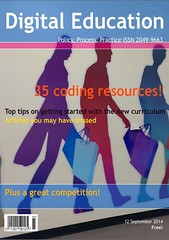 We’re in the first couple of weeks of the new school year here in England, and the first edition of Digital Education, our free newsletter, is now available! Pardon the exclamation mark, but the fact that it has now been published is a minor miracle. Right at the very last minute, I tried to delete a letter, and Microsoft Word went insane. It reform mated the whole document into just three pages, and hid most of it. I managed to retrieve it though — by selecting it all and then copying and pasting it into a new document. So, given that I almost threw the newsletter, my computer and the cat out of the window in frustration, I think an exclamation mark is more than justified!
Digital Education: Getting the year started
 Now that we’ve have had a week or so to get settled in to the new school year, I thought a short edition of the Digital Education newsletter would not come amiss. That will be published tomorrow, and here’s what it will contain:
Become an expert Google educator
Ed tech heroes get nervous too
I was struck by a comment made my Steve Dembo on Facebook recently. He said:
“I imagine that some day I'll stop getting nervous before presentations. But today is not that day”
I’ve met Steve: passionate, enthusiastic, a great speaker. I came across him via his blog and podcasts some years ago. I found him to be really inspirational, and was delighted to meet him at a conference a few years ago. So I was shocked to read his comment, though not surprised.
Girls cram for exams using a mobile app
Everyone goes on about “boys and their toys”, but according to research carried out by a revision app company, more girls than boys are using the app to help them revise.
Read MoreThe usefulness of technology in education
 Strangely enough, the most popular blog post on this website is 13 reasons to use educational technology in lessons. Why strange? Because I wrote it over three years ago. I re-read it recently, and (thank goodness!) I still agree with what I wrote all that time ago. I’d like to add more to it, but rather than do that I thought I would contribute to Mark Anderson’s series on this subject.
three cheers for antiplagiarism software
 I like to think that had there been anti-plagiarism software around when I was at school, and had my English teacher used it, I’d have been saved years of wasting time looking for ways to make money. I’d have enjoyed more sleep too.
Digital Education latest edition!
For the final edition of this free newsletter, we have a great line-up of experts and articles:
Read MoreShould we welcome the nanocams?
I’m reading a short story by Ian Creasey called “The Edge of the Map”. In the world depicted by Creasey, automated cameras called “nanocams” take photos and newspapers (and other media, presumably) source their illustrations from the pool created by them. In other words, there is no need for specialist photographers.
This raises a number of interesting questions.
Digital Education Coding Resources Special
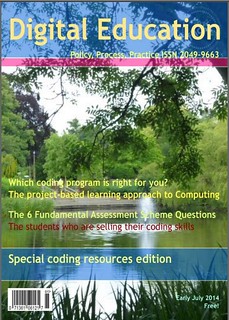 The new edition of Digital Education, the free newsletter for those with a professional interest in educational ICT and Computing, has a special focus on resources you can use to teach coding. Here’s what it contains: