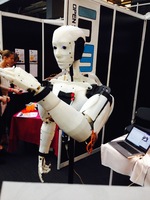
Report from the 3D print show

Richard Smith, of Igloo in Education and Amazing ICT, recently visited the 3D Print Show in London. What did he make of it?

Hi, Richard Smith here from Igloo in Education. I am delighted to have been asked by Terry to do a guest blog post on the 3D print show that took place in London from 7-9th November.

The venue of the event, the Business Design Centre in Islington, sent out a clear message out to visitors: 3D printing should be about innovative design and the encouragement of original business ideas. Of


Read More

To be an ed tech maverick, you need to be sensible

What is a Maverick?What does it mean to be a maverick? To me, it means not going along with the general consensus about something, just because it’s a consensus. There is always a natural tendency to think “all those people can’t be wrong”, or “there’s no smoke without fire”, but in fact all those people could be wrong and there could be smoke without fire. (Think, for a moment, of all the vilified minority groups throughout history and throughout the world about whom all sorts of ridiculous and terribel things were believed by the majority.)
Read More

EdExec Live - ICT Matters: A conference worth going to

I look for three main things in a conference:

  • Good topics, by which I mean not only ones about the latest fad but useful, down-to-earth ones too, and ones that make you think and reflect
  • Good speakers, by which I mean people who are experts in their field, and not merely good entertainers
  • An opportunity to meet and network with others
Read More

The BETT Blog Begins!

Here’s a new blog to start looking at and to put into your RSS reader*: the BETT 2014 blog. So, the first thing I’ll do is declare an interest: I’ve been asked to contribute to it, which is quite flattering, but that’s not the reason I’m writing about it. I think the important thing about the blog is that it provides a variety of views and suggestions from different people
Read More

British Gas and the Internet of Things

Andrew Brem HiveBritish Gas and I go back a long way. For years they have provided me with heating and hot water, and until relatively recently with energy for cooking too. I won’t say it’s all been smooth running. For example, there was the time when they threatened to get the bailiffs round to my flat in order to read the meter that they had removed the week before. But on the whole they’ve been alright. I daresay were it not for the customary British reserve we’d be on first name terms by now. I’d write letters beginning,

“Dear British”

and go on to say how pleased I am to receive the latest bill and how much pleasure I have in enclosing payment.

Read More

Conference catch-up

It's been a busy period conference-wise. In the near future I hope to report on all of them: dealing with the new Computing Programme of Study, dealing with data and Ofsted, an RM Apple day and the awe-inspiring Apps World 2013.

Good riddance to levels in ICT and Computing

P1020520Who’s afraid of life without Levels? Quite a few people if the number of schemes of work and assessment grids being developed that incorporate levels are anything to go by. Working without levels is clearly very hard: it is almost impossible to think, much less talk, about pupils’ progress without mentioning levels at some stage.

Yet this is precisely what the government expects.

Read More

As I was saying…

I have two blog posts already started, and another two waiting to be transferred from my head to the computer and thence to the web. I have had to interrupt myself so many times because of work commitments that I have become impatient – with myself! Hence the title of this post which should read, in full:

As I was saying before I was so rudely interrupted…

Anyway, while I am in the process of completing the aforementioned articles, I thought I would mention the Propaganda exhibition that is currently on at the British Library.

Read More

How much should we share online?

audio surveillance zoneI’ve been thinking a lot about this topic recently, and even more so since Simon Finch sent me a link to his excellent article, Privacy is gone, live with it. In the article, Simon talks about managing his digital identity, not so much for self-promotion, but for self-preservation. His view is that if you don’t take charge of your digital identity, it will become defined by what others are saying about you.
Read More

Do 21st Century Skills make you employable?

Are youngsters being misled by being told that in order to get a job they will need "21st century skills"? Certianly, they need to be digitally literate, however one wishes to define that term, and they need to be flexible and agile in order to be able to retrain themselves when the job they are doing disappears in x years' time. But beyond those so-called "skills" -- which became apparent in the 20th century actually -- what?
Read More

How computers decrease efficiency

Burglar Bill at largeNot everything that is good, is good. Take this as an example. If I were to give my neighbour’s children some private tuition in return for a modest fee, I could go out and spend the money, thereby contributing to the local and national economy. Everyone benefits.

On the other hand, if I were to go on a really prolific one-man burglary spree, they would have to employ extra police or pay the existing police force more overtime, local residents would invest in updated security systems and the local economy would benefit even more from all this spending.

Read More

Videos on aspects of Computing and ICT

I thought you might be interested in two new sets of video resources which are, and are becoming, available. The big problem with video in general, in my opinion, is that it’s hard to find the time to sit down and watch something for any length of time because you can’t do much else while you’re doing so. And by “any length of time” I mean anything over about 5 minutes.

So it’s good that there are some 3 minute videos now and some micro-videos coming on stream.

Read More

Evaluating a school’s computing and ICT

The guidance provided by Ofsted on what constitutes a grade of “Outstanding” in subjects is currently under review. This is a good time for them to consider a minimalist approach: what two or three factors should be instrumental in coming to a judgement? In my opinion, the more tick-boxes you have, the less useful the whole exercise becomes. I wonder: are there a few key things which determine whether a school’s offering in Computing and ICT is good or not, and which, if tweaked, could transform a low grade into a higher one?

I’m always interested in such things, and that interest was reignited today when I read an article I’d written in 2005. Apart from the documentation referred to, I believe it is still accurate, and pertinent – and could be applied to the inspection of individual subject areas like Computing and ICT as to a whole school or Local Authority.

Anyway, see what you think.

Read More

Why Michael Marland is relevant for educational technology teaching

I hadn’t realised, until I read Geoff Barton’s post (Remembering Michael Marland) this morning, that it is five years since Michael Marland died. Mr Barton had the astounding good fortune to know Michael Marland. I didn’t, but I did meet him and chat with him once, which left me with a warm glow that has never dissipated. It was one of the few occasions that I have met one of my heroes and not been bitterly disappointed.

At the time of Marland’s death, I wrote a small tribute to him, which I have reproduced here. His ideas were and are relevant to teachers who use technology in their classroom, as I hope I’ve explained.

Read More