As I was saying…

I have two blog posts already started, and another two waiting to be transferred from my head to the computer and thence to the web. I have had to interrupt myself so many times because of work commitments that I have become impatient – with myself! Hence the title of this post which should read, in full:

As I was saying before I was so rudely interrupted…

Anyway, while I am in the process of completing the aforementioned articles, I thought I would mention the Propaganda exhibition that is currently on at the British Library.

Read More

How much should we share online?

audio surveillance zoneI’ve been thinking a lot about this topic recently, and even more so since Simon Finch sent me a link to his excellent article, Privacy is gone, live with it. In the article, Simon talks about managing his digital identity, not so much for self-promotion, but for self-preservation. His view is that if you don’t take charge of your digital identity, it will become defined by what others are saying about you.
Read More

Do 21st Century Skills make you employable?

Are youngsters being misled by being told that in order to get a job they will need "21st century skills"? Certianly, they need to be digitally literate, however one wishes to define that term, and they need to be flexible and agile in order to be able to retrain themselves when the job they are doing disappears in x years' time. But beyond those so-called "skills" -- which became apparent in the 20th century actually -- what?
Read More

How computers decrease efficiency

Burglar Bill at largeNot everything that is good, is good. Take this as an example. If I were to give my neighbour’s children some private tuition in return for a modest fee, I could go out and spend the money, thereby contributing to the local and national economy. Everyone benefits.

On the other hand, if I were to go on a really prolific one-man burglary spree, they would have to employ extra police or pay the existing police force more overtime, local residents would invest in updated security systems and the local economy would benefit even more from all this spending.

Read More

Videos on aspects of Computing and ICT

I thought you might be interested in two new sets of video resources which are, and are becoming, available. The big problem with video in general, in my opinion, is that it’s hard to find the time to sit down and watch something for any length of time because you can’t do much else while you’re doing so. And by “any length of time” I mean anything over about 5 minutes.

So it’s good that there are some 3 minute videos now and some micro-videos coming on stream.

Read More

Evaluating a school’s computing and ICT

The guidance provided by Ofsted on what constitutes a grade of “Outstanding” in subjects is currently under review. This is a good time for them to consider a minimalist approach: what two or three factors should be instrumental in coming to a judgement? In my opinion, the more tick-boxes you have, the less useful the whole exercise becomes. I wonder: are there a few key things which determine whether a school’s offering in Computing and ICT is good or not, and which, if tweaked, could transform a low grade into a higher one?

I’m always interested in such things, and that interest was reignited today when I read an article I’d written in 2005. Apart from the documentation referred to, I believe it is still accurate, and pertinent – and could be applied to the inspection of individual subject areas like Computing and ICT as to a whole school or Local Authority.

Anyway, see what you think.

Read More

Why Michael Marland is relevant for educational technology teaching

I hadn’t realised, until I read Geoff Barton’s post (Remembering Michael Marland) this morning, that it is five years since Michael Marland died. Mr Barton had the astounding good fortune to know Michael Marland. I didn’t, but I did meet him and chat with him once, which left me with a warm glow that has never dissipated. It was one of the few occasions that I have met one of my heroes and not been bitterly disappointed.

At the time of Marland’s death, I wrote a small tribute to him, which I have reproduced here. His ideas were and are relevant to teachers who use technology in their classroom, as I hope I’ve explained.

Read More

The technology-related cost of going to school

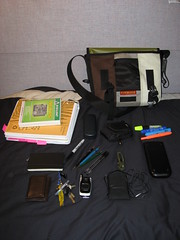
What's In my bag: School editionAccording to an article in the Daily Telegraph, it now costs £550 for  child to go to school, compared with around £230 in the 1960s and £250 in the 1980s. This is because of the number of gadgets included in the pupil’s school bag, compared to earlier times. The article says:

Today, while the cost of lunchboxes, calculators, and pencil cases have come down, the rise in demand for technology means parents face having to find a small fortune for the Back to School rush.

What a ridiculous, non-news article!
Read More

Computing and ICT misinformation

IMAG0311I am continually astonished by people’s misconceptions or misinformation about education in general, and ICT in particular. To be more accurate, I am often shocked, but no longer surprised, at how poorly education tends to be reported on in the press – at least in my experience when it concerns stuff I know about.

Now, I understand this when it comes to a subject like science. I used to say to Elaine, over breakfast, things like:

Read More

Technology for an ageing population: competition

Technology UseHere is a competition which is aimed at secondary school students.  I quite like the idea of this: both the topic and the nature of what has to be submitted by entrants: a video of not more than 90 seconds answering the question:

In the future, how will technology help an ageing population?

This is an opportunity to get some really interesting discussions going. Perhaps you could get other colleagues involved, such the RE department.

Read More

ICT Lessons and internet privacy

Privacy keyboardWhatever you think of the current debate over news that the US Government may have been monitoring the online activity of not only its own citizens but those of other countries too, you have to admit one thing. It provides a great opportunity for ICT teachers everywhere to bring some real-world issues into their lessons, in a very newsy (ie current) way.
Read More

Cloud Services White Paper and Survey

CloudsCloud Education ICT Design (CEID), which is run by the South-west Grid for Learning Trust, has published a very useful White Paper on Cloud Computing. At only four pages long it explains what cloud computing is, and what the benefits and risks are from an education establishment’s point of view. CEID intends to expand on the list of risks and benefits once it has analysed the survey results.
Read More

A matter of trust: 7 ways of finding the right ICT supplier for you

Mullah Nasrudin was in a village he was visiting for the first time. He rushed into a shop, and demanded of the shopkeeper:

“Have you ever seen me before?”

“No!” answered the owner.

“Well then,” asked Nasrudun. “How do you know it’s me then?”

You might think that an ancient Persian folk hero would have little to say a 21st century citizen, but I think you’d be wrong.

Read More

Teens and social media

Texting in the ParkThere was an interesting article in the UK’s Daily Telegraph about the film The Bling Ring. Entitled “Is the Facebook generation anti-social?”, the article presents what I think is a fairly balanced view of how teens seem obsessed with recording every moment of their lives. Well, balanced in the sense that the writer, Tim Stanley, attempts to present it as something we have always done. He cites the example of people in years gone by insisting on showing their (boring) holiday snaps to their friends and family. Now they upload them to Facebook instead (thank goodness!).
Read More