Evaluating a school’s computing and ICT

The guidance provided by Ofsted on what constitutes a grade of “Outstanding” in subjects is currently under review. This is a good time for them to consider a minimalist approach: what two or three factors should be instrumental in coming to a judgement? In my opinion, the more tick-boxes you have, the less useful the whole exercise becomes. I wonder: are there a few key things which determine whether a school’s offering in Computing and ICT is good or not, and which, if tweaked, could transform a low grade into a higher one?

I’m always interested in such things, and that interest was reignited today when I read an article I’d written in 2005. Apart from the documentation referred to, I believe it is still accurate, and pertinent – and could be applied to the inspection of individual subject areas like Computing and ICT as to a whole school or Local Authority.

Anyway, see what you think.
Read More

Why Michael Marland is relevant for educational technology teaching

I hadn’t realised, until I read Geoff Barton’s post (Remembering Michael Marland) this morning, that it is five years since Michael Marland died. Mr Barton had the astounding good fortune to know Michael Marland. I didn’t, but I did meet him and chat with him once, which left me with a warm glow that has never dissipated. It was one of the few occasions that I have met one of my heroes and not been bitterly disappointed.

At the time of Marland’s death, I wrote a small tribute to him, which I have reproduced here. His ideas were and are relevant to teachers who use technology in their classroom, as I hope I’ve explained.

Read More

What new teachers need to know -- Personal ICT Skills

This article was originally published on 7th March 2006. Surprisingly perhaps, much of it is still relevant today, given its focus on the importance of having an understanding of computer programming concepts and other aspects of computing.

Making assumptions is a dangerous game! It's commonly assumed that new teachers will automatically know all about information technology because they are young (which is in itself an assumption: what about mature students, housewives returning to work, retired bankers looking for a new challenge, and so on?).

Read More

7 Criteria for evaluating a computing scheme of work

curriculum perspectivesNow that it’s certain that here in England we will have a computing curriculum to follow in September 2014, many people are going to be writing schemes of work. Whether you are a producer or a consumer in this regard, I think you will find the following evaluation criteria useful.
Read More

Computing and ICT misinformation

IMAG0311I am continually astonished by people’s misconceptions or misinformation about education in general, and ICT in particular. To be more accurate, I am often shocked, but no longer surprised, at how poorly education tends to be reported on in the press – at least in my experience when it concerns stuff I know about.

Now, I understand this when it comes to a subject like science. I used to say to Elaine, over breakfast, things like:

Read More

Criticism and self-criticism: some thoughts for ICT teachers and leaders

Feedback Festival, S.Casciano, June 2009I was looking in the archives this morning, to see what I wrote about on this date in the past. By some strange twist, my articles on 4th July in both 2010 and 2011 were about criticism. Not criticism aimed at anyone or anything in particular, but in terms of general principles.
Read More

My biggest mistake as an ICT Co-ordinator

Act 1, Scene 1

Setting: an interview room.

Chair of Governors: So, Mr Freedman, do you have any questions you would like to ask US?

Terry Freedman: Yes. What are YOUR criteria of a successful ICT Co-ordinator?

Headteacher: I want to see teachers banging on the doors of the computer labs demanding to be let in.

Read More

4 ways to make your educational technology facilities more inviting

T-Pain's Singing TeacherHow do you ensure that the ICT facilities at your school are attractive enough to be used by pupils and staff? Even if your school has a Bring Your Own Technology (BYOT) scheme or a tablet-centred 1:1 scheme in place, you will want to ensure that the school’s own stuff is being used as fully and as effectively as possible. What can you, the ICT Co-ordinator/e-learning co-ordinator/senior leader in charge of ICT in the curriculum, do to help make that happen? Here are some suggestions.
Read More

A matter of trust: 7 ways of finding the right ICT supplier for you

Mullah Nasrudin was in a village he was visiting for the first time. He rushed into a shop, and demanded of the shopkeeper:

“Have you ever seen me before?”

“No!” answered the owner.

“Well then,” asked Nasrudun. “How do you know it’s me then?”

You might think that an ancient Persian folk hero would have little to say a 21st century citizen, but I think you’d be wrong.

Read More

L is for lesson observation

I watched an episode of that seminal contribution to English culture, Waterloo Road last week, for the first time in ages. I wrote about Waterloo Road in What makes a good ICT role model? if you’re interested, but basically it’s a soap set in a school which has to be the most dysfunctional school anyone has ever come across. The kids are alright (as some pop song said once), on the whole – but the adults…..
Read More

Two effects of new technology

1961... 'Gorgo'Here are a couple of interesting cartoon strips about the (possible) effects of new technology. Yesterday’s one is more about unintended consequences, while today’s is really about how apparently intelligent software and monitoring systems might be fooled.
Read More

An Interview with Dominic Savage

In this interview, Dominic Savage OBE discusses, amongst other things, the purpose of the Education World Forum, the effect of increasing access to devices, and what schools need to do as far as investing in ICT is concerned. Mr Savage has been the Director General of BESA since 1984. The following is not a verbatim account, but has been checked by Mr Savage before being published.
Read More

An Interview with Naace ICT Impact Lifetime Achievement Award Winner Dr Christina Preston

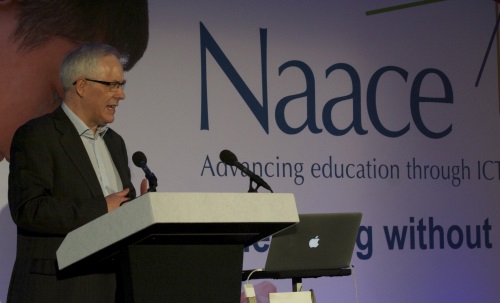
Christina Preston was one of two people given the Lifetime Achievement Award at the 2013 Conference of Naace, the subject association for ICT. I interviewed her to find out about her and her work.

Read More

Naace ICT Impact Awards - A Profile of Penny Patterson

Penny Patterson is on Twitter, but prefers to listen rather than talk, unless she has something of value to add to the conversation. She is active in ICT circles, though doesn’t have her own blog. And if you visit a conference she’s speaking at, you’re likely to chat to her while she serves the tea. She prefers, to use her own words, to be “one of the backroom team”.

Indirect evidence of this was seen in this year’s Naace ICT Impact Awards. When Penny was selected as one of the two people to be given a Lifetime Achievement Award, the look on her face was one of surprise, bordering on shock, and tinged with bewilderment. Typically, she told me that “other people deserve this award far more than I do.”

Read More

Lessons from Reviewing the new Computing Curriculum

discussionThis is not so much a review or even a summary of the recent Westminster Forum Conference called ‘Reviewing the new Computing Curriculum’ as a series of observations arising from it and related articles. The reason for that approach is that I’d like to make this article useful and interesting to as wide a range of people as possible, not only those concerned with the ICT or Computing Programme of Study in the National Curriculum in England and Wales.
Read More