My analogue program

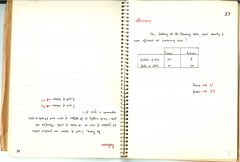
Absolute and comparative advantage bookWhen, on my teacher training course, I was told I had create a resource to be used in school, I thought it would be fun to devise a programmed learning guide to the economic concepts of absolute and comparative advantages. Unfortunately, that was in 1974. Word processors were not yet ubiquitous, and home computers had not yet been invented. That came a year or two later. In any case, when I finally did get my hands on a word processor, courtesy of a friend of mine on my MA course, it was slo-o-o-o-o-w.
Read More

A history of data storage and recovery

I once mentioned to the kids I was teaching how useful I found having CD-ROMs to store stuff on. “What?!”, they said. “You had CDs back then?”

Young people always seem to have a working assumption in life that the technology they use only came into existence when they did. Anything else is ancient history. With that in mind, perhaps your pupils will find the infographic below useful and interesting. It charts the development of data storage and recovery from the time of Babbage, in 1834. Along the way there are interesting articles, photos and videos.

Read More

Computational thinking and spreadsheets

Data Model Template - Excel spreadsheetOne way you can “get into” computational thinking is through spreadsheets. Taking a practical view of what “computational thinking” means (see What is Computational Thinking?), I’d say that spreadsheets definitely fit the bill. In order to try to solve a problem using a spreadsheet, which is a tool for modelling or simulation, you have to do the following things:
Read More

British Gas and the Internet of Things

Andrew Brem HiveBritish Gas and I go back a long way. For years they have provided me with heating and hot water, and until relatively recently with energy for cooking too. I won’t say it’s all been smooth running. For example, there was the time when they threatened to get the bailiffs round to my flat in order to read the meter that they had removed the week before. But on the whole they’ve been alright. I daresay were it not for the customary British reserve we’d be on first name terms by now. I’d write letters beginning,

“Dear British”

and go on to say how pleased I am to receive the latest bill and how much pleasure I have in enclosing payment.

Read More

A self-marking spreadsheet

I like a challenge so I thought I’d try to create a self-marking spreadsheet in Excel. (Look, some men like fast cars, some like sport, and some like womanising. Me? I like spreadsheets. OK?)


I was inspired to have a go at this by someone called Lee Rymill, who uploaded a self-marking spreadsheet to the CAS resources area. However, I wanted to take it a few steps further…

Read More

We don’t need no official scheme of work for Computing

It is my fervent hope that Computing At School (CAS) does not update its Computing scheme of work, that Naace does not update its own scheme of work, and that the two organisations do not produce a joint scheme of work. This is not to disparage the work they have done so far, including a very useful document giving joint CAS-Naace guidance on dealing with the new Programme of Study. Indeed, it’s my belief that between them they will produce an excellent scheme of work which raises my concerns.
Read More

Good riddance to levels in ICT and Computing

P1020520Who’s afraid of life without Levels? Quite a few people if the number of schemes of work and assessment grids being developed that incorporate levels are anything to go by. Working without levels is clearly very hard: it is almost impossible to think, much less talk, about pupils’ progress without mentioning levels at some stage.

Yet this is precisely what the government expects.

Read More

How computers decrease efficiency

Burglar Bill at largeNot everything that is good, is good. Take this as an example. If I were to give my neighbour’s children some private tuition in return for a modest fee, I could go out and spend the money, thereby contributing to the local and national economy. Everyone benefits.

On the other hand, if I were to go on a really prolific one-man burglary spree, they would have to employ extra police or pay the existing police force more overtime, local residents would invest in updated security systems and the local economy would benefit even more from all this spending.

Read More

Videos on aspects of Computing and ICT

I thought you might be interested in two new sets of video resources which are, and are becoming, available. The big problem with video in general, in my opinion, is that it’s hard to find the time to sit down and watch something for any length of time because you can’t do much else while you’re doing so. And by “any length of time” I mean anything over about 5 minutes.

So it’s good that there are some 3 minute videos now and some micro-videos coming on stream.

Read More

7 Ways to make IT real: #3 Solve real problems

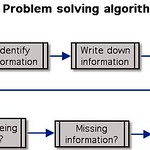
Problem solving processAs I said in 7 ways to make IT real: #0 Make IT unreal, setting the kids a problem like “Imagine you’re going to open a video shop” is not going to cut it these days. You either need to set problems that are outlandish and obviously unreal, or set them ones which are all too real.

I’d suggest that the best way of doing so is to get the pupils themselves to identify problems. That’s the approach taken by

Read More

7 Ways to make IT real: #1 Get local

mboneIt’s easy to take your local area for granted, but try to see it with new eyes. Try to see it as if you were a tourist visiting the area for the first time. You may be pleasantly surprised to discover just how much is noteworthy from a computing or ICT point of view. Whether you want your pupils to simply notice the use of technology, or wish to get them to figure out how things work or even to create their own digital assets, you won’t be disappointed.
Read More

7 ways to make IT real: #0 Make IT unreal

KL-43 Off-line/On-line Digital Encryption (Adaptation of language translator technology) late 70s-80sOne way to make ICT interesting is to make sure it is relevant to young people’s lives, and has a genuine connection to the “real world”. Indeed, these are required of Ofsted in order to achieve an “Outstanding” grade in ICT. I have referred to this as “authentic learning”. So, in the next few articles I will be suggesting ways of approaching this.
Read More