By Ben Davies
The trip to the Bett Show has always stirred feelings of both excitement and anxiety and this year's trip was no different. The excitement stems from the chance to spend the day immersed in education technology
 By Ben Davies
The trip to the Bett Show has always stirred feelings of both excitement and anxiety and this year's trip was no different. The excitement stems from the chance to spend the day immersed in education technology
 At last! Or, to use the vernacular, woo hoo! The latest edition of the Digital Education ezine is now out. It contains a round-up of products seen at Bett, articles on girls and women in technology, loads of links and book reviews. Here’s a detailed list of the contents:
 Being digitally literate is not just about knowing how to use programs or being aware of copyright law. It’s also about being able to ask the right questions. This is another reason to have a news section in your Computing lessons
 Like many Englishmen, the most important thing to me is having a decent cup of tea. So I was delighted when we bought a variable temperature kettle. This doesn’t just heat up the water to boiling point. It lets you select the right temperature for the kind of drink you have. But how does it work?
 I’ve long been an ardent advocate of spreadsheets. They can be an invaluable tool in business, education or any other field in which planning, cost or both are paramount. As far as Computing and ICT is concerned, they can be used for teaching modelling and computational thinking. However, they have been denigrated as being “just” an office tool, far removed from the exciting world of coding or robotics.
 I have suggested 5 reasons to have a Computing news section of your lessons. If you think that’s a good idea, here’s how to go about it.
 One of the ways in in which you can help enliven the Computing curriculum is to allocate some time in every lesson (yes, every lesson) to news. There are several reasons for this.
 "It’s true to say that the vast majority of children, whilst at different levels of risk, will not come to harm. But what can we as parents do to give ourselves a level of assurance that our children are safe and know what to do if they get into an unfamiliar situation, or one that makes them feel uncomfortable?" Alan MacKenzie gives some practical advice.
  “Young people can be sensible online – if they want to be”, says Ellie Gregson. Ellie offers a teen’s-eye view of staying safe online.
"Until adults move on from the dismissive and patronising position of ‘the online world isn’t real or valid’ we will continue to fail in the quality of the support we offer our children."
Simon Finch suggests a much more useful approach.

Being safe on the internet is vital. If you’re concerned about being safe on the internet or just want a few ideas of how to be safe you have come to the right place!
 Whether you're a newly qualified teacher starting out on your career, an experienced classroom practitioner, or somewhere in between, you will find something to take away from Terry Freedman's digital publication Go On Bore ‘Em, says Ben Davies.
 Every so often there comes along a new daft idea (or a newly-packaged old idea that has been mangled out of recognition (and thereby rendered useless) so that its “inventor” can be designated as a guru. Me? Cynical? Never!) One of the more unfortunate manifestations of this phenomenon was the three part lesson. It sounds good and logical, but then the thing that usually happens happened: Ofsted started insisting on it, and Headteachers demanded to witness it in every lesson. Woe betide the brilliant but hapless teacher whose lesson plans failed to include the three parts.
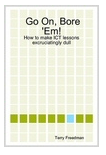 Mr. Freedman uses his extensive experience to write a clear and concise booklet on the different ways he has observed teachers instructing their students straight into boredom purgatory. But, he also explains how the lesson could have been changed to make it more interesting.
 I thought it would be interesting to dig out my scheme of work for Information Technology – as it was then then – from 1997. It was based on the Informatics scheme of work published by the now defunct organisation Acitt. Acitt was a subject association for ICT Co-ordinators. I helped to shape the Acitt scheme of work, but the one I used myself was a variation, adjusted to meet the circumstances pertaining to my school. I’ve reproduced it below.
(c) Terry Freedman All Rights Reserved