ICT and computing lessons should be organic

"Green Bar" Computer PaperStephen King, in his book ‘On Writing’, makes a very interesting point. Going against just about all the advice proffered in books and magazine articles, he says:

Plot is, I think, the good writer’s last resort and the dullard’s first choice.

You might be inclined to dismiss that as hogwash, but given King’s phenomenal success as a writer I’d suggest that would be unwise.

Read More

Stop Press! The machines have taken over!

the screamKevin Hodgson has written a make-believe article about technology taking over from humans. The theme is a well-known one in science fiction circles, of course, but what I especially like about Kevin’s article is that he has written in the form of a newspaper article. To do so he has used a fake headline generator, for which he provides a link in the story.
Read More

Computer help is not always helpful

Help PointIt’s very tempting to try to make life as easy as possible for end users by being proactive, ie anticipating what is likely to be useful to them, and then implementing that as a default option (or possibly not even an option, but compulsory).

Perhaps some of your students will be tempted, when designing a computer program for use by non-technical people, to make it as ‘proactively helpful’ as possible. If so, they should beware. A good idea would be to undertake some market research, if only of a rudimentary nature, to avoid the pitfall of merely annoying people.

Read More

The internet in a day

Here is an infographic that depicts what happens in an internet day. It goes through what happens in one second, one minute, one hour and then calculates the statistics for a day.

It’s interesting, though not – in my opinion – for the statistics in themselves. If big numbers impress you, then you will be impressed. Indeed, those whose mission it is to promote so-called 21st century skills and to prove that the current education system cannot cope with the new reality tend to use statistics like this to prove their point.

Read More

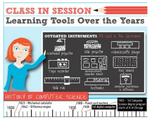
Learning tools over the years

Here’s an interesting infographic which looks at how the technology used in the classroom has changed over the years (or remained pretty much the same!). The only one of the “outdated instruments” I never used was a slide rule! How many of these do you remember? And please don’t send me messages along the lines of “Before my time, Terry.” I feel ancient enough when I look at things like this already!  The infographic includes the history of Computer Science.
Read More

We need ICT teachers, not facilitators

Teaching the youngster to feedWhen did ICT teachers stop becoming teachers and become ‘facilitators’ instead? I’ve largely managed to ignore this sort of nonsense but now it’s getting out of hand. The other day someone said on Twitter or Facebook that he is an ‘active facilitator’, while someone else shared a sign which read “I am not a teacher; I am an activator.”
Read More

An Interview with Naace ICT Impact Lifetime Achievement Award Winner Dr Christina Preston

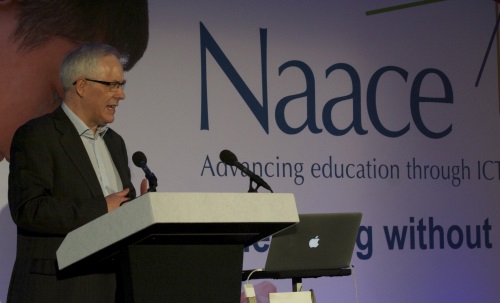
Christina Preston was one of two people given the Lifetime Achievement Award at the 2013 Conference of Naace, the subject association for ICT. I interviewed her to find out about her and her work.

Read More

Naace ICT Impact Awards - A Profile of Penny Patterson

Penny Patterson is on Twitter, but prefers to listen rather than talk, unless she has something of value to add to the conversation. She is active in ICT circles, though doesn’t have her own blog. And if you visit a conference she’s speaking at, you’re likely to chat to her while she serves the tea. She prefers, to use her own words, to be “one of the backroom team”.

Indirect evidence of this was seen in this year’s Naace ICT Impact Awards. When Penny was selected as one of the two people to be given a Lifetime Achievement Award, the look on her face was one of surprise, bordering on shock, and tinged with bewilderment. Typically, she told me that “other people deserve this award far more than I do.”

Read More

Lessons from Reviewing the new Computing Curriculum

discussionThis is not so much a review or even a summary of the recent Westminster Forum Conference called ‘Reviewing the new Computing Curriculum’ as a series of observations arising from it and related articles. The reason for that approach is that I’d like to make this article useful and interesting to as wide a range of people as possible, not only those concerned with the ICT or Computing Programme of Study in the National Curriculum in England and Wales.
Read More

It doesn’t have to be pink

Make my day, punkI turned my collar up against the wind. A useless gesture, because the wind contemptuously insinuated itself under my skin regardless, but it made me look hard. And hardness was needed in this job. I walked around the playground, glaring at kids who even just looked like they might be thinking of doing something wrong. Crowds of them parted as I approached. One looked shifty.

“You got a problem, son?” I gritted.

Read More

7 images of London

LitchtensteinI’ve had the enormous pleasure of having to go into London two days running! “Pleasure?!”, you say. “What? With all those people?” Definitely. In fact, it’s partly ‘all those people’ that make  it a pleasure. That, the architecture, the general buzz. I’m definitely with Samuel Johnson on this one:

Sir, when a man is tired of London, he is tired of life.

Which is partly why I always carry a camera around with me. As I explained in Pictures as stimuli, pictures can act as, erm, stimuli. You should always  carry a camera of some sort around you, and so should the kids you teach. Oh wait, yes, many of them probably have mobile phones that can take photos and video. Fantastic!

Read More

Reading and technology

Ebook readersWhat do you think of when you see the words “reading” and “technology” in the same sentence? I tend to think of e-book readers and how easy it is to transfer stuff to, and then read, on my phone. But there is more to it than that. According to Dyslexia Action, around one in ten students struggle to read standard print.

Read More

E is for… Equality

Digital FlowEquality is a big issue in education, especially in connection with technology. For example, we are used to hearing phrases like “the digital divide”. But what does “equality” mean in this context – or, more pertinent perhaps, what should it mean?

Read More

A Map of the Internet

You are hereI recently discovered this map of the internet through Stephen Downes’ newsletter, OLDaily. Downes says, “It’s mostly eye-candy, but it’s good eye-candy”. I prefer to think of it as “interesting” eye-candy. It’s visually attractive, but what I find interesting is the fact that the descriptions are not necessarily value-free.

Read More

5 ways to establish credibility on your blog

ezine-expert-authorI don’t know what it’s like living in other countries, but here in England we are fortunate indeed. If I want to have a discussion on any subject at all, I can simply walk into the pub nearest to where I happen to be at the time, where I am virtually certain to discover a self-styled “expert” declaiming about the economy, or what’s wrong with kids today, or how to solve the financial crisis, or whether or not kids should be taught how to programme, or how the entire education system should be put right.

Read More