 Quadblogging founder David Mitchell talks about what he saw at the BETT Show this year, and quadblogging.
BETT 2013 Interviews: David Mitchell
Quadblogging founder David Mitchell talks about what he saw at the BETT Show this year, and quadblogging. Quadblogging founder David Mitchell talks about what he saw at the BETT Show this year, and quadblogging.
 Edtech guru Andy Black talks about what wasn't at the BETT Show this year, and some of the trends he spotted.
 E-safety guru Simon Finch talks about why pupils should be allowed to use social media, why teachers should use it, e-safety and identity management.
 When a young man with dreams of becoming a writer sent a manuscript to Samuel Johnson for his opinion, Dr Johnson is reputed to have replied:
“My congratulations to you, Sir. Your manuscript is both good and original; but the part that is good is not original, and the part that is original is not good.”
I thought it might be interesting to look at 10 ideas that have gained popularity in the world of educational technology and ICT in recent years, to see if they meet the “good and original" test”. Here are my considered, though possibly opinionated, views.
 In this video, Yolanda Halston, of the Educational Apps Store, talks about pupils collaborating and other matters.
 The BETT Show is, I’m reliably informed, the biggest education technology show in the world. It takes place in London, England, every January. This year it was slightly later, but I’ll come to that in a moment. The first thing I’ll say is that even if you didn’t attend you may find this article interesting, as I suspect that several comments will apply to any education technology conference.
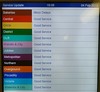 Here’s a photo I took recently on the London Underground. There are periodic announcements, static noticeboards, and electronic delays constantly assuring us that we are experiencing a good service. I presume it is intended to introduce a feel-good element into an otherwise mundane existence.
 When I first had email and an internet connection, it was made possible by using a dial-up modem. These modems were positively snail-like compared to today’s devices. For example, my first modem could transmit data over the telephone line at the blistering speed of 9 kilobytes per second (kbps).
 I will never understand why so many people think that Wikipedia is OK to use for serious research on the grounds that it is mostly reliable. Mostly? Some years ago I posited the idea of a wiki timetable, in which people get to edit train timetables how they like. Some of the information displayed on the electronic noticeboards would probably be accurate some of the time. Useful, eh?
 In a couple of hours’ time I will be distributing the latest version of Getting the Best out if BETT, which includes the views of over 30 people who attended last year’s BETT. Here’s a Wordle of what products they thought worth pursuing, the trends they spotted, and the advice they offer to schools in these straitened times.
 I recently discovered this map of the internet through Stephen Downes’ newsletter, OLDaily. Downes says, “It’s mostly eye-candy, but it’s good eye-candy”. I prefer to think of it as “interesting” eye-candy. It’s visually attractive, but what I find interesting is the fact that the descriptions are not necessarily value-free.
 There has been much discussion about the curriculum in general in England recently, and the ICT curriculum in particular. I wrote about the latter a few months ago, in an article entitled 5 Characteristics of an Ideal Programme of Study for ICT. Now, three months and two draft versions of a new ICT Programme of Study later, I should like to put forward a few comments, both about the area of “ICT curriculum” in general, and about recent developments in the UK in particular.
 Like many others, I find blogging a useful activity. So useful, in fact, that I think everyone involved in education should do it! Here, in no particular order, are my reasons.
 I recently discovered a fairly new educational technology and ICT news service. Published daily by UK ICT veteran Leon Cych, Learn for Life News is a welcome – and different – addition to the plethora of information sources currently available.
Why “different”? Because it is not just another source of news but, as Leon himself describes it, filtered news. Leon is acting as a human filter of what is currently being discussed on the UK ICT grapevine.
 Adobe has rolled out an exciting series of online courses called Adobe Generation, which are designed to help students between the age of 14 and 19 develop new skills that will put them in a better position when exploring career options in the creative industry.
 The general thrust of education these days is on student-centred learning. This is often expressed by depicting on the teacher’s role as being the guide on the side rather than the sage on the stage. Regardless of whether you agree that that’s how things should be (and as it happens I don’t: see Please! No More Mantras!), the often-stated philosophy these days is that students know best.
But does stating that philosophy mean that it is observed in practice?
 How I hate the word “narrative”! At least, I detest the way it has been usurped by smart-suited political advisers who say things like “We need a new narrative”.
But sometimes, like now, I get what they are talking about, though I prefer to use the word “story”. And my question is: what is the story, what is the whole experience, of ICT in your school?
(c) Terry Freedman All Rights Reserved

