8 Reasons to Look at the Books Page

Some time ago I set up a book page on this website, because I thought it would be handy to have all the books I've reviewed in the same place. It would also make it easy for readers to purchase books too.

What I have now done, to give the page additional value, is put a brief extract from each review alongside each book. If you like what you read, you can click on a link to be taken to the complete review; otherwise, you can just skip it and go on to the next one.

I think in due course I will probably have to create more such pages because that page is already starting to look rather long -- the number of books has been set to 25, but I may start a new page before then. I suppose I'll also have to figure out how to put them into alphabetical order, although it may be easier to create an index, or even just to leave it altogether: I have tested the website's search engine for finding books, and it works very efficiently.

I'd be interested in your views on such matters. I've devised a survey that will take about 2 minutes to complete and is anonymous. I hope you will be kind enough to use it to have your say.

Oh, and the 8 reasons referred to in the title of this post? Eight of the books have been reviewed and published on the page so far; there are several more to come.

Looking Back In Wonder (That We Achieved Anything At All)

I was struck by Lisa Nielsen's article, There is Such a Thing as a Free Lunch: 8 Free and Easy Ways to Begin Educating Innovatively, because just a couple of days ago I was ruminating on how things used to be.

And feeling glad that they're not like that any more.

Lisa says "The best tools in life are free…at least for educators. There is such a thing a free lunch.”. And whilst I disagree with the free lunch part, as I've explained in my 'non-review' of Chris Anderson's latest book, Free, I most certainly agree with the statement that there are tons of tools available which are not only fantastic, but free of charge.

Now, I am absolutely not one for nostalgia: I believe that, for the most part, the best thing about the past is that it's past. And technology is a case in point. It's only 12 years since I was in the classroom, and in that time the landscape has changed unrecognisably. But if you weren't teaching then, you might not realise it: people never truly know what life was like before the technology they use was ubiquitous, a point made in a recent article I wrote based on a cartoon.  

To get a feel for how, I'd like to show you what it was like not by discussing changes in technology or economics (although those things are implied) but by sharing with you what my main two concerns were just over a decade ago, as far as resourcing was concerned. The overarching theme here is quite simple: how to make technology accessible to my students.

One of the things I spent many hours doing was looking for a low-cost alternative to Microsoft Office. I have nothing against Microsoft Office. Indeed, of all the tools I've used, I still think Word and Excel are the best. But that was part of the problem. There were  low-cost alternatives to Word and Excel, but the features they cut down on were either essential in curriculum terms, or simply made life difficult, or more difficult than it needed to be.

For example, if you can't remember how a function works in Excel, as you type it in some bubble text appears showing you the syntax. If you still can't figure it out, just press Shift-F3, and a dialog box appears which 'talks' you through it. I don't know about now, but at the time other spreadsheets, especially the cut-price ones, didn't have that.

My philosophy is: why make the tools themselves hard to use, when what you really want the kids to do is use them to solve problems? You know, if I want to measure up my room for a new carpet, I don't want to have to spend a day figuring out how the tape measure works.

Another concern was to increase the amount of kit we had and, crucially, to put it into the students' hands. Thus it was that I found myself spending hours and hours looking through used or discontinued laptops, preferably with adequate software preinstalled.

Unfortunately, even if the software was OK (rarely), the cost of even the cheapest usable laptop was such that, if I was really lucky, I might be able to obtain three or four of them.

I once spent a day driving down to a company in Kent that was getting rid of a whole load of computers, loading them into my car, driving back up, and unloading them, only to discover that they were more or less useless to me. It wasn't a complete waste of time, because the design and technology department took them off my hands, and used them for running some basic word processing and computer aided design programs. But even so....

To summarise, 12 years ago both software and hardware were expensive, and one result of this was that ICT (Technology) Co-ordinators spent half their time looking for ways of increasing their resources to a reasonable level without breaking the bank. Of course, that's exactly the situation now, and it probably always will be.

However, my point is this: in this regard, things are infinitely better than they were even just ten years ago. And the reason for saying that is not to indulge in some sort of inverse one-upmanship about how bad things were in the 'old days', but to suggest that perhaps people, like those two old fossils in Lisa's story, who really cannot see that things are nothing like what they were should be getting their retirement plans in order. As Bob Dylan said:

"Your old road is
Rapidly agin'.
Please get out of the new one
If you can't lend your hand
For the times they are a-changin'."

Cross-posted on the Technology and Learning website.

50 Ways to contribute to a website

This article has been superceded by this one.

Please note:

In view of the implementation of the Online Safety Act in the UK, I am not accepting guest articles until further notice.

I love having guest contributors to this website and the Computers in Classrooms newsletter, because it provides more variety. However, not everyone likes writing. If that applies to you, or your pupils or students, there are several ways in which you – and they – can contribute.

I've written this relatively objectively because these suggestions would apply to contributing to any website or blog I should imagine, not just this one. Indeed, one or two of them don't apply to this one at all at the moment, such as contributing to a forum.

Also, the list is almost certainly not complete. If you have any other suggestions, do let me know.

If you're a website or blog owner, you might find this list useful as a way of suggesting to your own readers how they might contribute to your efforts.

  1. Write an article.

  2. Write a poem.

  3. Write a special type of poem, like a limerick or a haiku.

  4. Write a song.

  5. Write a special type of song, like a rap song or a blues song.

  6. Write a play (but not a full-length one please!).

  7. Write a special type of play, like a play for one person.

  8. Draw a picture.

  9. Draw a special type of picture, like a cartoon.

  10. Design a quiz.

  11. Design a special type of quiz, like a word search or a crossword.

  12. Create a presentation in SlideShare. The beauty of having an online newsletter is that your presentation can be linked to, or even embedded.Create a video.

  13. Create a special kind of video, like a 12 second one .

  14. Make a podcast.

  15. Make a special kind of podcast, like an interview with someone who uses technology in interesting ways.

  16. Review a podcast.

  17. Review a SlideShare presentation.

  18. Review a software application.

  19. Review an item of equipment.

  20. Review a service.

  21. Write a case study of practice you know about.

  22. Write a report on something you've tried out in your classroom.

  23. Write a report on something you're thinking of trying out in your classroom.

  24. Write a lesson plan.

  25. Write a lesson resource.

  26. Review a website.

  27. Write a how-to crib sheet.

  28. If you're representing an organisation, take out an advertisement in the newsletter. 

  29. If you're representing an organisation, place a sponsored article in the newsletter.

  30. If you're representing an organisation, offer a book, some hardware, or some software for review.

  31. If you're representing an organisation, offer a book, some hardware, or some software as a prize in a competition. I've run competitions from time to time, and they always go down well.

  32. Proofread a newsletter issue.

  33. Contribute to a survey (I always try to ensure that they never take more than 10 minutes to do).

  34. Leave comments. Sometimes it feels like nobody is reading anything, especially in the early days. Fortunately, I receive comments through email, Twitter and Facebook, but if someone has just started out, as it were, they need some encouragement to carry on.

  35. Send the author a comment by email. At least s/he will know that someone is listening!

  36. Contribute to a forum on the website, if there is one.

  37. Make suggestions for improvements.

  38. Write an article about something they've written, with a link back to their article.

  39. Offer a White Paper or similar resource for them to review -- as long as you don't make it conditional on a positive recommendation.

  40. Share articles you like via Twitter and other networks.

  41. Suggest a reading list for readers.

  42. Suggest a blog list for readers.

  43. Suggest a podcast list for readers.

  44. Suggest a video list for readers.

  45. Send in a photo or a link to one.

  46. Report on a conference, especially if it's one that the website owner was unable to attend.

  47. Offer to report on a conference session. Parallel sessions are the bane of our lives in some respects! Being able to attend one session and report on two or three is the stuff of dreams.

  48. Take part in an interview, via email or Skype.

  49. Invite the author to take part in a discussion. I love being invited because it means I make contact with people I may not otherwise have come across.

  50. Contribute in a way that I haven't yet thought of.

If any of these suggestions appeal to you as a way of contributing to my efforts (ed tech-related only, please), please look at the notes and terms & conditions.

If you want privacy, start by being private

Derek BluntDerek Blunt is ranting again...

Alexis de Tocqueville said:

"In a Democracy, the people get the government they deserve."

Maybe the same applies to privacy? People seem to be upset about the so-called lack of privacy these days, or about private information going missing, but I don't notice people being that worried about such matters in their everyday lives. In a (definitely not) highly scientific survey I witnessed the following on a recent train journey in which the carriage was packed (that is to say, there was a large audience):

  • Someone yawned, and treated us all to a first class view of his tonsils.
  • Someone was discussing his company's business plan with his business partner on his phone at the top of his voice.
  • Someone else was making her personal arrangements at the top of her voice.
  • Someone else let his friend -- and all of us -- know exactly what he told his boss to do with his job.
  • Someone else spent the entire journey putting her make-up on.
  • Someone else picked his nose without bothering with such niceties as a tissue.

Was I just unlucky in my choice of fellow travellers? Or does all this signify a deeper malaise in our society, characterised by an absence of any sense of what is appropriate behaviour in public?

If enough 'ordinary' people don't care about maintaining their privacy and a sense of decorum, why should any government?

Derek Blunt: Blunt by name, blunt by nature.

Review of The Edge of Madness

In What would happen in a national cyber attack? 23 suggestions for tackling this issue in the classroom I looked at ways in which teachers wishing to explore the idea of cyber-warfare, ie the possibility of one country waging war on another by attacking its computer infrastructure, might go about doing so. A terrifying thought, if you think about it, and possibly something that has already happened to Estonia.

Interestingly enough, The Economist ran a story about this subject, and the outlook is not good. The biggest threat comes from small groups or individuals, much like the terrorists threat with which we're already familiar. In such a scenario, there would be no clear target to attack, even if one could, so the best option is to beef up the defence against such an occurrence.

Frankly, the UK's record of even such a simple thing as looking after people's data when it's in a digital form (see Dealing With Data Loss: A Look at the Problem and a Possible Solution for a summary of the problem) is so appalling that I can't imagine there are enough people in the corridors of power who would even to begin to have a sufficient grasp of the issues. The problem isn't necessarily with the people at the top, but the administrators. As I said in a talk I gave at the Westminster Forum:

[There needs to be] ... An insistence that all teachers become computer literate to some extent. Why is it acceptable for people to remain ignorant about technology basics in this day and age?

This is getting to be a hot topic. Information Age ran an article on Gary McKinnon, a hacker fighting extradition to the USA because of his activities. In it he said:

We do need to be prepared for cyber-economic warfare: I know that sounds futuristic and alarmist, but it is coming. There will be attacks on financial centres.

The Edge of Madness is author Michael Dobbs' attempt to explore the cyber-warfare scenario through fiction. Now, I'm not a techie when it comes to what's possible or not in this area, so whilst reading the book I was constantly wondering about that. My worst fears were not much alleviated by the author informing us, after the end of the book, that the stuff in the book was only slightly exaggerated. He states that:

I have taken dramatic licence with much of what they [two experts] have told me, although in truth it seems difficult to exaggerate the potential for cyber skulduggery.

Dobbs has a facility for touching a nerve. Everyone in Britain remembers his House of Cards even if they don't even realise it. The expression "You may say so, but I couldn't possibly comment" has entered the language as the verbal equivalent of the nudge and wink in the world of realpolitik.

This his latest book is no disappointment in that regard. The title might just as well have been "Edge of your seat", because there are two terrifying scenarios unfolding at once. On the one hand, China is in the process of wreaking havoc without sending a single soldier or missile anywhere. On the other hand, the leaders of Russia, the USA and the UK are attempting to devise a solution to the problem when they can't even be in each other's company for five minutes without trying to score points off each other.

In a sense, that's the real worry. When you watch films like Independence Day, you're invited to believe that in the face of a terrible external threat erstwhile mortal enemies would put their differences aside and fight the common foe. Hmm, well, we can but hope.

I think a particularly skilful characteristic of the book is the way Dobbs weaves in real life events, like Chernobyl. So all the time you can't help wondering: does the author know something I don't?

I would definitely recommend this book. Buy it for yourself, and order it for your school library (if there still is one!). If you do decide to explore the possibility of cyber warfare as part of your approach to considering the effects of technology on society, it will be good to make this one of the reference sources. You can order it via this website.

And if the film of the book ever appears, order your students to go see it!


Dealing With Data Loss: A Look at the Problem and a Possible Solution

I once wrote, somewhat flippantly but not entirely jokingly, that if you live in the UK and pick up a newspaper on any particular day there is almost certain to be yet another news report about a government laptop going missing. The very next day another of those articles appeared. My perception is that things have improved since then, but that could be because little has occured for a while on a large enough scale, or frequently enough, to warrant the attention of the mass media.

The sorts of disaster I'm talking about include the occasion when it was reported that the UK's tax website had to be closed temporarily because:

"a memory stick containing confidential pass codes to the system was found in a pub car park."

That was repeated again a few months later, along with another article stating that according to official figures, one official is disciplined over data loss every day. And if that's the "official" figure, there is no doubt in my mind that the actual figure is higher. I wonder what it is when you take into account private companies "losing" data, or Local Authorities "losing" data?

I've even attended a seminar on the subject of missing data and laptops, where a number of experts gave talks on the problem. But it seems to me that the problem could actually be solved very quickly by changing the way we think about data.

One of the aspects of many ICT courses is the effects of IT on society. Perhaps this opinion piece (which, as you will see, is backed up by facts and figures) might be used as the starting point for a debate and other work on the subject.

The phenomenon

For those outside the UK who may not have heard about this phenomenon, these are basically what seem to be the common features of these cases.

1. Someone, for reasons best known to themselves, leaves their place of work with a laptop or memory stick containing personal data details of thousands -- or in one case, 25 million -- people.

2. They leave the laptop or usb stick on a train, back seat of a car or other equally safe places.

3. Someone discovers it and reports it to the authorities or the press.

4. There's a press release assuring us that the data was encrypted, but they've changed everything anyway, so there is no need for anyone to worry.

5. The person who lost the item is reprimanded or fired.

6. There's a lot of wringing of hands, promises of internal inquiries and so on.

7. It all goes quiet as the media focus on the next organisation to lose a load of data.

Terminology

To my mind, there is something wrong with the word "loss" in this context. I'm not sure exactly what the right word would be, but I think of it in much the same way as road accidents. Traffic "accidents" tend not to be called "accidents" these days, because most of them are caused by human error. The word "accident" conveys a sense of "not my fault", when actually most road crashes are someone's fault, as opposed to, say, mechanical failures or acts of God.

In the same way, losing thousands of people's details is not simply accidental, as the term "loss" implies. To leave a laptop lying around or to lose a memory stick in the street surely suggests a lack of attention. We all lose stuff -- I'm always putting things down and then retracing my steps mentally to work out what I did with them -- but I can assure you that when I leave the house with something really valuable, like my passport, I go to absurd lengths to prevent losing it, such as using a bulldog clip to attach it to the inside of my pocket. Or, despite wearing a jacket with zipped pockets, I check that it's still there every 5 minutes.

But wait...

Why do people feel the need to take such huge amounts of data away from the office in the first place? I've been working now for nearly 35 years, and in all that time I have never taken home the kind of data that seems to go missing virtually all the time now in the UK. If I did take data home, it consisted of pupils' names and their exam grades. School registers, which contained pupils' names and addresses and phone numbers, were never allowed off the premises.

These days, if people have to work from home, they should be able to access the data they need over a secure internet or extranet arrangement. I just don't see why there should ever be a need to physically remove the data from the place of work.

What to do about it?

Health and safety

As long as people continue to think of data loss as losing "data", there is never going to be a real appreciation of the possible consequences of the data loss in human terms. There have been cases of armed forces personnel details going AWOL, fugitive criminals' details, financial records going missing . See this article for a summary of this pretty bleak picture as it stood in August 2008, and then this article for more examples from the first few months of 2009. Just last month someone walked into a council office and walked out again carrying a laptop containing over 14,000 people's names and other details.

So surely the first thing we should do is redefine data loss as a health and safety hazard? According to a report last year into identity theft:

"More than 49% of the respondents reported stressed family life, 22% felt betrayed by unsupportive family members and friends, and 23% said their family didn't understand.

The strongest feelings expressed were: rage or anger, betrayal, unprotected by police, personal financial fears, sense of powerlessness, sense they were grieving, annoyed, frustrated, exhausted, sleep disturbances, an inability to trust people, and the desire to give up and stop fighting the system. ITRC long term emotional responses included: 8% felt suicidal (my emphasis), 19% feeling captive, 29% ready to give up and 10% felt that they have lost everything."

When we discuss e-safety with kids we talk about the need to keep their identity secret from strangers. There's an inconsistency if we fail to regard the losing of data, which could clearly lead to identity theft on a massive scale, as a health and safety issue too.

Now, if a company was poisoning its employees or the local populace with toxic waste or a contaminated water supply, they would risk being fined. The directors could even find themselves arrested on a charge of corporate manslaughter. I wonder what effect it would have on data loss if employees and their managers knew that if a memory stick ended up in a rubbish tip or whatever they could end up facing years in prison?

Learning from schools

Schools in the UK are subject to inspection every so often, and are also obliged to undertake self-evaluation. Why shouldn't companies have to do the same, and be expected to show high standards, and improvement over time, on a range of criteria, including data security?

Learning from photo libraries

If you're in the media business in the UK, and you need to hire photographic transparencies from a photo library, don't lose or damage them. Why not? Because you're likely to be fined between 400 GBP (630 USD) and 600 GBP (945 USD) for each one.

What if, applying this principle, companies or government departments were fined for each unit of data they lost? Even if only £1 per item was levied, losing 25 million names would be a costly business. Or do we as a nation think that in principle photos have more value than people?

Over to you

What do you (or your students) think of my suggestions?

This is an updated version of an article which appeared in 2008.

The Well-Fed Writer, by Peter Bowerman

Reviewed by Terry Freedman

The Well-Fed WriterWhat's a book on writing doing in a publication about educational ICT? Looked at from one point of view it's completely out of place. However, that is not the only perspective available. Much of the ICT curriculum centres on the concept of audience. Whether it's preparing a presentation for a particular audience, or responding to user feedback, the work requires an attention to someone other than oneself, and something other than the technology. Peter Bowerman, the author of TWFW, has managed to forge a living out of writing. It follows, therefore, that he may be able to teach us something about audience, and have some useful web resources up his sleeve into the bargain.

The book is, in effect, a marketing manual for the would-be serious freelance writer. Thus there is much about how to choose products and services (free is not always second-rate compared to exorbitant, it turns out), and how to approach potential clients. There is good advice about website design and what you should provide on the site, a wealth of websites to explore, and guest sections by other writers (including a few I've come across in the blogosphere, and whom I respect as writers).

There are a couple of niggling things. One is that although Bowerman makes it clear that social networking is very important in today's economy (schools that ban them, please take note), he admits that he himself isn't a member of any of them. That is disappointing because he may have been able to distil into a few bullet points the best way of making contacts in such spaces from his own first-hand experience.

As far as I can tell, there is no information about print-on-demand. Given that writers can be their own publishers these days, a section on that would not, I think, have gone amiss. There was a section about it in his companion book, The Well-Fed Publisher, in which he disparages the use of PoD (although at that time Lulu had only just appeared on the scene, and Bowerman himself had not used it yet).

However, given the readability of the book, such annoyances can be overlooked. Although the jocular (in parts) tone can start to sound a bit forced occasionally, it more often has the effect of making you want to look up that website or read such and such a blog.

Bottom line:

Perhaps not the most obvious choice for an ICT department in a school, but full of hidden gems and a cornucopia of resources. Buy it.

Related article: The case for print-on-demand.

A Teenager's View of Social Networking and Digital Citizenship

MillerElaine and I had the pleasure of chatting to Miller, a 15 year-old girl living in the USA. It is so refreshing to listen to someone who is so level-headed when it comes to issues such as cyber-bullying. It is also interesting to hear how blogging and other web 2.0 applications helped Miller to find her writer's voice within, and to deal with some difficult situations.

There is a lot in this: how her class handled a setback created inadvertently by Google, how their teacher laid down the rules and gave tuition on internet safety right up front, how their other teachers are learning from Miller and her classmates, and a lot more.

The stories I mentioned in which Facebook was involved are here:

Facebook and suicide prevention

Facebook and bankruptcy prevention

Her teacher, Vicki Davis, made the following comments on the recording:

Actually, the middle schoolers aren't using Jott; they are using cell phones in English. They are using Jott to proofread papers. We just use it for 9th grade (Year 9) but they just started charging so we had to discontinue it. That was pretty recent so Miller may not know it. I actually just canceled my Jott account but they were using it like crazy in the fall. Miller doesn't use the features requiring premium Jott.

I actually do not like Jonas brothers chat rooms, etc. That is a place for a lot of predators -- Woogi world is better than Club Penguin. But Miller and I differ on our opinion on that one.

On the issue of over-familiarity between students and their teachers, Vicki said it wasn't an issue in her school because it's a small community in which many people know each other anyway.

Miller mentioned PowerSchool. Their website is here.

The recording lasts just over 25 minutes.


Miller has also written a fantastic article for the Computers in Classrooms newsletter.

Acknowledgements

Thanks to Vicki Davis for her help and support in setting up this interview, and to Miller for her time.

The music after the introduction and at the end is Simple Soulman by The Groovebusters. The music is under a Creative Commons licence. Hear the band at:
http://www.garageband.com/song?|pe1|S8LTM0LdsaSkYFexYGE

Disclaimer

Miller's views do not represent the views of her school, her teacher, nor any other organization which she belongs to, but are solely her own views and opinions.

If you enjoyed listening to this, you may also enjoy hearing our interview with Edith, and English teenager.

Computing at School

Last night I attended the Owers Lecture on the subject of "Can we reverse the decline in schools' computing, especially with girls?" (I'll report on this in due course.) As the group called Computing at School was mentioned a lot, I thought I'd reproduce the following article from the April 2009 issue of Computers in Classrooms. The conference mentioned has, obviously, been and gone, but I think it's worth retaining that information for the links and because the agenda is interesting in itself.

The group has recently produced a glossy magazine (insofar as a pdf can be described as 'glossy'!) and some teaching materials, which I intend to review.

My own interest in this (as it's now de rigeur to declare one's interest, however slight) is that I love messing about with programming, having dabbled in Visual Basic and Visual Basic for Applications. Indeed, my chapter in the Year 8 book in the ICT 4 Life series is all about addressing the sequencing aspects of the National Curriculum through the use of VBA in a  spreadsheet.

There is a looming crisis in the world of computing, says Roger Davies.

As the speed of technological developments increases and with it the need for ever greater rdaviesthumbnail1numbers of computer scientists, researchers and technologists the numbers opting to study computing in higher education have halved in the last ten years. There are many reasons; the image of the discipline, the lack of a coherent study pathway in secondary education, limited exposure to any computing before 16 to name just a few. Post 16 the numbers studying Computing are small. As a result, Computing teachers often feel isolated and face difficulties keeping up-to-date.

It is ironic that as ICT becomes increasingly ubiquitous, fewer children are being taught the fundamentals of computing, in particular programming. Bright students, of the kind who might make a career in computing, often progress in spite of, not because of, their school education.

Yet many children are curious about the technology we take for granted. They want to know how Google finds so many hits so quickly, and how it ranks them. How does an email get to its correct destination? How does file compression work? It is computing that gets i-tunes onto their mobiles, allows them to stream videos from across the world and buy things safely online.

In recent years, diverse groups of enthusiasts have sought to bring these concepts to life in a way that is understandable for children. For example Queen Mary College produce CS4Fn – a magazine aimed at secondary age pupils with a wonderful supporting website. Based at Glasgow University, Computer Science Inside have worked with teachers to develop a growing number of resources and in New Zealand the Computer Science Unplugged team have produced a marvellous collection of classroom activities to demonstrate computing concepts without the need for a computer.

If the thought of programming conjures up visions of blank faces staring at incomprehensible lines code it is time to rethink. There are many exciting resources that aim to introduce children to programming in enjoyable and engaging ways. GameMaker (developed at Utrecht University), Greenfoot, (Kent University), Scratch (MIT) and Alice from Carnegie Mellon are just some of the excellent free tools finding their way into schools.

The recent revision of the National Curriculum, with a new, welcome focus on sequencing provides an opportunity to replant the computing flag within our Key Stage 3 (11-14 years old) ICT provision. Computing has a rich and deep tradition and it is time for teachers to rediscover it. Programming teaches children the skills to dissect problems, understand the logic and sequences that lie behind solutions and be able to construct those solutions so a computer can execute them. These foundations provide generic and extendable skills that have value in many spheres beyond IT. As Nicolas Negroponte (architect of the OLC project) commented:

"Computer programming is a powerful tool for children to 'learn learning,' that is, to learn the skills of thinking and problem-solving... Children who engage in programming transfer that kind of learning to other things."

There is something special in pupils being able to get a computer to dance to their own tune. In my experience computing projects are highly motivational because of their capacity to make pupils think and stretch them. But above all else, they can be fun. One of my Year 9 (14-15 year old) pupils observed, on completing a unit using GameMaker:

“That was great. You normally teach the boring bits of my Mum’s job”.

‘Computing At School’ is an open, informal working group of enthusiasts that aims to promote Computing at school. Its membership is broad including teachers, examiners, parents, LEA advisors, university faculty, and employers. CAS was born out of our excitement with the discipline; a key goal being to put the fun back into teaching computing.

We would like to invite fellow teachers to an inaugural conference at Birmingham University on June 19th. Speakers will include Tim Bell (http://csunplugged.org/), Paul Curzon (http://www.cs4fn.org/), Michael Kölling (http://www.greenfoot.org) and Quintin Cutts (http://csi.dcs.gla.ac.uk/) amongst others. We hope this free event will provide an excellent opportunity to explore new ways to bring computing into our classrooms.

We hope the conference will provide a basis for creating an organization similar to the American Computer Science Teachers Association which has done much work to support teachers and promote a passion for computing. Please come and join us.

Further details about the conference and booking details can be found at http://computingatschool.org.uk/files/CAS_Conference_2009.pdf or by mailing conf2009@computingatschool.org.uk

Roger is Director of ICT, Queen Elizabeth School, Kirkby Lonsdale, Cumbria. He started the social network http://aqacomputing.ning.com/ which aims to provide a self help group for teachers involved in A Level Computing. He is a member of the CAS Working Group.

How good is the teaching of ICT? An interview with Edith, an English teenager

EdithWe're always interested in hearing the views of young people, so it was with great pleasure that Elaine and I interviewed Edith. Edith is a teenager living in England, and has some definite views about the teaching of information and communications studies (ICT).

I saw her, not for the first time, at a recent Teachmeet and was struck by her statement that she, and her peers, were being 'under-taught'. This ties in with what I reported in a recent newsletter:

"It's been found recently , by Ofsted, that teachers tend to teach ICT up to the limit of their own knowledge, and that this effectively holds children back."


In this interview we explore this and other issues. The podcast lasts just over 19 minutes.


The music after the introduction and at the end is Simple Soulman by The Groovebusters, and is under a Creative Commons licence. Hear the band at:  

http://www.garageband.com/song?|pe1|S8LTM0LdsaSkYFexYGE

Edith is 14 and attends school in England. She has spoken at Teachmeet events, such as the North London Teachmeet in 2009.

To respond to Edith, please submit a comment in the comments area below, or send me an email.

If you enjoyed listening to Edith's views you may also like our interview with Miller, an American teenager. That will be posted here on the 11th December 2009.

And you will probably enjoy the following: What are your kids learning while you're not looking?

That was the title of a presentation that Miles Berry and I did at the BETT Show 2009. Based on original research, it made it very clear that teachers make life more difficult for themselves, and less than interesting for their students, by ignoring what their students can already do.

For more information, including a link to Miles' blog on the subject and a slide show, see my article on What are your kids learning while you're not looking?  There is also a more up-to-date article I wrote for the IFIP newsletter, which is based in India.


21st century skills do not exist; here are 9 skills that do

Guest blogger Derek Blunt suggests what the real 21st century skills are.

Has there ever been such a frenzy of thinking and activity over a concept which does not even exist? I am referring, of course, to the ridiculous notion of so-called '21st century skills'.

Bloggers, teachers, employer organisations and even governments have fallen over themselves to produce documents 'proving' that 21st century skills are essential in the 21st century. Papers have been written. Rubrics have been created. In England the National Curriculum itself has been perverted from its course to include 'Personal Learning and Training Skills' (aptly pronounced, generally, as 'pelts').

I am surprised that I've yet to see jobs advertised: "Wanted: Dynamic Director of 21st Century Skills"; "Needed as soon as possible: 21st century skills co-ordinator."

The truth of the matter is that there are no such things as 21st century skills, only the skills that have always enabled people to get on in their lives since time immemorial.

Think about it for a second: 21st century skills can't include technical ability, because technology is changing so rapidly that what is far more useful is an ability to learn, and an ability to be flexible. Since when was that not the case?

Before the Industrial Revolution, people had to learn to be flexible when the harvest failed, or when the local squire decided to hog all the produce for himself.

During the Industrial Revolution, people had to learn new skills, and almost certainly didn't finish their working lives using the same skills as they started with.

Perhaps the pace of change was slower, in which case perhaps a candidate for the title '21st century skill' might be the ability to cope with change taking place at a breakneck speed. I haven't seen that on any syllabus or rubric.

So what are the skills which are essential to every young person? They're certainly not the wishy-washy 'soft skills' like 'being a good team member', which is not even something you can measure. No. Any decent educational system will make sure that young people leave school being proficient in the following:

  1. Ability to size people up instantly. We don't have time to mess around with people who are going to mess us about or, worse, rip us off. An ability to spot charlatans and other ne'er-do-wells instantly and to act accordingly is essential.
  2. Aye, and there's the rub: to act accordingly. Too often we don't, choosing instead to ignore first impressions and intuition and to give the miscreant the benefit of the doubt. Malcolm Gladwell, in Blink, has convincingly shown us that making near-instant judgements is natural and normal. A good education system will teach youngsters to listen to that inner voice, regardless of what their reason is telling them.
  3. Next, an ability to network is crucial. What matters in the 21st century is being connected, both offline and online. All young people should have to take some form of Enterprise education in order to develop their networking abilities.
  4. A corollary of this is that a good school will ensure that every member of staff and every pupil belongs to a social network. It can be a closed (Ning) network if Facebook is felt to be too risky. People have to learn how to behave in such environments, which are becoming part of the normal work and leisure landscape in modern societies.
  5. Manners. We seem to have reared a generation of young people who feel that the world owes them a living and that grunting and snarling are appropriate forms of behaviour. You only have to look at the behaviour of the people who are rejected early on in shows like the X Factor or American Pop Idol. How many of them say, "Thank you, panel. That is a really useful piece of free advice given by three experts at the top of their game."
    Not a bit of it. What you see instead is the all-too-familiar curl of the lip and the barely decipherable mumble along the lines of "You'll be sorry you missed this opportunity when I'm famous!"
  6. An ability to write. I have no issue with text-speak. Used in the proper context it's fine. But I expect to see apostrophes used correctly, and not see a comma when a semi-colon should have been used.
  7. Skill in making small talk. Schools should run simulated parties in which pupils learn key skills like how to hold a glass of wine, how to make light conversation, and to how to talk without spraying their audience with the mushroom vol-au-vent they've just put into their mouth.
  8. An ability to change course almost at the drop of a hat.
  9. Finally, how to think, and how to put a logical and coherent argument together are absolutely critical. To this end I would make Computer Programming compulsory from the first grade of primary school to the final grade.

Twenty-first skills? On the contrary: what we need is a return to the basics which have served people well for as long as anyone can recall.


Derek Blunt: Blunt by name, blunt by nature.

The Case for Print-On-Demand

Terry Freedman's PoD books

The article below was first published on 20 December 2006. It still stacks up now, but I have one or two additional comments to make at the end.

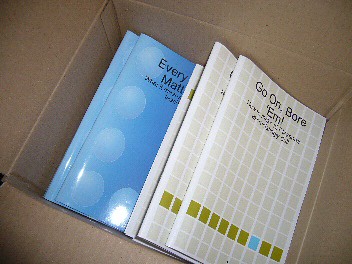
What could be better than receiving a box of books? Receiving a box of books that you wrote, of course! Is there a place for self-publishing in schools?

The books I refer to are the two booklets I wrote, on Every Child Matters and Boring ICT lessons. These were produced by print-on-demand, through Lulu, but published by, an therefore assigned an ISBN number by, Terry Freedman Ltd.

I ordered 10 copies of each in order to be able to comply with the UK requirement to send 6 copies of a newly-published books to various libraries and agencies. And that, of course, leaves 4 copies of each for me to send to reviewers and casually leave lying about when guests come to the house....

But isn't this just a case of vanity publishing? Well, yes and no. "Yes", in the sense that you pay the costs of having it printed and bound, whereas in mainstream publishing those costs are borne by the publisher. And "Yes" in the sense that if it's a niche product it would be hard to find a mainstream publisher that will take it on, which leaves doing it yourself as the only option. But "No" in the sense that if, as in my case, you have been approached by mainstream publishers and declined their advances and therefore made a free choice about whom you want to publish your book. And also "No" if the book has virtually no market at all (cf The Long Tail), which is what I should like to consider now.

Print on demand is a very good option when you need  very few, perhaps even just one, copy of a book. The origination costs, ie the fixed costs of setting up the book, are not spread over a large number, and so the fixed cost per book is relatively high. On the other hand, you don't have the twin problems of trying to find (a) start-up capital and (b) room to store hundreds of copies. In the case of Lulu, it's easy to amend the text of your book very quickly too, which in education, and especially the educational technology field, is a must these days.

So, what does all this mean for the ICT (Educational Technology) leader in a school?

I have long believed that if you want people to take something seriously and treat it with respect, it has to look good. What can look better than a publication which looks like it just came from a bookstore? Most schools do not have the facilities to be able to even begin to compete.

So, if I were a Head of Department or subject leader in a school now, I would use Lulu for a number of purposes:

  • The staff handbook
  • The 3 year strategic plan
  • Information about assessment
  • A year planner or calendar with important internal events (like report deadlines, term dates) and external events (like conferences) pre-filled in.
  • Students' completed projects (added Dec 09)
  • Students' leaving portfolios (added Dec 09)


If you wanted to produce your own textbook to distribute to all your students, it may be better, because cheaper, to go down a more traditional self-publishing route. That means, finding a printer who does short print runs, ie 500 or 1000. The biggest barrier to this avenue is the advance cost.

I'm not convinced that such a strategy would be cost-effective: On the one hand traditionally-published books are much cheaper as a rule. On the other hand, it's hard to beat the cost of a ring-binder and handouts or, of course, an online collection of resources.

But for the purposes of boosting your team's morale and creating a great impression with inspectors, having a dozen each of a few publications printed is hard to beat.

Reflections, two years on

Having read this article again, two years after I wrote it, the question arises: do I still agree with it? Broadly speaking, the answer is 'yes', but it's not quite as simple as that.

It is definitely the case that print-on-demand works out more expensive per copy than going to a short-run publisher. However, the issue for me would be: how many copies are required, or are you likely to sell? In other words, the more narrow the niche, the more attractive becomes print-on-demand. So if, say, you want enough copies for your ICT team and perhaps a few more to hand around, I would think that print-on-demand is the way to go.

However, I would not recommend print-on-demand for fiction writing if you can possibly avoid it. Self-published fiction is still associated with rubbish that is not good enough for mainstream publishers to bother with. I think that perception is slowly changing, because most new writers simply do not get a look in these days, and there have been some notable self-published successes. (Update: I accidentally referred to 'non-fiction' in this paragraph in the original version; I have corrected this, although hopefully the context, and the following paragraphs, will have indicated that I'd made the error, which was a slip of the pen as it were.)

In fact, if you have the stamina and the time, there is probably a case for saying that the best thing you can do is self-publish your novel (say) and market it incessantly in the hope that it will come to the attention of a mainstream publisher. But don't count on that happening, not least because you will be hard-pressed to even get it reviewed.

There's another caveat here. The CEO of Lulu didn't do anyone any favours when he said earlier this year that Lulu publishes the worst collection of poetry in the history of mankind. (See this article for a report on that by Angela Hoy, and this article for a follow-up.) I should not go so far as to say that he did a Ratner, because everyone knows that Lulu does not edit manuscripts (you'd have to purchase that service as an extra), and that many, probably most, self-publishers have received 'critical' acclaim from nobody other than themselves and their families and friends, who for the most part are too caring and too polite to say, "Sorry, but you just can't write. Take up painting instead."

Even so, I don't think comments like that help the general perception, based on a bygone era which possibly never existed, in which manuscripts were either eagerly snapped up by publishers willing to invest money and time into them, or were taken to a vanity press.

People's perception of self-publishing is better in non-fiction, certainly in the UK, possibly because people recognise that a lot of non-fiction would not be commercially viable for a mainstream publisher. Also, if you are recognised as an expert within your field, people in the same field are almost certainly not going to be deterred by your book's self-published status.

Of course, these days you can easily avoid physical books altogether and go down the ebook route. But why not do both?

I'd be interested in hearing about your views and experiences in these areas.


My Nominations for the 2009 Edublog Awards

Here are my nominations for the 2009 Edublog Awards.

Best individual blog

This is an easy choice; Shelly Terrell’s Teacher Reboot Camp. With interesting articles, the ‘month in review’ series, challenges and guest bloggers, the site is always interesting and thought-provoking.

Best individual tweeter

Well, I’d like to nominate Shelly for this as well, on the grounds that she retweets incessantly. This sharing is what the Web is all about these days, and Shelly exemplifies the principle brilliantly.

I’d also like to nominate Neil Adam. Neil is absolutely brilliant to have at a conference, because he live blogs keynote talks in the form of tweets. I often use his twitter stream to double-check my own notes!

Best educational use of video

My nomination in this category is for Leon Cych, who publishes the Learn for Life blog. Whenever there is a conference going on in Britain, there’s a fair chance that Leon will be there live streaming or recording it. The results are of a very high, professional standard, and his recordings of events such as Mirandamod discussions are forming an important archive that will be useful for years to come.

Best group blog

I quite like the Technology and Learning Blog. I suppose I have to declare an interest, which is that I write for it every other Tuesday, but in fact I’d nominate it even if I didn’t. There’s a good bunch of writers there, and the result is quite a rich reading experience.

Best educational use of a social networking service

My nomination here is for the Digiteen Ning, set up by Julie Lindsay and Vicki Davis. The posts, mostly by teenagers, are usually incredibly thoughtful. Anyone who bemoans ‘the youth of today’ needs to visit this site.


Computers in Classrooms December Edition Just Published

Here's what it contains:

  • Editorial
  • Website news
  • Web 2.0 Projects Book
  • The K12 Online Conference
  • Mobile Learning Mirandamod
  • Are you taking Twitter too seriously?
  • How useful are elevator speeches?
  • What To Do When An Inspector Calls: 9 Suggestions
  • The Children, Schools and Families Bill
  • What the recent Ofsted report says about ICT
  • The New Ofsted Framework and ICT: 7 Key Points
  • Learning new software: Adobe CS4

Reviews section:

  • Your Justice, Your World - A Primary Teacher's Perspective
  • Your Justice, Your World - A Secondary Teacher's Perspective
  • WriteMonkey
  • Marxio Timer
  • The Making of a Digital World
  • The Well-Fed Writer
  • Totally Wired
  • Wikified Schools
  • Twitter Means Business
  • Grown Up Digital

Look here for details of how to subscribe (it's free).

You Need To Set a Good Example

If you want students to be good learners and users of technology, you have to set a good example. That is basically the message of Shelly Terrell's latest post, Most Teachers Don't Live There. Shelly asks:

Shelly Terrell

If we are knowledge sharers, shouldn’t we continue to fill ourselves with knowledge?

If we want to inspire students to continue learning throughout their lives, then shouldn’t we continue to learn throughout our lives?

If we want motivated students who see learning as a journey, then shouldn’t we continue our journey?

If we want to motivate students to be the best in their fields, then shouldn’t we be the best in our fields?

If we want other educators to listen to our ideas, then shouldn’t we read about their ideas?

If we want support from our colleges, then shouldn’t we support their workshops and projects?

If we want students to use digital media responsibly, then shouldn’t we give them access and show them how?

If we want student to not let technology overtake their lives, then shouldn’t we teach them how to balance themselves?

How can we teach balance, if we don’t have any social media in our diet?

These are great questions, and they are spot on. Whether you work in a school, a Local Authority or for a company or for yourself, if you do nothing else you must at least be an excellent role model in your appraoch to education in general and to educational technology in particular.

In fact, I would go further than Shelly has, and say it's not only about setting a good example to our students, but to our colleagues as well.

Of course, some of Shelly's challenges are hard to meet, like the ones about balance. Recently we watched a programme called "Email is ruining my life", which looked at someone who sleeps with her Blackberry next her in case an email comes through in the middle of the night, checks emails in the bathroom, checks them whilst having dinner.... I am not that bad, but I must be heading in that direction because at the end of the programme Elaine said to me:

"Recognise anyone you know?"

I tried to plead the 5th, but that doesn't cut much ice in England.

It reminds me of this story:

A woman takes her little boy to see a Holy Man. She says, "Please tell my son to stop eating sugar."

He replies: "Certainly. Bring your son to me in three days' time."

Three days later, she returns with her son, and the Holy Man says to him, "Stop eating sugar."

The woman says, "Why couldn't you have told him that three days ago?"

"Because", he says, "Three days ago I had not stopped eating sugar."

Shelly's post is very challenging, I think, and she finishes it with a great challenge to the reader. Do head on over there to read her post in full.

Who Ya Gonna Call? Results of My 'Experts' Poll

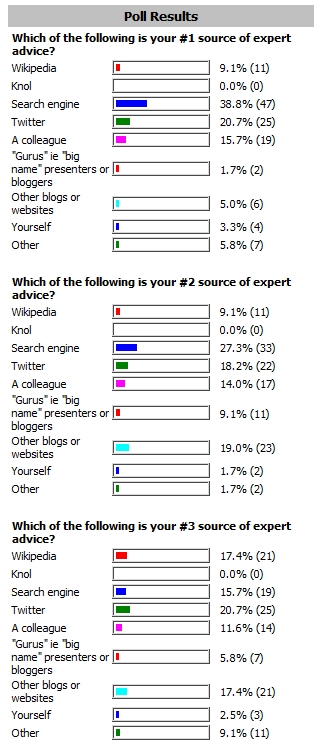
A while ago I conducted a survey to find out who or where people turn to for expert help. Here is a quick snapshot of the results:

Who you turn to for answersIn a forthcoming issue of Computers in Classrooms I'll be adding more detail, such as what people suggested in the 'Other' category. Thanks to everyone who took part in the survey.


The Online Information Conference and other news

In this video I talk about the Online Information Conference. If you're in London and you see this in time (it finishes on 4th December 2009) you might like to get along, for reasons I describe.

If you can't get there, it's worth checking out the website for information and podcasts.

I've also included a short video I shot with a pocket video recorder called the Kodak Zi8, which I'm quite impressed with.

Other items mentioned include the next issue of Computers in Classrooms, which includes several book reviews, two reviews of the same website, current legislation in the works, elevator speeches and coping with inspection. That will be out very soon.

Plus information about the Web 2.0 Projects Book I'm working on, and my two presentations at BETT, which are:

Driving Your ICT Vision: how might advanced motoring techniques help us achieve our ICT goals?

Amazing Web 2.0 Projects: Real projects in real classrooms with real kids!

Wasteful Widgets #4: Maps

Like many bloggers, I have a map on site showing where visitors are coming from. Why?

World viewI think there are two aspects to this question: why have a map, and why show it to the world?

On the first issue, it is quite nice to look at one's reach. I have to admit to a little thrill when I see that someone in Borneo, say, has been checking out my blog. And I find it fascinating that I can write something now, sitting here in my home near London, England, and seconds later someone on the other side of the world, in Australia or New Zealand, can be reading it. I am still intrigued despite having done this kind of stuff for nearly 15 years.

But the other question, about why show it, is more problematic. At first, I did so because I wanted people to see that I am being read internationally. I now feel that one should be able to take it as read that that's the case, and not make a big deal out of it.

I also think, like recent comments, it's a matter of context. When I took part in the Classroom 2.0 Live discussion, people were asked right at the start to click on a map to show where they were listening from. Seeing the whole world 'light up' as members of the audience did so was an incredible experience. And for me, as the guest speaker, it really did bring it home to me that, although I was loafing around in casual clothes and unshaven, I was addressing a global audience in just as real a way as if I had been speaking at a physical event.

So, given that there's not much point in displaying a map on my site, because it lacks context and smacks ever-so-slightly of egotism, why do I continue to do so?

The answer, I'm afraid, will be familiar to married men everywhere. My wife likes to look at it, and doesn't want to have to bother logging in in order to do so.

International ICT in education superstar I may be, but at home I know my place!

Other articles in the Wasteful Widgets mini-series

Wasteful Widgets #1: Most popular articles

Wasteful Widgets #2: Twitter Feeds, and 7 Reasons to Eschew Them

Wasteful Widgets #3: Recent Comments

Delete: The Virtue of Forgetting in the Digital Age

In "Sketches Among The Ruins of My Mind", Philip José Farmer depicts a nightmare scenario in which an object suddenly appears in our skies, and proceeds to remove everyone's memories, four days at a time. Gradually, people regress through their chronological age, ending up drooling like babies, and forgetting all their relationships and skills. As people realise what is happening, they resort to leaving themselves notes and tape recordings by which to tell or remind themselves, on waking up in the morning, what's been going on.

That's an extreme description of what might happen if we were unable, unaided, to remember anything about the last three days, but humankind has always tried to find ways of remembering.

John Mack, in "The Museum of the Mind", looks at how different people in different times and places have used artefacts such as paintings and sculptures to help them remember, a story he tells through the collections in the British Museum.

We have always been afraid of forgetting which, as Viktor Mayer-Schönberger has pointed out in a recent lecture, is the "default setting" for human beings. However, we have now entered a digital age in which this balance between remembering and forgetting has been reversed. In other words, the default setting is now remembering, and we as a society have perfect memory.

A good thing? In some respects, of course; but Mayer-Schönberger fears that we have not fully considered the negative implications of perfect memory.

One of the sources he draws upon is the Argentinian writer, Borges. In “Funes, The Memorious”, Borges provides us with a startlingly accurate insight into what a curse perfect memory would be for an individual person. “Startlingly accurate”? Yes, because decades after he wrote this we have discovered a handful of people in the world who have this rare ability affliction.

And the societal perspective on this?

As Mayer-Schönberger points out, a society that never forgets, may stop forgiving. That unfortunate photo of yourself, or that article you wrote whilst a student, may come back to haunt you years, even decades, later.

Such a situation leads people to self-censor, not just in the here and now, but with one eye on the future. It reminds me of a science fiction story I read in which crime was effectively eradicated because the police used cameras that could go back in time to record actual events instead of people's recollections of them. The story centred on one man's attempt to commit the perfect murder: he had to engineer the situation to cause his victim to have a fatal heart attack, so that when the inevitable cameras came, they would record that he had caused the person no physical harm.

Mayer-Schönberger's suggestion is that we should remember to forget. Technology can help us by prompting us to specify expiration dates for the data we store.

It was a fascinating talk, which you can listen to. I am now in the process of reading his book, 'Delete: The Virtue of Forgetting in the Digital Age', and will review it due course.

In the meantime, perhaps this is a topic that would make for a good discussion in ICT and even Citizenship lessons.

The books mentioned in this article are featured on my Amazon page, where they can be purchased, thereby providing me with a (very) modest additional income. Also mentioned on the page are Fictions, a collection of short stories by Borges that includes Funes, The Memorious. Although nothing to do with ICT in education as such, these stories make you think. And one, The Library of Babel, really does have echoes in the Web 2.0 world, as I described in this article about collaboration.

Also featured is Google Bomb, which covers similar ground, but looked at through the lens of online defamation and cyber-attacks.

Although I have yet to review them, I will say now that these books deserve a central place in your educational technology library.