
Professional judgement in assessing Computing

idea

“OK, then. What do you think about this?”

I was talking to the delegates on a course I was running entitled Assessing Computing. We were discussing sources of evidence of pupils having learnt stuff.

“What if you took the view: I’m a professional, and I’ll know it when I see it?”

The reactions of the class were very interesting.

Read More

Book review: Don’t Change the Lightbulbs

This book collects together the thoughts and observations of over 71 people in education. These are each a little longer than the bite-sized comments typical of Twitter – I understand that they were curated from Google+ discussions. Being longer than 140 characters makes them "meaty" without being too long.

In total around 70 topics are covered, not all of them curricular.

Read More

7 questions to ask regarding whether education technology improves learning

computer classDoes education technology improve learning? The intuitive answer to those of us involved in education technology is “of course it does”. However, the evidence from research is not conclusive. I think the reason is that it’s actually very difficult to carry out robust research in this area. As the impact of education technology has often been a topic for discussion in the Naace and Mirandanet mailing lists, I thought it might be useful to try and clarify the issues as I see them.
Read More

A too-robust approach to spam

Spam wallI was reading recently that something like 47% of emails are spam. I can believe it. I get the whole range: offers of Russian brides, Viagra, genie bras, news that a previously unknown relative has left me tons of money and messages exhorting me to open the attached document or confirm my security details. All this would be quite funny on one level, but it makes downloading and then sifting through email that much more difficult.

So I decided to do something about it.

Read More

Flash fiction and computing

Flash!I’ve been trawling through the archives, and came across the following article. If you missed it the first time around, here’s a chance to read it. If you read it when it was first published, well here’s your chance to enjoy it again!

It’s about flash fiction, and how it can help teach ICT – don’t be put off by the old-fashioned terminology: it all still applies to the new computing curriculum.

Read More

7 Expectations for Computing lessons

signI don’t think rules, as commonly formulated, are very useful in the context of Computing lessons. Rules are usually framed in the negative. For example, in a computer lab I went into a few years ago on one of my school visits, there was a poster on the door listing all the things that people shouldn’t do:

Do not leave the computers on.

Do not leave printing next to the computers.

Do not just switch the computers off.

and so on.

There are two main problems with this sort of thing.

Read More

6 routines for Computing lessons

2015-03-11d How can I structure these types of days -- index card #limbo #routinesI mentioned recently that in his book The Craft of the Classroom) , Michael Marland provided very useful advice on very practical issues in the classroom, and good routines to ensure a smooth lesson. Routines are good, because pupils know what to expect. They are able to predict what is going to happen, and when. Some pupils, whose home lives are chaotic and unpredictable, may even feel safe because of routines.  Here are some routines that I think are useful for Computing lessons.

Read More

Review of the Association for Information Technology in Teacher Education (ITTE) Conference

deck chairsITTE held its annual conference recently, and I bought a ticket and went along. As far as the ITTE conference is concerned, I was a newbie, and so I wasn’t sure what to expect. I do recall dragging my carcass to the local station in sweltering heat, mumbling to myself something along the lines of “Please let the trains be cancelled; I’d rather be in the garden.” Well, that proved too much for Transport for London to arrange, and so I made it to the conference.
Read More

7 reasons that the FAIL acronym fails

fail-owned-full-parking-lot-sign-failIt is fashionable these days to avoid the ‘F’ word – by which, of course, I mean “Fail”. This is not confined to the area of teaching Computing, but enough people in this field have written about it to nudge me into writing my thoughts on the matter. So, the FAIL acronym, in case you haven’t come across it, is First Attempt In Learning. The idea of it is that instead of telling kids that they have failed at something, you tell that they have not failed. They may have not succeeded, but that is fine, because it was a First Attempt In Learning. Well, I have always been a believer in telling it how it is, and so for me the FAIL acronym does not benefit kids at all. Quite the opposite in fact. Here are my objections:
Read More

Some interesting-looking computing conferences coming up

There are several conferences coming up in computing, ICT and education technology. If you’re not careful, you could spend all your time and money going to conferences without getting any actual work done! Still, I do think it’s worth going to two or three a year if you can persuade the powers-that-be that it’s in their interests to allow you to attend. So, here’s the current listing. I’m not saying it’s a definitive list, just the ones I know about.
Read More

Everyone’s an educational expert, but it was ever thus

How to be an expertHave you noticed how everybody seems to be an expert on education these days? In fact, you only have to pick up a newspaper more or less any day of the week to find some minor celebrity saying something asinine like “Schools should teach kids how to stay safe online” (Really? What a great idea. How come we  didn’t think of that?!). I don’t take much notice of these people, but it does annoy me when they somehow get on to conference programmes.
Read More

21 reasons that education technology projects fail

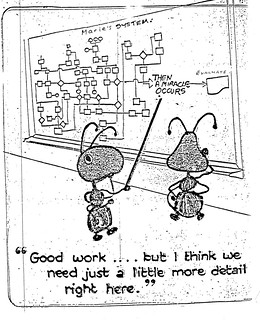
miracleWhy do some school and local authority initiatives, not to mention government initiatives, fail, especially when they concern education technology. In my experience, the cause can usually be found in one or more of the following. The next time you read about a 1:1 project turning into a nightmare, or a fantastic opportunity being wasted, it is almost certainly going to be because of one or some of the following
Read More