A Reflection On The ICTLT2010 Conference

#iCTLT2010 It's interesting how people who are at the same event can have such widely differing opinions on the same thing. David Warlick and I were both at the ICTLT2010 Conference, for example, but our experiences of the penultimate keynote were not the same by a long shot.

He writes:

One of the best parts of her [Jenny Lewis'] presentation was her questioning of why we still teach safe themes in our classes, like dinosaurs, Eskimos, etc.  She then suggested that our students, within the context of curriculum, explore more important issues.

The list these 'more important issues', taken from a book called High Noon: 20 Global Problems, 20 Years to Solve Them,  includes the following:

  • Reinventing taxation for the 21st century
  • Biotechnology rules
  • Global financial architecture
  • Illegal Drugs
  • Trade, investment and competition rules
  • Intellectual property rights
  • E-commerce rules
  • International labor & migration rules

Wait a minute! Does Jenny Lewis seriously think we should tell five year olds that instead of looking at dinosaurs this year, they'll be considering global financial architecture? And does the usually sensible David Warlick seriously go along with that?

I have to say that I thought the statement a little silly, and actually detracted from what Jenny Lewis said, which for the most part was pragmatic and encouraging.In fact, until I saw that David had commented on it, I was convinced that I must have misheard it.

Here are four reasons to not jettison dinosaurs and other favourite subjects:

  • These subjects are fun. Isn't learning supposed to be fun? Global financial architecture doesn't sound like a barrel of laughs. What does it even mean?
  • These children are, erm, children. Aren't kids supposed  to be kids?
  • Let me get this straight. Our  generation totally messes up the environment, finance, world peace and 17 other problems, so we decide to steal the next generation's childhood so they can sort it all out for us? Let them grow up first! Then they can sort out our mess and create one all their own!
  • If dinosaurs etc are taught properly, kids will learn to think and ask the right questions for themselves. I'd have thought that that is exactly what we want.

Besides, call me a big kid, but I happen to like dinosaurs.

But Where Are The Kids?

This is a modified version of an article written and published in 2009. I am reproducing it because it is still relevant, and I shall be referring to it in articles in the near future.

One of the big absences at most educational conferences, as far as I'm concerned, is children and young people. Let's be honest: you would have no idea, walking into most conferences, whether you were attending an event about education or one about how to improve the market share of widgets.

Youngsters remind us why we're thereIt is hard to get this right, without a doubt -- not least because of child safety considerations -- but the more I think about it the more important I think it is to involve young people in conferences in meaningful ways. After all, it is they who, in management-speak are our clients and, in marketing-speak, our final consumer.

I've been to a few conferences recently where young people were involved to a greater or lesser extent. First, take the Naace 2009 Conference. There were children in evidence, but in my opinion in an utterly tokenistic way. I don't mean this to sound as critical as it does. When I organised the Naace conference a few years ago, it was generally regarded as being very good indeed, but there were no youngsters there. In hindsight I regard that as a mistake, and think I should have worked harder to include them (we did try, but it was logistically difficult, because of the distances involved, to liaise effectively with local schools; also, I think it requires a more imaginative mindset which is easier to nurture once you're away from all the deadlines and other headaches involved in planning a large conference).

The youngsters were there to help represent their schools, which had been invited in order to receive the ICT Mark. Traditionally, this little ceremony takes place straight after the talk by the Secretary of State for Education, so that it is he or she who is, in effect, handing over the certificate.

Alright, the fact that there are children there reminds us that this is all about them, but it seems to me that here is a golden opportunity wasted. Why not go straight into a panel discussion in which the audience can ask the youngsters what difference, if any, the process of applying for the ICT Mark has made. If it has made a difference, the session might just be the thing that's needed to convince a wavering school that it ought to take the plunge. Also, and of more immediate importance and interest, it would help us see the process from the customer's point of view (I cringe from using such terminology, by the way, but it does seem rather apt).

On the subject of a panel discussion, last year's ASPECT conference featured a panel session in which a group of students of around 17 years of age really gave the assembled educational glitterati a run for their money. For example, one of them said, in response to a rather patronising answer, to a genuine question, to the effect that it was a nonsense to say that young people were left out of decision-making, "I notice that all the people in this room have been given briefing packs. But we haven't." Stunned, embarrassed silence: after all, you can't argue with something which is so visibly true.

The Dimensions conference run by the then Qualifications and Curriculum Authority went a stage further. As you arrived at the entrance to the building, students (from a school local to me (Mayfield School), as it happened) were there to greet you and point you in the right direction. They were also involved in a workshop about the BBC School Report event (which I hope to write about separately), took part in a panel discussion, generally helped out and, crucially, went around conducting video interviews of delegates.

In the workshop, two of the students were on hand to advise us oldies of what would be best to include in a news bulletin that would fire up the interest of people of their age (15-16). They were brilliant, somehow managing to combine brutal honesty with humour and courtesy. (Perhaps we adults could learn a thing or two from them.)

Here is the video they made of the day:


There are other ways in which youngsters can be involved. A lovely way of starting a conference, for instance, can be seen in the programme of last year's Game-Based Learning conference, the second day of which was opened by a performance by children from the John Stainer school. (That was nice for me on a personal level because I worked with the school a few years ago helping it to implement its Framework for ICT Support programme).

I think what I would ultimately like to see is youngsters involved at all stages of a conference:

  1. Planning.
  2. Attending.
  3. Taking part.
  4. Evaluating.

Difficult, perhaps, but surely a goal worth striving for?

A slightly different version of this article was first published on 7th April 2009.


General Impressions of ICT in Singapore

#iCTLT2010 If I were asked to give a one-phrase description of education in Singapore, I should have to say that the overriding impression is one of faith and trust. Faith in the ability of the child to rise to challenges that we might consider beyond their years. Trust in the ability of the teacher to guide the youngsters and nurture their talents and abilities.

Faith and trust also in their ability to look at what other countries have done and experiment and come up with solutions all their own.

I am not naive. I understand that when one visits a foreign country, one will be shown the best, not the worst or even the mediocre. But seeing the best is actually what should happen: we need to see what our own students might aspire to given the right circumstances and ingredients.

Two mottos struck me as especially noteworthy. One is the Ministry of Education's ideal that teachers should teach less in order that students may learn more. Teach Less, Learn More, or TLLM, appears to be another way of stating the 'guide on the side' idea, but it seems to me to run deeper. The TLLM philosophy is not simply to leave the students to it, but to encourage and guide them in asking important questions, and then seeking the answers.

A great sentimentThe other motto is 'Every Child Ready for the World'. This strikes me as so much more positive than our own, unfortunately necessary, Every Child Matters. One of the strengths of our education system is that it considers the whole child; school is not only an educational (in the narrow sense) establishment, but the hub of the community and the locus for all sorts of services – police, social, medical – that may impinge on the individual child.

But that is also its weakness. As Michael Gove has pointed out, there is no official body in England that is solely concerned with excellence in school. We do not have a ministry of education, we have a department for children, schools and families. Even Ofsted, the inspection body, is not exclusively focused on schools, but in everything ranging from childcare provision to old age homes.

I'm not familiar enough with the Singaporean education system to be able to say whether they have cracked this dilemma, of striking the right balance between the academic and the social and emotional aspects of the child's experience. But certainly what we saw was impressive: students, even as young as 8, who were articulate about what they have done, and why; students who have worked with mentors in further education in extended projects; students who are able to work well with each other.

I don't think they have completely got it right. A teacher who has been doing very innovative work in science gives her class a pencil and paper test every six weeks. There is no slot on the curriculum for ICT, which is embedded in other subjects across the curriculum. Many will agree with this philosophically, but in my experience it's quite difficult to make it work.

Despite such doubts, for me the real issue is not whether Singaporean children are ready for the world, but whether the world is ready for them. 

Experimenting With E-Junkie

I've written several ebooks over time and am always interested in looking at different ways of selling them. The free ones are easy to deal with: I just upload them to my website and tell everyone where to get them. Ones for sale are more complicated, because you have to take into account other things, like:

  • Sales tax, in my case VAT.
  • Temporary URLs -- otherwise some people would just post the URL and effectively make the book available free of charge.
  • Shopping carts which are automatically updated as purchase requirements change.
  • A variety of payment methods.
  • An automated thank you email and/or redirect to a 'thank you' web page.
  • Bundles/deals, should one wish to offer them.

I've just started a free trial of e-Junkie. I've read a couple of articles in which people are singing its praises. One attractive thing is that, unlike many services, it doesn't take a transaction fee. Typically, that runs at a fixed amount, like one dollar, plus a percentage. That doesn't sound much, but if you want to make the books available at a fairly low cost you will find that hard to do: don't forget, PayPal, or whatever payment method you use, also takes its share.

E-Junkie was easy to set up. I only needed to look at two things in the documentation: how to enable the VAT charge for EU residents, and how to set up the API settings for PayPal to handle payments. And that was only because I didn't look at the set-up page to start with. I have to say that so far this is the easiest set-up of this kind that I've implemented.

The transaction side of things appears to be just as easy. When you make a purchase you are redirected to a page with a download link straight away, and you also receive an email with the same information plus a receipt for your records.

Now that I have set up the PayPal link, and other 'fixed-cost' items, uploading new ebooks should be easy.

Fingers crossed!

It seems to me that this sort of service could have use in a school setting too. Some schools sell DVDs of school plays and that sort of thing, to raise money for charity or to offset the cost of school trips for poorer pupils. At $5 a month for the lowest entry level, e-Junkie may be just what's needed. I notice, for instance, that you can set up tax rates for individual countries and even individual states in the USA. It may be worth giving it a whirl for a week.

The Tyranny Of Relevance

IMG_0836

#BloggersCircle In a recent address called 'What is education for?' to the Royal Society of Arts, Michael Gove bemoaned the fact that there is no government department in the UK whose sole remit is the pursuit of educational standards.

According to Gove, education is not regarded as a good enough end in itself, but as something which can help to achieve some other goal.

In his exposition of his views in favour of liberal education, he used the term 'the tyranny of relevance'. Although he wasn’t talking about Information and Communications Technology (ICT), this phrase did strike a chord with me. In the continuing debate over whether ICT should be taught as a subject in its own right, is there perhaps too much store set by 'relevance'?

I’ve noticed (although, curiously, I’d never consciously noticed it before) that whenever people tell me that they think ICT should be taught through the context of other subjects, they always cite 'relevance' as a factor. They almost always throw in a reference to kids having to suffer boring lessons on spreadsheets and databases. They seem to think that having lots of lessons on e-safety and plenty of opportunities to use blogs, Google and Wikipedia will somehow turn out youngsters who can use their knowledge of technology and ability to transfer their skills to excel in subjects right across the board.

Perhaps I have overstated my case slightly – but only slightly. Like Gove, I happen to think that the best kind of education is one in which students develop a deep knowledge of subjects. I like the idea of cross-curricular themes, and of making subjects 'relevant' both to each other and a wide range of issues and circumstances. However, I do not think you can achieve that without mastering individual subjects. To summarise, I regard the following statements (which are mine, not Gove’s) as axiomatic:

     
  1. It is important for students to gain a deep knowledge of ICT, because only by understanding key issues (such as the difference between data and information) can they protect themselves against some forms of hype.    
       
    More positively, an understanding of how ICT can be used for 'provisional' activities, such as drafting and modelling, and an ability to appreciate the importance of precision in language (as required, for example, in 'sequencing' or programming, is essential for being able to avoid being subservient to a computer system’s apparent will.    
       
    However, even this is falling into the trap of looking for 'relevance'. Why can't ICT be studied and enjoyed for its own sake?
  2.  
  3. Far from being boring, spreadsheets and databases can be extremely interesting, even beautiful. I don’t mean just to look at, but in their design and construction.
  4.  
  5. Any teacher who makes spreadsheet or database lessons boring either has not had the time to develop interesting lessons, or does not really have a deep grasp of, and appreciation for, these areas themselves.
  6.  
  7. What we need are teachers who have a deep love of ICT. I think to achieve that we have to encourage teachers to join communities in which important subject-related (not necessarily education-related) issues are debated (such as the RSA or British Computer Society).
  8.  
  9. To help promote #4 we need to ensure that teachers have the time, and the authority, to develop teaching resources of their own.
  10.  
  11. As part of that, teachers should have the flexibility to be able to teach topics they have a deep interest in.When I started teaching economics, something I was especially interested in was road pricing. I usually spent around 2 weeks on that topic alone, but in doing so I was able to touch on a whole plethora of concepts that I knew would prove relevant throughout the rest of the course.
  12.  
  13. Finally, there needs to be an entitlement for top quality professional development, and the funds to back it up. For example, why shouldn’t teachers be able to apply for a ‘scholarship’ to attend national or even international conferences about educational technology?

I strongly believe that if we are to tackle the oft-cited lack of computer programming courses, say, or the sometimes perceived 'dumbing down' of ICT as a subject in its own right, we have to address the 'tyranny of relevance'.

The video of Michael Gove’s talk may be viewed on the RSA website.

This article was first published on 2nd July 2009.

The world according to Potter Part 2 -- Opposites Attract

There is an updated version of this article here: UPDATED! The World According To Stephen Potter

In this brief series I am looking at the concept of "one-upmanship", as developed by Stephen Potter, and exploring how the observations he made 50 years ago might still be applicable in the world of educational technology today.

Background

As I said in the first article in the series (which contains much more background information), his books are concerned with the study of how to be "one up" on other people. Although they are written very much tongue-in-cheek, they are clearly based on real-life observation. I first came across them 40 years ago, and have read and re-read them over the years for their humour. However, I find myself more and more discovering that a number of aspects of modern life may be found in these books, despite the elapsing of half a century, a fact which I believe puts them on a par with other classics such as Parkinson's Law and The Peter Principle.

To summarise, the 4 main books he wrote on the subject were:

  • Gamesmanship, or the art of winning games without actually cheating

  • Lifemanship, which was concerned with the application of the principles of gamesmanship to everyday life

  • One-upmanship, which was a further extension of Lifemanship, and

  • Supermanship, or the art of staying on top without falling apart.

In Potter's world, the practitioner of one-upmanship, or Lifeman as he or she is known having completed the Lifemanship Correspondence course, has one overarching thought: that if you are not one up then you are, by definition, one down.

Looked at in the cold light of day it sounds ridiculous, I know. But Potter very accurately described people and practices that you and I see almost every day of our lives. So suspend your disbelief and bear with me, as today I look at the law of opposites.

Presentational dissonance and self-contradictory names

As I have said in the past, in describing activities for which I coined the term "presentational dissonance", some practices are inherently conttradictory. Examples that spring to mind immediately are:

  • Authors who write books about self-publishing -- for a publishing company, and

  • A lecture I attended once which lasted well over an hour -- on the importance of participatory learning techniques.

  • More recently, one might add those globe-trotters who visit different parts of the world to deliver lectures on the benefits of e-learning and the interactivity of Web 2.0.

But there is a far more powerful manifestation of this sort of thing: the conjuring up of names for initiatives which are really the precise converse of what the initiatives are actually about.

For example, three or four years ago in the UK there was a welfare initiative called "Supporting People". Under this initiative, the hours of work of wardens in sheltered accommodation were cut, and sometimes reduced to zero, thereby placing at risk some of the most vulnerable people in our society. When I enquired why this was being done, I was told that the organisation concerned had chosen to do it: apparently, it was not an inherent part of the policy itself. Well, maybe it was, and maybe it wasn't, but the point is that once Supporting People came on the scene, some people stopped being supported.

A more recent initiative, this time in the Health Service, is called Fit for the Future. Note the clever play on the word "fit", which in this context means fit as in healthy, and fit as in suitable. Apparently, in the future there will not be traffic jams, and there may not even be accidents and emergencies. Why else would my local Health Trust be using Fit for the Future as a means by which to axe perfectly good locally-based Accident and Emergency units in hospitals, and force people to travel to a modern hospital that can barely cope now, let alone when that happens? In other words, like "Supporting People", "Fit for the Future" seems to me to mean the exact opposite of what it sounds like it was supposed to mean.

But the prize must go to "Building Schools for the Future". I am not referring to the programme itself, which has achieved some success, but the name. If you think about it, it contains the seeds of its own failure, making success that much more difficult to achieve. After all, if one were to really start to think futuristically about education, one might hesitate to think in terms of schools at all. And as for building, would that even merit a mention, except perhaps as a footnote?

The Potter dimension

So where does Potter fit in with all this? Well, before I tell you, here is a little more background information which will prove useful to you. Potter's "day job" was English lecturer in the University of Oxford. So there is a kind of in joke running throughout the books whereby Potter gives spurious academic-sounding names to types of behaviour. I'll go more into this in another article, but to give you an idea of what I mean, he came up with such immortal terms as "Trojan Horsemanship", "Book Reviewership" and "Derby and Joanmanship" (with its associated phenomenon of "still-ridiculously-in-love-with-each-othering"). It will therefore come as no surprise to learn that Potter came up with a very apposite term for what I've just been describing.

In the Supermanship book, there is a riotous exposition of the natural one-upness of babies, and how to counteract it. In one paragraph, he says that as well as being undermined by the baby itself, parents will also start to be got at by external forces in various guises. He writes:

"Baby Literature makes itself felt first, and Baby Instruction. Many prettily got-up booklets start with the dictum 'Enjoy your baby'."

To this last point is appended a footnote which states:

"This is known in Yeovil [where the Lifemanship Correspondence College is based] as 'The Petrification of the Implied Opposite'."

If the term "Building Schools for the Future" is not a superb example of the petrification of the implied opposite, I don't know what is. Another example we might cite is "e-learning credits" which, when this form of funding first appeared at least, had everything to do with digital content and nothing to do with e-learning, and involved no type of credit in the usually-understood meaning of the term.

Implications for educational technology

So what does all this mean for the educational technology subject leader? I'm not interested in having a dig at the names of initiatives just for its own sake. After all, things have to have names, and the pithier and more evocative the better. But from the point of view of, if you like, the consumer (ie us), we have a responsibility to try and tease out exactly what any new initiative entails. Does it really mean what we took it to mean at first glance? What does the small print say? Is it deliverable? And is it even worth delivering? Can we deliver it with our existing policies rather than spending time and energy setting up new structures?

And let's be clear about this: some initiatives really do do what it says on the tin. Harnessing Technology is about finding ways of harnessing technology in the service of learning. The Hands-On Support funding of a few years ago was very much concerned with providing practical, in-class, support for teachers using educational technology. It's only by scrutinising the various policies, strategies and initiatives that we can get behind the soundbite of the title to determine what it's really all about, and sometimes what we discover is actually good!

And if it does turn out to be an example of the petrification of the implied opposite, it is our responsibility to try to ensure that the initiative lives up to its promise, rather than down to our lowest expectations.

This article was first published on 31 October 2007.

Ebooks: No Need For Publishers To Worry?

Still safe?Are ebooks merely a footnote to publishing? I attended a Society of Authors' conference yesterday afternoon, and the panelists seemed to take that view. Apparently, according to the latest stats, ebooks in the UK account for only about 2% of the published output, and next year it's not predicted to rise to much above 3%. From this, the panelists concluded that the book industry was unlikely to go the way of the music industry.

Far be it from me to question the experts, but it seems to me that a few things are not being considered here.

Firstly, it's generally the case that when there is a sudden transformation, it's almost impossible to predict that it's going to happen. There's even a theory to help explain such changes: catastrophe theory. A good example is boiling water: until the last second, there is almost no indication that anything dramatic is about to happen to the state of the water.

So, just because only two or three percent of published books are in the form of ebooks should not, in itself, give any comfort to publishers at all.

Secondly, it is now technically feasible to sell books in single chapters. It used to be the case that you had to buy an album, and hope that most of the tracks were OK. Now you can buy only the tracks you want. By the same token, why should I have to buy a whole book, when there may only be one or two chapters that are relevant to my needs? One of the things preventing this may be that there are not good enough micropayment systems around (I say 'may' because there wasn't the last time I looked; there may be now).

Thirdly, when it comes to niche publishing, the situation may be different. I wonder, for example, what the proportion is in educational publishing or, even more specialised, ICT in education?

Fourthly, and this was actually stated by the panellists present, it is essential these days that if you're going to publish a book, you have to make sure there is an e version. This advice probably comes naturally to those of us have been experimenting with print-on-demand.

Like a lot of people, I like the feel of a 'real' book, and I like being able to put physical bookmarks and post-it notes in it, and to annotate it (in pencil, of course). But given ebooks' convenience and lack of weight, and the growing ubiquity of devices on which to read them, I think the panellists were perhaps being more optimistic than may have been justified.

Teachers and writers

The London Book Fair 2008

Teachers and writers perhaps have more in common than people realise. Yesterday I visited the London Book Fair, and that helped me to gather my thoughts on this matter....

     
  1. The most important element in the education system is, in my opinion, the expert teacher. You can verify this by the economist's approach of determining the marginal cost of something by taking it out of the picture completely. If you take the expert teacher out of the classroom, and replace him or her with non-expert teachers following, to all intents and purposes, a script, then I think you would very quickly see that to have been quite a costly move, whether in terms of behaviour or examination results or enthusiasm for the subject on the part of the students or whatever.    
       
    Note that I am not necessarily restricting myself to subject expertise. A good teacher can take a subject they know very little about and, with the help of good materials and training, do a reasonable job of teaching. The important element here is pedagogical expertise. Of course, if the teacher is an expert in both pedagogy and the subject, so much the better.    
       
    On the other hand, if advisers, consultants and speakers were to disappear from the educational scene, would that make a huge amount of difference? Let me rephrase that. It would make a great deal of difference, of course, but would it make a very big marginal difference? Let's put it another way: if you wanted to increase educational standards in your area, and you had to get rid of either an expert teacher or a consultant, adviser or visiting speaker, in order to balance the books, whom would you choose to get the chop?    
       
    Please bear in mind that I am trying to be objective here. I am myself a consultant and visiting speaker, and have been an adviser; and some of my best friends are speakers, advisers or consultants.    
       
    The most important element in the publishing industry is, in my opinion, the author. Publishers will argue otherwise, of course, because many books these days are not so much written as produced. The Dorling Kindersley books are an excellent example of this: lavishly illustrated, beautiful to look at, but not necessarily easy to read because of all the colours and pictures, though that's another matter and a personal opinion anyway.    
       
    But again, look at this at the margin. Other things being equal, if you had to cut costs by getting rid of an editor, an illustrator or an expert writer, surely your decision would not be to fire the writer?
  2.  
  3. The curious thing, though, is that when it comes to trade shows, both the teacher and the writer share the ignominy of being regarded as unworthy of much attention, generally speaking. Visit the BETT show, say, with the word "teacher" on your badge, and you will not be treated as well as if you have, say, "Chief Software Buyer" displayed. The reason is obvious, of course.    
       
    The same obtains at shows like the London Book Fair. The "most important" people there are the ones who buy and sell rights. Authors? Don't make me laugh. As soon as exhibitors see "Author" on your badge, they either humour you as politely and briefly as possible, or else ignore you all together.    
       
    This is so pronounced that after it had happened to me the first time, I thought I must have developed some sort of personality defect or acute paranoia. But then the following year I tried an experiment: I asked my wife to accompany me, and she discovered exactly the same thing. Then the following year I spoke to someone who works for the UK's Society of Authors, and she said it was a common experience: authors are regarded with disdain.    
       
    This year I tried another experiment. Instead of "author", I described myself as a "Digital Content Provider". This was definitely a good move: I had much better conversations with people. Even so, I made a special effort to visit one particular exhibitor, but when I arrived one of the people manning the stand peered at my badge and then, clearly deciding that I was of no use to him at all, did not simply ignore me but completely turned his back to me. The man is an idiot: thousands of people read my articles, and that company is definitely one that they will never hear about from me.
  4.  
  5. People's attitude to both teachers and writers is ambivalent. When I was a teacher, people used to say "I don't know how you can do that job, the way kids are today". And a moment later those same people would tell me what an easy life I had, with those short days and long holidays.    
       
    At the same time, everyone thinks they can do it. A doctor we met a few weeks ago said that teaching is easy because all you have to do is and at the front of the class and tell the kids what you know. That's the thing about experts: they are so adept at what they do that they make it look easy. A bit like doctors you might say.    
       
    So it makes you wonder why there is a teacher recruitment crisis in the UK, the job being so easy and all. A recent study shows the state of teacher recruitment in the UK to be less than optimal, whilst an article in the Times today claims that there has been a massive increase in the number of unqualified teachers practising in UK schools, with two thirds of them coming from overseas. The study referred to earlier also suggests that in information and communications technology, the number of places on post-graduate training courses will not be filled this year.    
       
    But you get the same thing in the field of writing. There are tons of books on the market about how to write a best-selling novel, which suggests that it must be hard to do, yet half the population is attempting to write a best-selling novel. That's anecdotal, by the way, and no doubt a huge exaggeration, but there does seem to be a large number of people who are writing a book at any given time, so they must think it's easy. In fact, you just have to look at the number of blogs that get started and go nowhere (the number is always changing, so I haven't given one, but it's a lot) to see that it's the case that lots of people think writing must be easy.    
       
    But both good writing and good teaching are not easy for most people, they only look "easy". I would suggest that part of the reason is that both good writing and good teaching actually take a lot of effort. Even the teacher that says he just plans his lesson on his way to the lesson has brought to bear a vast repository of knowledge and experience, and the same goes for most writers. What's the expression? 10% inspiration and 90% perspiration? I think that applies in both cases.
  6.  
  7. Both teachers and writers can be precious. The second hardest thing in the world is giving negative feedback to a teacher whose lesson you have just observed. The hardest thing in the world is suggesting to a writer that she changes a few things.    
       
    That's why, to take the first example, I am always careful to give positive feedback followed by some suggestions. There's not usually much point in doing it another way, because the person you're talking to simply shuts down and doesn't hear anything positive or useful.    
       
    And to take the second example, I know that when I receive suggestions on my book chapters from an editor, I have to make a conscious effort to read the suggestions objectively, rather than as implied criticisms. But it's really hard to do.
  8.  
  9. In both writing and teaching, training and experience are all-important. Yes, there are "natural" teachers, just as there are "natural" writers, but raw talent is not usually enough. I think no matter how good you are, you can always hone your craft. Indeed, one of the most common traits of experts is that by and large they think they don't really know anything, at least compared to the vast amount that they do not know.
  10.  
  11. Neither teachers nor writers work well with templates. I have recently been asked to write some book chapters in a template, and found it stifled rather than released my creativity. In the end I wrote the chapters and then, just to keep the peace, reverse-engineered them so that they fitted the template. I don't think the publisher noticed.
  12.  
  13. Finally, for all the reasons described, and probably more, I don't think either teachers or writers could be replaced by machines, except in very specific circumstances and under highly-specified conditions. I find it interesting that science fiction writers of old routinely predicted the use of teaching machines or robot teachers, but almost universally failed to predict the decline in smoking. It's because they focused on the technology rather than behaviour, in my opinion.    
       
    However, I have to say that I loved the idea propounded in one episode of The Avengers, in which a publishing company churns out novels by getting an elderly woman to play the piano. Soft, mellow sections create "gooey" passages in the book, and so on and so on. When the music playing is over, a manuscript pops out  of the side. Delicious!

 This article was first published on 16th April 2008.

Sweat The Small Stuff

I think it's great that we have visionaries and big thinkers, and I enjoy working with such people. (After all, I consider myself to be one of them!) But what we appear to have a deficiency of is people who pay attention to detail. I mean real, nitty-gritty detail. The small stuff.

But that is the stuff that makes or breaks a project or an enterprise. Don't believe me? Next time you're somewhere that seems a bit grubby, though you can't quite put your finger on it, have a look at the details. In a hotel lobby, for example, that is gleaming, and yet.... Have a look in the corners. You'll probably see that it hasn't seen a broom in ages. Or the wallpaper: there's that slight nick near the light switch....

I'm sure that we pick up on all these things on a subliminal level, but it all creates an impression. For me, when it comes to projects, such as events, or publications, the small stuff really does matter:

  • I once spent two hours trying to work out why my spreadsheet covering a project of £100,000 was 57 pence out. I figured that while the 57 pence didn't matter, it could just be symptomatic of a much larger problem. I was right, in a sense. One of the formulae was rounded up, and that was compounded as its result worked its way through the spreadsheet. It wasn't a huge deal, but it was an anomaly. I don't like anomalies.
  • I wish one of my co-workers had been as assiduous. He may then not have needed to come to me as white as a sheet to tell me that he had double-counted an income stream, with the result that rather than have £30,000 to play with, we had to make up a shortfall of £30,000.
  • A student once sent me an article for publication in the Computers in Classrooms newsletter. The title of the piece was 'Article for Computer Weekly'. I had to waste time asking him if he'd sent me a recycled article or had merely put the wrong title on the top. We got that sorted out, but he blew it when he told me he hadn't had time to spellcheck it or anything. Well, if he can't be bothered to take a pride in his work, why should I be lumbered with the job? I suggested he re-send the article when he does have the time.
  • I once failed to land a contract I thought was in the bag. I asked for feedback. They sent me an email in which they said: "It was a minor thing that kinda wasn't a minor thing: you referred to the project as TCB, when it is actually GBC" (an entirely different project that was on my mind because I'd been working on it).

We're all human, we all make mistakes. But I think there are steps that we can and must take if we are to ensure that the mistakes, and their impact if they do occur, are minimised:

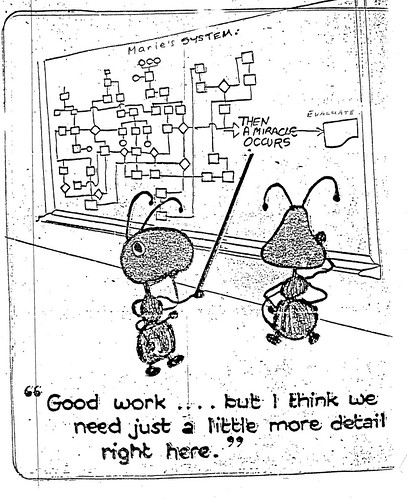
  •  Pay attention to detail. Don't make the mistake shown in the cartoon here(sorry, I don't know who the copyright owner is)
  • If it's a written piece of work, spellcheck it, proofread it, and get someone else to read it.
  • If it's a spreadsheet, run it with some numbers you can handle in your head. For example, if I am messing about with percentages, I'll insert the number 100 in the appropriate cell. If the spreadsheet tells me that 50% of 100 is 127.8, I'll know something's amiss!
  • If you're citing a website, check that it still works. OK, it may be taken offline three seconds after you've sent the email, but you can't account for that. All you can do is check and double-check as much as you can before making your statement or recommendation.

I'm not asking for perfection, just for people to sweat the small stuff. It's important.

In fact, you could say that the small stuff is pretty big.

The Case For Bullet Points

So who says that bullet points are always bad? I'm referring, of course, to presentations. I think the humble bullet point has for too long been the scapegoat of dreadful presenters. Just because awful presenters use bullet points, it doesn't necessarily follow that all presentations containing bullet points will be terrible.

Perhaps this is just a bit of self-defence on my part, because I'm in the process of creating a couple of presentations which contain quite a few bullet points. Nevertheless, having sat in and also given numerous presentations, here is my take on the issue.

  • Used well, bullet points can enhance a presentation. If they summarise what the speaker is saying, that's a good thing is it not?
  • When I was training to be a teacher, we were told that the board at the front of the lesson should tell a story. If the writing was all over the place, climbing up and down the margins, and with no obvious logic, any pupil who went off in a daydream or came to the lesson late would be unable to pick up the thread of the lesson. Clearly, slides and boards are not the same, but I think the same sort of logic applies.
  • That brings me on to the next point. I have found that nine times out of ten when I download a presentation, it is almost completely meaningless -- even if I actually attended the session. At least some well-worded bullet points make the slides useful subsequently.
  • Although bullet points aren't the most visually compelling thing to show on a screen, they do have the advantage of being clear, assuming they are well-written of course. Contrast this with the situation in which every slide is a picture, and so as well as having to listen to the speaker you also have to try and figure out what the picture has to do with what he or she is saying. That isn't always the case, but in my experience the more intent a speaker is on demonstrating how far they have mastered the art of the 'killer presentation', the more apparently divorced from each other are the meanings of the graphics and the words. Having said that, I have been privileged to witness some brilliant graphic-intensive presentations, but I think it's difficult for a presenter to carry off.
  • As an audience member, I don't mind bullet points at all, especially if they enable me to relax and listen to what the speaker is saying instead of either trying to work out what the slide is showing or furiously scribble down notes. However…
  • I do get annoyed when the speaker proceeds to read the bullet points. Yes, by all means draw attention to the salient points, but a bit of paraphrasing doesn't come amiss.
  • I like the speaker to have more information or insights than are displayed on the screen. For me, the bullet points should act as both a launch pad and a summary. They should not merely be a substitute for thought.

When all is said and done, I think the most appropriate type of presentation is one which is suited to the audience and the topic. A presentation by an advertising agency to a potential client would probably not wear bullet points very well. In contrast, a presentation to an audience of school leaders on the issues facing them in a particular sphere could well benefit from a liberal sprinkling of bullet points. It seems to me that, like a lot of things in life in general, whether bullet points are good or bad depends on the context, the audience and how they are used.

A slightly different version of this article has been posted on the Technology and Learning website.

Computers in Classrooms Post-BETT Special

The promised post-BETT special has now been published, here. It contains contributions from a host of educational ICT writers and bloggers.

Here is the table of contents:

  • Safer Internet Day
  • The Next Generation Quiz
  • The Amazing Web 2.0 Projects Book
  • Web 2.0 For Rookies
  • The Learning and Technology World Forum
  • Louise McDonough on Her First BETT
  • The Home Access Programme
  • My BETT
  • Educational Technology Taskforce Launched
  • BETT: A True British Export
  • New Computer Basics Course Launched
  • WOW! Moments from BETT 2010
  • Technology Exemplar Network to be Doubled
  • The Minister's Opening Speech at BETT
  • Dawn Hallybone Talks About Teachers Presenting
  • BETT Stats
  • Doug Woods on What Was NOT There
  • The BETT Awards 2010
  • Too Much Emphasis on Technology?
  • National Education Network Reporting...
  • Seminar: Breaking the Bonds of Learning, featuring Stephen Heppell, Angela McFarlane, Max Wainwright and Tim Rylands
  • Steve Beard Discovers A New Game
  • Seminar: Power Up: How ICT is Transforming BSF Schools, featuring Steve Moss
  • A Projector with no Bulb
  • The Unconference
  • Virtual Learning Environments
  • Mirandamod Discussions
  • ICT CPD
  • Gerald Haigh on the Assistive Technology Party
  • Paul Haigh's Views
  • Merlin John Liked...
  • The Politics Game
  • NComputing: Virtual Desktops

It makes for a good selection of views about the BETT Show and what was hot and what not! Apologies to Paul Haigh and Sean Carragher for inadvertently omitting their Twitter details, and to everyone for addressing them, in the subject line, as FNAME SNAME. Had I remembered to include the brackets, they would have seen their names instead! Thanks to Mark Chambers, Chair of Naace, for pointing out my error!

Efficiency? Don't Make Me Laugh!

One of the reasons always advocated for adopting technology is that it leads to efficiency gains. In other words, it (supposedly) helps you do what you already were doing, but faster, cheaper or easier.

I wonder if this is actually true, as opposed to a convenient white lie with which we console ourselves? Has anybody undertaken a Total Cost of Ownership type of analysis which looks not only at the financial costs of ownership but also the social and economic costs? If anybody were to do so, I imagine we would have to re-evaluate our investment in time, energy and money into technology.

This may sound an odd way to open an article by an educational ICT specialist (and one who loves technology). But I think these issues should be addressed.

Take three examples. Firstly, I've been working on a couple of presentations. Each presentation will last an hour. I have to allow ten minutes for questions, so once I've allowed for five minutes at the start being introduced and saying 'Good Morning', I'm left with 45 minutes to fill. That is, a total of an hour and a half.

So far, preparing for these presentations has taken nearly three days.

Part of the reason is that I like to be well-prepared. As the old saying goes, you don't get a second chance to make a first impression, so I always like to have the problem of trying to pack in as much as I can rather than the opposite one of hoping that nobody will notice if I start talking incredibly slowly in order to drag it out.

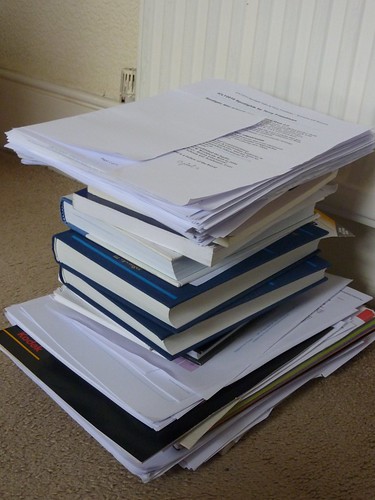
A little light reading...But another part of the reason is that it is now so easy to keep finding new sources of information to read and consider. The photograph represents the amount of reading I've done so far. Admittedly, this includes a few books, but the rest of it is, by and large, printed from the internet. In  fact, only this morning I accidently came across yet another article I think I ought to read.

Now, if I'd had to do all this research in my local library, as I used to before the web was invented, I would have stopped long ago. There comes a point where the likely benefit of reading one more article is outweighed by the cost (however measured) of acquiring it. That point is reached much sooner when you have to physically move from your home to a library (and possibly cart a load of stuff home afterwards).

What we have here is a modern manifestation of Say's Law, which states that supply creates its own demand. The reason I'm acquiring all this reading material is that it's so easily available. Perhaps too easily available.

Another example is in the field of writing. It is so easy to rewrite stuff that it's almost impossible to exercise the self-discipline required to say "That is now good enough." When trying a different turn of phrase, or looking up a nice quotation, or finding an appropriate illustration (or, in my case for this article, actually creating one) is so easy, the temptation is to keep on and on tweaking in the vain hope of achieving perfection.

Thirdly, lesson preparation has been made far more time-consuming now than it ever used to be, for all the reasons I've rehearsed so far. Worksheets and other resources tend to be more interactive, colourful, neat and engaging than ever. But I wonder if the gains in terms of students' learning are enough to justify the huge increase in person-hours that computer availability has led to?

(I'm sure I won't be the only person to be able to recount that some of my best lessons were the ones I thought of on the way in to work or even, sometimes, the ones in which I allowed a chance comment or question by a student dictate the content of the entire lesson, because the moment was there and had to be seized.)

Being able to answer such questions does not mean advocating a return to the steam age. But it strikes me that it would represent a much more honest appraisal of the relative costs and benefits of access to computer technology.

This is important, for two sets of people: teachers, because it's a workload issue, and students, who need to learn how to evaluate the effectiveness of technology. They should understand such matters both because it's all part of being digitally literate, and because otherwise it will become a workload issue for them too.

What all this boils down to is an economics argument. We tend to work, especially in education, on the basis of the well-known saying, 'If a job is worth doing, it's worth doing properly.'

This is almost never the case.

Think of it in terms of exam grades. If you advise your students to work as hard as they can to attain a grade A in your subject, the extra hours they spend doing so could mean their obtaining a lower grade in other subjects. Looked at from a higher perspective, what's better: one grade A and four grade Gs, or two grade Bs and three grade Cs?

Think of it in terms of lesson preparation. If you prepare one group's lessons absolutely perfectly, at the cost of being almost completely unprepared for all the others, would that be acceptable?

At the risk of sounding as if I'm advocating low standards (which I most definitely am not), I think we have to try to develop, and inculcate into students, the idea of 'good enough'. It's OK for things to be 'good enough': they don't have to be perfect.

Being a techno-addict (a boy who likes his toys), I imagine a technological solution. Perhaps a macro that will actually prevent you from working on a document any longer once a particular length of time has been spent on it. It would be easy to write.

Indeed, there is a free text editor that does something similar. Write or Die seeks to cure writer's block or slow writing by becoming more and more noisy and unpleasant as time limps on. It's almost impossible to continue in the circumstances it creates.

A technological solution to a problem caused by our inability to exercise self-discipline in our use of technology? I like it!


Less Waffle, Please

One of the things that educators, especially teachers, are really good at is talking. That's not intended as a criticism, just an observation. Talking is what the job is all about, regardless of what people say about becoming a guide on the side instead of the sage on the stage. Whether it's giving instructions, explaining a point, or teasing out of a student what she or he really understands, talking is what we do best.

But as in every other aspect of life, there are times when you can have too much of a good thing, and here is a case in point. I recently questioned the usefulness of a 'book' called the Field Guide for Change Agents, on the grounds that it's not a guide at all and contains no strategic advice whatsoever. This attracted two comments to the effect that the process by which the 'guide' was produced was really good in itself.

I don't doubt it, although I have to wonder why it took a whole room full of people an hour to produce a 47 page book consisting of quotations and pictures. Be that as it may, what we have here is the following, as far as I can tell:

  • A bunch of people think we need change.
  • It's not that clear what change they'd like to see, or why it's necessary, but still.
  • A book has been produced full of quotations about how wonderful we all are and how marvellous change is.

Nowhere in the book does it give much indication of how to bring that change about, except for a few slides along the lines of 'foster collaboration'. That's in a section called  The Change Agent Toolkit -- another misnomer: imagine if you went to your local DIY store and bought what you thought was a set of screwdrivers, only to discover when you got home that all it contained was vague bits of advice  instead of the tools and instructions on how to use them. The fact that this 'book' is free doesn't really negate that argument in my opinion.

If you're going to have a book of inspirational quotes, why not call it a book of inspirational quotes? But if you're going to produce a guide or a toolkit, then do that.

Reading this 'guide' reminds me of this cartoon:

More detail, please

(Sorry, I don't know to whom to attribute it.)

That, in turn, reminds me of all the worst team 'leaders' I have ever worked for. They would say, at the end of a meeting, "OK, so by next month X will have happened." And I would say, "How? By Divine Intervention?"

I have the utmost respect for the people who took part in producing this 'guide', and I'm sure the process was useful in many respects. But as a product, I have to say that, for me at least, the guide has questionable value.

Review of the Field Guide for Change Agents

I've been thinking a lot about change management recently. I think about it a lot anyway, but at the moment I am preparing a presentation I'm giving next month.

And so it was that I eagerly opened the Field Guide for Change Agents, which I heard about through Stephen Downes' OLDaily newsletter.

Now, I don't mean to sound too pedantic or critical, but it's not a field guide at all, at least not in the sense that I understand by the term. It looks pretty, and there are lots of inspirational-sounding quotations, but no real strategic guidance.

So I guess whether it's useful or not will depend on what you need at the time. I've bookmarked it for those times when I need an inspirational quote about change. But if you're in a job where you need to bring about a fundamental change on a whole school level, or even on a smaller scale, I doubt that you'd find this of much use at all.

Cool Tools for Ed Tech Leaders: TaskCoach

In this series I will be looking at tools that leaders of educational technology or ICT may find useful. In fact, anyone who needs to do project management should take the time to explore them.

TaskCoach is a task management application, and has a number of things going for it. But first, what does it actually do?

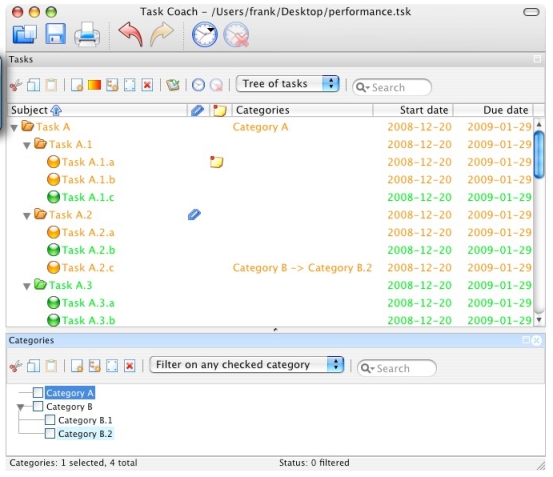
TaskCoachIt helps you organise tasks. You can have categories, which contain tasks, and within tasks you can have 'efforts'. I'm making it sound a lot more complicated than it really is! So let me describe how I use it.

I work for several clients, and so it's important for me to keep track of how much time I spend on various activities.

For example, let's suppose that for Client A I look for resources on the internet, represent them at meetings, and write a blog update once a week.

One of my categories in TaskCoach is therefore 'Client A', and there will be three tasks within that category, corresponding to the activities I've just described. I've configured these tasks with an hourly rate of pay.

Every time I work on one of the tasks I start a new 'effort'. That records how long I spend on the work, and because it knows what the hourly rate is it will calculate how much I've earned from that work. At the end of the month, I can easily see how long I have spent on each activity and therefore how much to invoice the client.

Moreover, should the client want me to, I can itemise the work not only by how much I've done per day, but even by each individual effort. For example, I can show that I worked for three hours from 6 am till 9, and then a further three hours from 2 till 5, or I can just indicate that I worked for 6 hours on that day. I could also view my efforts by weekly or monthly totals.

The only two things that are not that great are the export function, which seems to export the data in a text summary format, whereas the most useful option would be a detailed format that could be imported into a spreadsheet. The other is that I have, somehow, detached a window of the program from the rest of it, and I cannot for the life of me figure out how to stitch it all back together again! But that's a minor inconvenience.

If you don't work for yourself but work for an organisation, the hourly rate feature, or the budget facility (which lets you allocate a budget to the whole task), would still be useful.

Even if you don't charge clients for your time, there is still an imputed cost that is usually worth being aware of.

So what does this program have going for it?

  • It's easy to use.
  • It's accurate.
  • Tasks can be colour-coded.
  • It's free.

 It's been in alpha version forever as far as I can tell, but I haven't had any major disasters with it so far. It's available in versions for Windows, Mac, Linux iPhone and iTouch.

If you know of any tools that do a similar job, please leave a comment telling us about it.

The 30 Goals Challenge

#30goals When a long-time subscriber to my newsletter, Computers in Classrooms, emailed me to ask if I could recommend a blogger she should follow, I had no hesitation: Shelly Terrell, without a doubt.

Seemingly indefatigable, Shelly writes an amazing amount of stuff, all of which is high quality. Following her on Twitter is good for one’s professional development in itself, but her blog, Teacher Reboot Camp, is definitely worth a visit.

And worth subscribing to.

At the moment, Shelly is writing a series in which she is setting a new challenge every day for 30 days. Known as the Goals 2010 Challenge Series, this is an excellent set of posts that are:

  • Challenging
  • Replete with resources
  • Well-written

The upbeat tone of the articles, together with their good advice and questioning, serve to remind us of the sheer excitement of working in education.

I have to say I find some of the posts a bit long, so I tend to speed-read them much of the time. That’s not a criticism actually. I prefer long posts sometimes because I like something I can get my teeth into. Besides, Shelly often formats her articles in such a way (ie with bullet points and suchlike) that reading them quickly is not difficult.

I love her challenge about causing a ripple. In fact, I love the idea of this sort of series, and will be starting one myself soon, on a different topic. I’ve been intending to do it for ages, but have been waiting for the right time. Inspired by Shelly, I’ve now decided to start writing it while I’m waiting for the right time!

Another series you might like is Steve Dembo’s 30 Days to be a better blogger.

But check Shelly’s out first ;-)


No Articles For Nearly Two Days? How Come?

Imagine this. You're enjoying a lovely sleep, completely enwrapped in your duvet. Well, you're not enjoying it because you're asleep, but you know what I mean. You start to become aware of something wet and sticky, and a bit rough, in your ear. All of a sudden you know: it's a tongue.

Now, in some circumstances I imagine this might be quite pleasant. But when there's a cat at the other end of the tongue, it is arguably less so. That's how my day started off yesterday morning, and this morning too, at around 3:30 am. Couple that with a horrible chest infection that I managed to pick up at BETT and the usual sorts of deadlines, getting stuff out at my usual rate has been a bit of a challenge.

So, thanks for your patience. Look out for a special post-BETT edition of Computers in Classrooms, another instalment in the Web 2.0 For Rookies series, a post about challenges and the start of a new series (one of two new series) for ICT/ed tech leaders.

In the meantime, I thought you might like to see a picture of the miscreant who disturbed my beauty sleep. Note how overworked he looks. I'd include a picture of myself too, but the bags under my eyes embarrass me.

Cat at work

Games-Based Learning: 3 Things You Need To Know About

If Games-Based Learning is something you’re interested in, or something you don’t know much about but would like to explore, you’ll be interested in these 3 events.

The Games-Based Learning Conference 2010

The first one I’d like to mention is the Games-Based Learning Conference in London. This takes place on the 29th and 30th March, and I would say it’s essential to attend, for the following reasons.

  • I think – and have always thought – that games have tremendous potential for education, as you can see from my case study. It’s great to have a conference dedicated to this subject.
  • I attended the conference last year, and found it extremely stimulating. I met or attended sessions by people who are not on my radar at all.

    For example, I attended a short presentation by someone developing a so-called ‘serious game’ (I thought all games were serious; but what’s wrong with having fun anyway?) for a particular organisation at the time. As I had already arranged a visit by a group of teachers to the company to look at their IT systems, I was able to ask our host for a special detour to find out more about the simulations it had commissioned.

    I also attended one or two talks by academics, some of whom came from abroad. These talks brought an extra dimension to my understanding and knowledge of games-based learning.
  • Like the Handheld Learning Conference, which is also organised by Graham Brown-Martin, the GBL Conference has a very vibrant, upbeat, celebratory atmosphere. At the end of the Handheld Learning Conference in October 2009 I scribbled one word on my notepad: ‘exhilarating’. The GBL Conference is similar.
  • The organisers have been sensible enough to invite Derek Robertson of Scotland to give one of the talks. They’re doing brilliant things in Scotland – so much so that, having attended a Scotland-centred session at the Handheld Learning Conference, half of us were ready to emigrate there and then!

There’s an early bird discount if you book by the 31st January. The cost will be £345 + VAT, a saving of around £250. In addition to a fully inclusive 2 day conference, there is a social networking evening with drinks and the choice of an additional workshop hosted during 2010 in London by Playgen. Also, every ‘early bird’ will receive a FREE digital camcorder so that they can record parts of the conference that interest them. Hopefully this will encourage some video blogging and uploads to YouTube, etc, which should make an interesting addition to the usual Twitter stream and the more official Blip TV videos of the keynotes. There are also two newsletters available at:

General: http://bit.ly/57jJuG

Trade: http://bit.ly/5e4Zr2

To find out more about the conference programme and to register, go to the conference’s home page. And don’t forget: Early Bird registration ends on the 31st January.

Computer games, learning and the curriculum: uneasy bedfellows?

Another, very different, event you might like to attend is the Mirandamod event on the 9th March at the Institute of Education. Run under the auspices of Mirandanet, an academic group founded by Christina Preston, these typically take the form of a seminar at which two or three guest speakers give a presentation and the rest of us chip in, followed by a debate. What makes the experience quite rewarding is the following:

  • Unlike a conference, the atmosphere is a bit more intimate. I’m not talking about candlelit dinners intimate, but with a smallish number (around 20 or so) it’s easy to get to talk to most people there.
  • The event is live-streamed, so we receive comments and questions via Twitter and through the FlashMeeting videoconferencing system.
  • There’s a nice variety of speakers and attendees. This time, for example, Handheld Learning Award winner Dawn Halleybone will speak, as will Colin Harrison, Professor of Literacy Studies at the University of Nottingham, and Dominic Preston (Christina Preston’s son), who will talk about marketing issues.

I will be chairing this event, and look forward to meeting you in person or seeing you online. To find out more about it, read the details, and register, online.

Computers in Classrooms Games in Education Special Edition

The final ‘event’ is the publication of a special Games-Based Learning edition of Computers in Classrooms, my free e-newsletter. I have invited a number of guest writers to give their perspectives on games in education, and there will be reviews as well a prize draw for an award-winning game. Only subscribers will be entered into the draw, and as a subscription doesn’t cost any money, what are you waiting for?

If you have experience of using educational games, or of games in an educational setting, or views, why not share them with your fellow travellers on this road to enlightenment? I can accept articles ranging from ultra short (140 characters), to almost ultra short (50 words) to average (600 words) to rather detailed (1500 words). But get in touch to pitch me your idea first!

If discursive writing isn’t your thing, do have a look at my 50 Ways To Contribute To A Website. There’s sure to be something there to appeal to you!

That edition will be coming out in April, after the Easter break. There are some other great issues planned as well, including a post-BETT special. If you’d like to look at past issues and sign up (did I mention that it’s free?), just go straight here:

http://www.ictineducation.org/newsletter/


Did You Know We Appear To Have Lost All Critical Faculties?

OK, I admit it: I just don't get it. Did You Know, which is now in its 4th incarnation, has to be one of the worst videos of all time. All it does is present fact after fact (assuming they are facts), as if the facts in themselves are important.

Why, for example, do I need to know that more video has been uploaded in the last two months than if ABC, NBC and some other TV station whose logo I don't recognise had been airing new content continuously since 1948?

What does this fact even mean, except that millions of people now have the ability to upload videos to a website, where millions of people can watch them! I can see the point of saying that, but what's the point of making that comparison?

The facts are presented so rapidly, and some of the numbers are so large, that it's difficult to mentally process them, let alone evaluate them in terms of their potential impact. Imagine if reading was not your forté.

And that's the thing: it takes some doing to take a potentially really exciting medium like video, and reduce it to the equivalent of the worst kind of PowerPoint presentation. The only thing missing are the bullet points. Well, actually, they're not missing: they're just not visible as such.

This latest version has been produced in collaboration with The Economist apparently. When I read that I thought it might have been really beefed up. It turns out that the main change as far as I can tell is that some upbeat music has replaced the awful dirge that accompanied the earlier versions.

And yet this video or its predessors has 'gone viral'. It's shown in schools all over the place, where headteachers and principals, who one would have thought could exercise enough critical judgement to recognise an emperor with no clothes, say how fantastic it is.

Like I said at the start of this article, I just don't get it.

Anyway, here it is. Judge for yourself, and if you think I'm wrong, or you have found it useful in any way, please share your views via the comments section. Thanks.

Educational Uses for Microsoft's Deep Zoom

I was impressed by Microsoft's Deep Zoom Composer tool, which I saw demonstrated at the Naace conference 2009. Deep Zoom Composer lets you explore hi-res photos in a very innovative way, letting you get in closer and closer, or back away further and further.

You can see what I mean by looking at the demonstration shown on a video created by Ollie Bray.

The question remains: is this a solution looking for a problem? Probably. But I can see how this might be used in an interesting, and perhaps unintended, way.

First, though, watch the video:

Pretty cool, right? Now, it seems to me that where the thrill factor comes in as that at each stage of the process you think you have the full picture, and then discover that you were only seeing a small part of a much bigger picture. In a sense, this is an alternative way of depicting what the TV advertisements for the Guardian newspaper in Britain showed a couple of years ago:


Getting back to Deep Zoom, you could use it as a metaphor in citizenship, media or politics courses. You could also use it in science, geography or history. Basically, you could use it in any situation where you wanted the students to understand that everything that happens, happens in a particular context, and that sometimes you have to go quite a distance away, or quite a few years back in time, to really get an idea of just what that context might be.

Wordle Summary:

Wordle: Deep Zoom Composer Article