 How do you assess project-based learning? John Partridge explains how he has approached this issue.
Assessing project-based learning in Computing
How do you assess project-based learning? John Partridge explains how he has approached this issue. How do you assess project-based learning? John Partridge explains how he has approached this issue.
 Kathryn Day describes how she and her colleagues have approached the teaching of the Computing Programme of Study in Suffolk, England.
 We’re now in the age of the smartwatch. Motorola launched its version very recently, and the Apple iWatch launches today. Bring Your Own Watch (BYOW) has been with us for ages, but the smartwatch introduces a new challenge to those schools which do not agree with the Bring Your Own Technology (BYOT) concept.
 In this series I’m going to be making some suggestions, putting out some ideas. These are based on presentations I’ve given. I can think of how these ideas, or their implications, might be applied in the classroom. However, I think it better if I stand back and let you do that part of the work!
One of the most depressing things for me is the degree of conformity I come across.
In this series I’m going to be making some suggestions, putting out some ideas. These are based on presentations I’ve given. I can think of how these ideas, or their implications, might be applied in the classroom. However, I think it better if I stand back and let you do that part of the work!
There’s a really good chance that in some schools, or in some classes, the computing curriculum will be just as boring as the old ICT curriculum was accused of being. I think the basic starting point for any scheme of work should be a simple proposition: using technology is mostly enjoyable. It can also be exciting. Therefore, learning about technology should be equally enjoyable and exciting. If it isn’t, something is wrong.
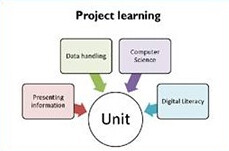 John Partridge, Assistant Head for eLearning, explains how Computing is taught through a project-based learning approach at his school.
I remember clearly looking at the first draft of the new curriculum and just being totally shocked by the degree of change. It had been clearly signalled that the new draft would be a step-change, but I didn’t appreciate the shift which was about to take place. Almost nothing remained from the previous programme, save a few references to digital resources and, in a later draft, safe use of technology. So it was clear that some serious work was going to be needed to make sure our school adapted.
 I've been giving talks on preparing for the new Computing curriculum, and as well as waxing lyrical that also involves listening to others' concerns. It also means hearing about some innovative approaches that colleagues have adopted.
At the same time, I have been conducting a survey of what people have been doing to prepare for the new curriculum. I'll be publishing the results in due course. In fact, some of the resources mentioned in the collection of coding resources in the early July 2014 edition of Digital Education came to my attention from that survey.
So, given that at the time of writing there's about 2 or 3 days to go till the end of term, what can you realistically do at this stage to prepare for September?
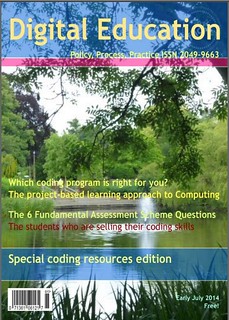 The new edition of Digital Education, the free newsletter for those with a professional interest in educational ICT and Computing, has a special focus on resources you can use to teach coding. Here’s what it contains:
In each case I have kept the text of the DfE’s announcement, and then added my thoughts under the heading “Applying this to Computing and ICT”.
Today: Cognitive Development.
 A couple of months ago I invited people to contribute to a survey about what they were doing to prepare for the new Computing curriculum. About 75% of my motivation for doing so was to help to spread ideas. I believe in the grass roots sort of approach to such things, as opposed to the ‘great and the good’ declaring what the rest of should be doing. Actually, to clarify, I don’t mind if the great and the good are doing it or have done it themselves. I find it tedious when people who have never been a teacher and/or had little contact with schools start issuing advice. OK, rant over!
 The DfE recently announced the winners of its Assessment Innovation Fund.Over the next week or so I will report on the winners and the descriptions of their approach. These descriptions are more like thumbnail sketches at the moment. I have used them to suggest ways in which they might be adapted for use in assessing ICT and Computing. I hope you find these suggestions useful, or at least a good starting point for your own further work.
In each case I have kept the text of the DfE’s announcement, and then added my thoughts under the heading “Applying this to Computing and ICT”.
Today: Progression planners.
In each case I have kept the text of the DfE’s announcement, and then added my thoughts under the heading “Applying this to Computing and ICT”.
Today: An iterative approach.
The DfE recently announced the winners of its Assessment Innovation Fund.Over the next week or so I will report on the winners and the descriptions of their approach. These descriptions are more like thumbnail sketches at the moment. I have used them to suggest ways in which they might be adapted for use in assessing ICT and Computing. I hope you find these suggestions useful, or at least a good starting point for your own further work.
In each case I have kept the text of the DfE’s announcement, and then added my thoughts under the heading “Applying this to Computing and ICT”.
Today: Another Ladder approach.
I am always suspicious of things that everyone agrees about – mainly because I usually find myself disagreeing. I would not be so arrogant as to believe that everyone else is wrong and I’m right, but I do often think that it would be good to evaluate what is taken as read in light of our personal experience and pedagogical expertise.
Here are just three examples of what I’m talking about.
In each case I have kept the text of the DfE’s announcement, and then added my thoughts under the heading “Applying this to Computing and ICT”.
Today: A Growth Mindset approach.
(c) Terry Freedman All Rights Reserved