The things you can do with data! Part 1

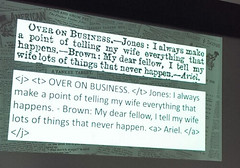
Victorian JokeI found it difficult to sleep last night. The reason is that I attended a symposium yesterday, and was exposed to so many new ideas that I’m having to do quite a bit of processing. Actually, that’s quite exciting. I often enjoy conferences, but rarely come away buzzing from them. Now, I normally wouldn’t write about a conference so soon after attending it, but I wanted to bring a few things to your attention straight away. I’m sure you’ll find them interesting in their own right (at least, I hope you do), and you may wish to discuss them with your students. It’s all part of my quest to show that computing and ICT can be interesting and enjoyable, and not just for geeks.

Read More

How can teachers get to grips with computer programming, and where do we start? By Lawrence Williams

Pupil using Scratch, by Lawrence WilliamsMany teachers have been utterly dismayed by the seemingly impossible demands of the new Programmes of Study for Computing. How can we all suddenly develop a wide range of new skills in Computing? Can our pupils, aged from only 5 years, really understand, write, and debug computer programmes? It seems an impossible task. But help is at hand…. And from a teacher of English, with no Computing training! (Though with some experience in using ICT.)

Lawrence Williams explains.

Read More

Ideas for the computing curriculum: #3 Be self-referential

ideaIn this series I’m going to be making some suggestions, putting out some ideas. These are based on presentations I’ve given. I can think of how these ideas, or their implications, might be applied in the classroom. However, I think it better if I stand back and let you do that part of the work!

I know that this is counterintuitive, but what if you devised an activity to teach programming or computational thinking, but instead of of just telling the kids what to do, you make them solve a problem first – by applying computational thinking or some elementary programming?

Read More

Ideas for the computing curriculum: #0 What box?

ideaIn this series I’m going to be making some suggestions, putting out some ideas. These are based on presentations I’ve given. I can think of how these ideas, or their implications, might be applied in the classroom. However, I think it better if I stand back and let you do that part of the work!

One of the most depressing things for me is the degree of conformity I come across.

Read More

Ideas for the computing curriculum: #1 Talk to the lamp post

ideaIn this series I’m going to be making some suggestions, putting out some ideas. These are based on presentations I’ve given. I can think of how these ideas, or their implications, might be applied in the classroom. However, I think it better if I stand back and let you do that part of the work!

There’s a really good chance that in some schools, or in some classes, the computing curriculum will be just as boring as the old ICT curriculum was accused of being. I think the basic starting point for any scheme of work should be a simple proposition: using technology is mostly enjoyable. It can also be exciting. Therefore, learning about technology should be equally enjoyable and exciting. If it isn’t, something is wrong.

Read More

Quick look: Literacy from Scratch

Scratch ProjectIf you’re concerned that young children won’t be able to grasp computing concepts, or are worried about how you’re going to teach it, have a look around the Literacy from Scratch website.

Managed – and, I think, written by – Lawrence Williams, the  website contains examples of pupils’ work in Scratch, cross-curricular ideas and examples, and notes on pedagogy.

Read More

Review of Espresso Coding

esspresso code 1This application is designed to teach Computing at Key Stages 1 and 2 (a more sophisticated version for older pupils is being worked on).

What struck me immediately on using it is the amount of guidance available, both in verbal form and videos. There is quite a large range of modules to choose from, including “Starter” ones which take you through the basics and, where appropriate, recapitulate what has already been learnt.

Read More

Review of J2Code

j2code 6As usual, I gave this application a workout without seeking help from a manual or anything like that – which is just as well because there does not seem to be a comprehensive manual.

There are three applications in one: JIT5, LOGO and Visual. This is quite useful because if you are familiar with LOGO but not JavaScript, you can start pupils coding in an environment that is familiar to you. Also, if you teach very young children, JIT5 is highly visual and colourful.

An advantage of J2Code as a whole over 2Code is that it covers the age range from Key Stage 1 (5-6 year olds) to Key Stage 3 (13-14 year olds).

Read More

Awarding Levels in Computing for the purpose of number-crunching

It’s all very well coming up with weird and wonderful ways of acknowledging students’ achievement, but at some point somebody, unfortunately, is going to ask you for a number. The number is important to them because they can enter it into  spreadsheet and show, hopefully, that the numbers go up over time.
Read More

A is for Assessing Computing: 16 criteria and 5 considerations

A student writes a program. What are you going to assess it on? There are at least 16 criteria you could take into account. Not all of these will be apposite – it depends on what you’re teaching and who you’re teaching. Also, I’ve framed the list below in teacher language; it’s up to you to adapt it into language that is more appropriate for your students.
Read More

The Magic of Human-Computer Communication

Palming Card Trick Magic Macro 10-19-09 3Magicians demonstrate that some kinds of human mistake are not down to stupidity or negligence but about how our brains are wired. Computer Scientists have to understand this too but instead engineer systems so no one makes mistakes – especially in critical situations like a hospital. The machines need to help not hinder. Professor Paul Curzon explains...
Read More

The (digital) revolution comes to the London Barbican

Digital Revolution explores and celebrates the transformation of the arts through digital technology since the 1970s. The exhibition brings together for the first time a range of artists, filmmakers, architects, designers, musicians and game developers pushing the boundaries of their fields using digital media. It also looks to the future considering the impact of creative coding, DIY culture, digital communities and the creative possibilities offered by technologies including augmented reality, artificial intelligence, wearable technologies, robotics and 3D printing.
Read More

Update on the Computer Education Project

DSC04520A couple of months ago I invited people to contribute to a survey about what they were doing to prepare for the new Computing curriculum. About 75% of my motivation for doing so was to help to spread ideas. I believe in the grass roots sort of approach to such things, as opposed to the ‘great and the good’ declaring what the rest of should be doing. Actually, to clarify, I don’t mind if the great and the good are doing it or have done it themselves. I find it tedious when people who have never been a teacher and/or had little contact with schools start issuing advice. OK, rant over!
Read More