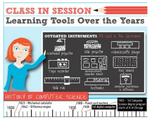
Learning tools over the years
We need ICT teachers, not facilitators
When did ICT teachers stop becoming teachers and become ‘facilitators’ instead? I’ve largely managed to ignore this sort of nonsense but now it’s getting out of hand. The other day someone said on Twitter or Facebook that he is an ‘active facilitator’, while someone else shared a sign which read “I am not a teacher; I am an activator.”An Interview with Naace ICT Impact Lifetime Achievement Award Winner Dr Christina Preston
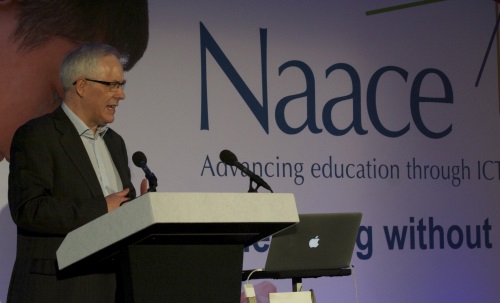
Christina Preston was one of two people given the Lifetime Achievement Award at the 2013 Conference of Naace, the subject association for ICT. I interviewed her to find out about her and her work.
Naace ICT Impact Awards - A Profile of Penny Patterson
Penny Patterson is on Twitter, but prefers to listen rather than talk, unless she has something of value to add to the conversation. She is active in ICT circles, though doesn’t have her own blog. And if you visit a conference she’s speaking at, you’re likely to chat to her while she serves the tea. She prefers, to use her own words, to be “one of the backroom team”.
Indirect evidence of this was seen in this year’s Naace ICT Impact Awards. When Penny was selected as one of the two people to be given a Lifetime Achievement Award, the look on her face was one of surprise, bordering on shock, and tinged with bewilderment. Typically, she told me that “other people deserve this award far more than I do.”

The Naace ICT Impact Awards
Terry Freedman considers why the Naace ICT Impact Awards are such a valuable feature of the educational ICT landscape in the UK.
Some years ago I was driving in America, and I passed a school with a massive sign which read: “Chuck Evans*: Teacher of the semester!”
Lessons from Reviewing the new Computing Curriculum
This is not so much a review or even a summary of the recent Westminster Forum Conference called ‘Reviewing the new Computing Curriculum’ as a series of observations arising from it and related articles. The reason for that approach is that I’d like to make this article useful and interesting to as wide a range of people as possible, not only those concerned with the ICT or Computing Programme of Study in the National Curriculum in England and Wales.It doesn’t have to be pink
I turned my collar up against the wind. A useless gesture, because the wind contemptuously insinuated itself under my skin regardless, but it made me look hard. And hardness was needed in this job. I walked around the playground, glaring at kids who even just looked like they might be thinking of doing something wrong. Crowds of them parted as I approached. One looked shifty.
“You got a problem, son?” I gritted.
7 images of London
I’ve had the enormous pleasure of having to go into London two days running! “Pleasure?!”, you say. “What? With all those people?” Definitely. In fact, it’s partly ‘all those people’ that make it a pleasure. That, the architecture, the general buzz. I’m definitely with Samuel Johnson on this one:
Sir, when a man is tired of London, he is tired of life.
Which is partly why I always carry a camera around with me. As I explained in Pictures as stimuli, pictures can act as, erm, stimuli. You should always carry a camera of some sort around you, and so should the kids you teach. Oh wait, yes, many of them probably have mobile phones that can take photos and video. Fantastic!
BETT 2013 Interviews: Simon Finch
E-safety guru Simon Finch talks about why pupils should be allowed to use social media, why teachers should use it, e-safety and identity management.BETT 2013 Interviews: Yolanda Halston
In this video, Yolanda Halston, of the Educational Apps Store, talks about pupils collaborating and other matters.Reading and technology
What do you think of when you see the words “reading” and “technology” in the same sentence? I tend to think of e-book readers and how easy it is to transfer stuff to, and then read, on my phone. But there is more to it than that. According to Dyslexia Action, around one in ten students struggle to read standard print.
F is for … Flash Fiction
Assessing what pupils have learnt in ICT is important, obviously. Why shouldn’t it be enjoyable as well as necessary? One approach you might wish to experiment with is flash fiction.
E is for… Equality
Equality is a big issue in education, especially in connection with technology. For example, we are used to hearing phrases like “the digital divide”. But what does “equality” mean in this context – or, more pertinent perhaps, what should it mean?
A Map of the Internet
I recently discovered this map of the internet through Stephen Downes’ newsletter, OLDaily. Downes says, “It’s mostly eye-candy, but it’s good eye-candy”. I prefer to think of it as “interesting” eye-candy. It’s visually attractive, but what I find interesting is the fact that the descriptions are not necessarily value-free.
5 ways to establish credibility on your blog
I don’t know what it’s like living in other countries, but here in England we are fortunate indeed. If I want to have a discussion on any subject at all, I can simply walk into the pub nearest to where I happen to be at the time, where I am virtually certain to discover a self-styled “expert” declaiming about the economy, or what’s wrong with kids today, or how to solve the financial crisis, or whether or not kids should be taught how to programme, or how the entire education system should be put right.
D is for… Data Protection
The topic of data protection looks as dry as dust in some of the syllabuses I’ve seen. They tend to focus on the legislative aspects, which in my opinion should be dealt with last of all.
Heard any good books lately?
When it comes to “personalised learning”, which has been the mantra of the educational world for as long as I can remember, paper books offer the least personalised experience of all.Typewriters? No thanks!
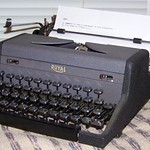
There is something romantic about an old manual typewriter. The clattering of the keys sounds somewhat industrial, which connotes “industrious”. Bashing away at a typewriter is what real writers do. No spellchecker, no thesaurus, no internet, and no forgiveness if you make a mistake. So typing something that looked reasonable, and which didn’t involve too much correction fluid, gave one a sense of achievement.
A is for … Assessing ICT
How would you rate the apple pie shown in the photo? Yes, I know the first thing that comes to mind is probably “Disgusting!”, because my food presentation skills are not what they ought to be. (Believe it or not, the apple pie depicted has not been eaten.) But how you assess my efforts must depend on what exactly you’re looking for. (I realise this is kind of obvious, but please bear with me.)