
Back through the time tunnel: the effects of technology on lifestyle, and techno-romanticsm

Time tunnel

P1040894.JPG

I watched an interesting TV programme last night. Called Electric Dreams, the programme followed the fortunes of a family whose home had been transported back in time to the 1970s. Each day brought a new year, and the technology that went with it.

Some insightful connections were made. For example, as the freezer began to make its way into people’s homes, it became feasible to do a weekly shop rather than a daily one. That, in turn, freed women (mainly) up to do more things besides housework.

I think a programme like this can be useful to show to youngsters for two reasons. Firstly, to help them perceive that there is a history behind the devices that they take for granted today. I remember one young lady being incredulous when she realised, from something I said, that there had been a time before video players! I don’t know why I think this is important, I just do.

Secondly, it’s useful to be able to explore the possible connections between technological innovation and lifestyle, as with the freezer example above. Most ICT courses include a section on the impact of technology on society, so this would not be time wasted.

Of course, and this is another avenue worth looking at, technological innovation is, at first, enjoyed only by the few. With freezers and colour televisions costing the equivalent of several weeks’ earnings, they could not be bought by everyone when they first appeared in the shops. Is this still the case now? I think it probably is, but my perception is that the time it takes for the price to fall is much shorter than it used to be.

One of the things I do find frustrating about such programmes, although this one was refreshingly honest, is the prevalence of what might be called ‘techno-romanticsm’. What, I ask myself, was so great about not being able to start my car on a cold winter’s morning? What was so wonderful about cassette-driven computers that took ages to be ready? The past may have been OK when we were living in it, but who would wish to go back there?

The lady of the house thought that it would be nice to get back to a time when families spent more time with each other, before technology was so ubiquitous. Am I missing something, or is she saying that the technology, not she or her husband, dictates what happens in their own home? That is like my saying I long for the time when there were only 5 TV channels to watch, because then I would spend more time with my wife. The solution is simple: switch the TV off and sit and read or talk!

I found it interesting that one of their children (none of whom had ever used a record player before) liked the idea of having a vinyl album because it was tangible, unlike music downloads. I also found it interesting, returning to the theme of how technology influences lifestyle, to reflect that whereas thirty years ago sending a child to their room was seen as a punishment, because there was nothing to do there and they would be incommunicado, now it would be seen as a reward!

As far as teaching was concerned, I enjoyed pushing the boat out with technology to see how it might be used in learning and teaching (and still do). But having to book a computer room at the Institute of Education for my evening class students back in 1982, or having to post my students’ decisions and then wait a week for the computer results may have been fine at the time, because we knew no better. But who in their right mind would look back on all that as some kind of golden age?

The past may be interesting, even fascinating, but the best thing about it, as far as I’m concerned, is that it is the past!

You can see the programme I've referred to, for a limited period of time, by following the TV link on the Electric Dreams website. The 1980s are next.
The Internet: Empowering or Censoring Citizens - A talk at the RSA

I attended a fascinating talk at the RSA last week. In a lecture entitled “The Internet: Empowering or Censoring Citizens”, Evgeny Morozov questioned whether the internet really is the means to inevitable freedom and democracy it is often portrayed to be.


‘So what?’, you may ask. From an educational point of view I think this is an important topic for discussion for two reasons. The first is that, in general terms, we should take every opportunity to ‘force’ students to think for themselves. When I was a teacher, I usually adopted Oscar Wilde’s stance:

“Don't say you agree with me. When people agree with me. I always feel that I must be wrong.”

Students need to be encouraged to seek questions, even if the answers are not as readily forthcoming.

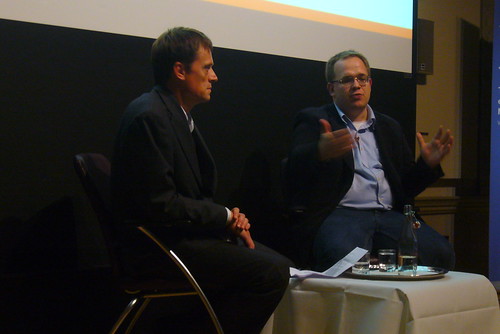
Matthew Taylor and Evgeny Morozov at the RSA

Matthew Taylor and Evgeny Morozov at the RSA

Secondly, in every ICT course, apart from purely skills ones, there is a section on the effects of technology on society. By examining issues such as whether or not the internet is automatically a means of distributing power more evenly in a society, the teacher would be addressing the spirit (if not always the letter) of that section.

Morozov challenged the view of the people he refers to as ‘cyberutopians’ that connectivity + devices = democracy. Some states, he pointed out, are using the web to crack down on dissidents.

In his talk, the link to which is given below, he described a number of ways in which some countries are using the power of the web to curtail, rather than to extend, democracy and freedom. If you think about it, it is obvious that web 2.0 applications are not inherently good or bad, so why would it be so surprising to discover that countries use them for their own ends?

In this context Morozov spoke of the ‘spinternet’. The idea is that when deletion of content is, in effect, impossible, the next best approach to dealing with what we might call off-message sentiments is to use political spin to defuse the issue.

The general and simplistic view seems to be that once every young person in a country has an ipod, they will miraculously turn into democrats. This ipod liberalism, as Morozov terms it, represents a deterministic view. It seems to me to be pretty insulting too. After all, if someone gave you an ipod, would your principles and beliefs suddenly fly out of the window? I realise that that is a somewhat simplistic counter-argument, but no more so than, it seems to me, the argument itself.

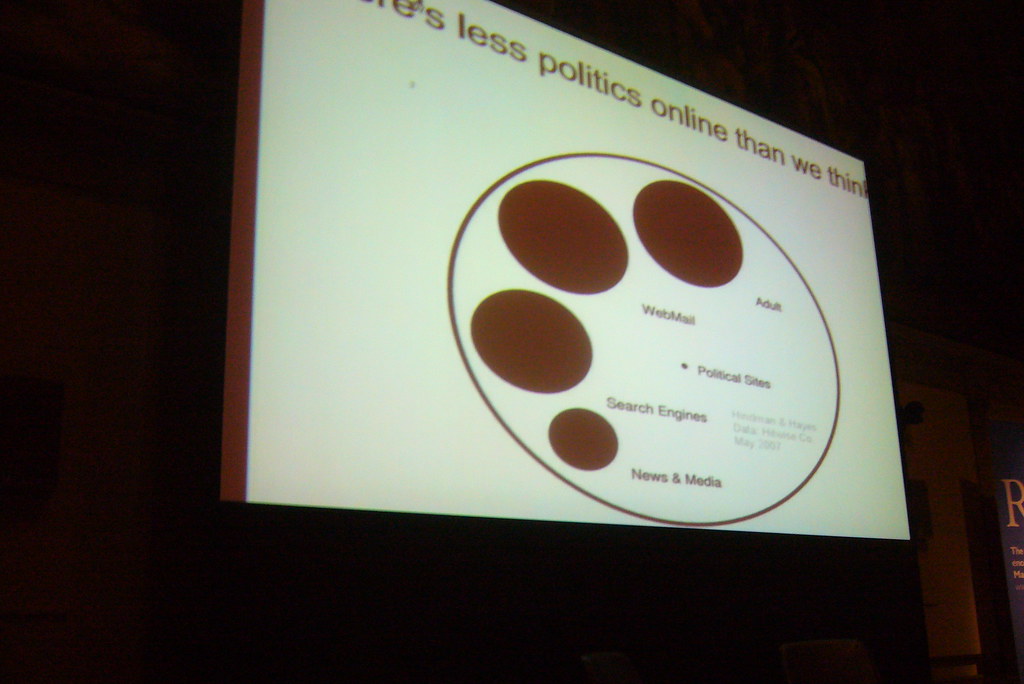
In any case, a more realistic approach would be to recognise the existence of cyberhedonism: most people are not interested in politics, as shown in this illustration:

 Evgeny Morozov's talk at the RSA

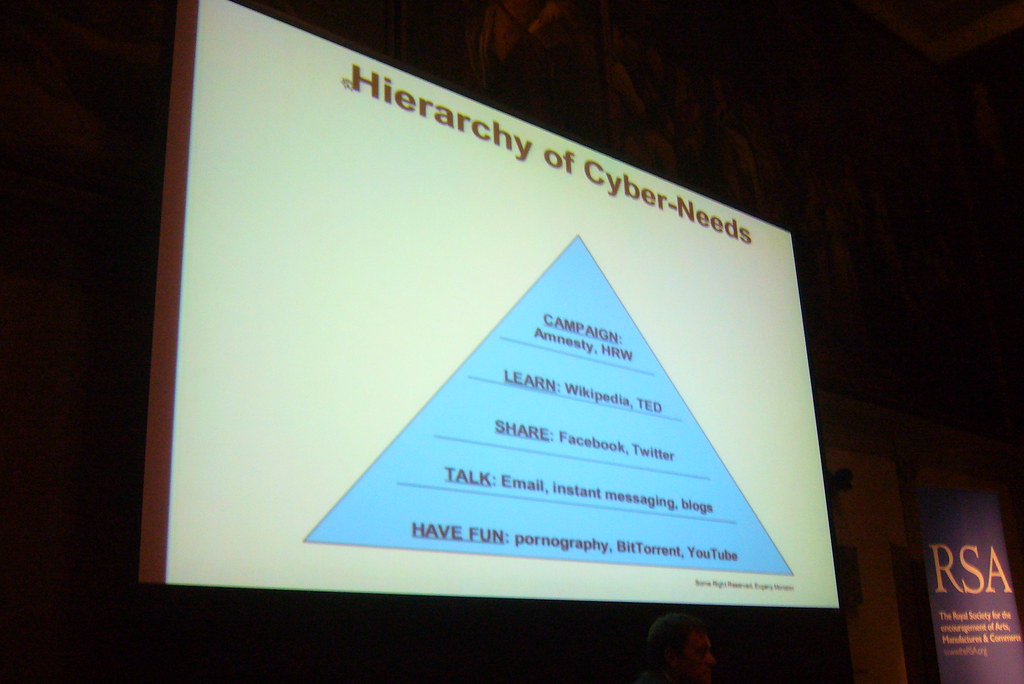
And perhaps we need to borrow from Maslow and draw up a hierarchy of cyberneeds (see illustration below). In this paradigm, internet users start by satisfying their basic ‘needs’ – for pornography, file-sharing and video downloading – before progressing to less self-centred activities.Evgeny Morozov's talk at the RSA

Towards the end of his talk, in an almost throwaway comment, Morozov vividly illustrated the power of the web in the ‘wrong’ hands. In the past, he said, a totalitarian regime would have to torture an activist to find out the names of his associates. Now all they have to do is go on Facebook.

Of course, it’s easy to point the finger at totalitarian regimes, but even in countries like the UK and USA, power is not evenly distributed on the web. For example, half of Wikipedia’s articles are accounted for by only 10% of its users (Clay Shirky has drawn attention to this sort of thing as well). There is nothing nefarious in this, of course, but it’s salutary to bear in mind that, according to Morozov, the average person stands only a 2% chance of being mentioned on the front page of Digg. Hardly an even distribution of influence.

It seems to me that a number of questions might fruitfully be discussed with students:

What do you think of Morozov's arguments?

Is the concept of a hierarchy of cyberneeds a useful one?

Does it exist?

Where would your students place themselves in that pyramid?

Where would you and your colleagues place yourselves?

If web 2.0 applications can be manipulated by governments and even individuals, how can one guard against being taken in?

Is being digitally literate enough?

One of the key points to come out of a discussion about these issues would surely be that of identity? Morozov focused mainly on the use of Web 2.0 applications by non-democratic governments, but the truth of the matter is that you actually don’t know who you’re ‘talking’ to in any online space unless you do a bit of research and cross-checking. How do you know that the word-of-mouth recommendation you have just received is genuine?

How do you know whether or not the person ‘bad-mouthing’ a particular product is working for a rival company?

How do you know if an Amazon book review is genuine?

And is it not crucial, therefore, that we take some issues out of the ‘niche’ area of e-safety and bring them into the mainstream, or widen the definition of e-safety to include such issues?

Further reading:

Read Matthew Taylor's blog post about this (which centres on the political rather than educational implications of Morozov's address) and, especially, the comments. I especially like Taylor's conclusion:

The web is changing culture, relationships and organisations. Its effects are real and important. Sometimes they are good and sometimes not. The exaggerated claims of those who say the internet is inherently a destroyer of organisations and hierarchies or that it is bound to lead to greater democracy and collaboration are an unhelpful distraction from the important study of the internet’s real impact on real lives.

The internet society – time to get real

Listen to Morozov's talk