A blast from the past -- with the emphasis on 'blast'. What I thought of self-service checkouts when they first appeared.
Read Morebananas, by Terry Freedman


bananas, by Terry Freedman
A blast from the past -- with the emphasis on 'blast'. What I thought of self-service checkouts when they first appeared.
Read More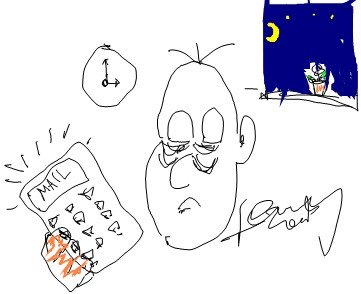
email deluge, by Terry Freedman
Three ways I’ve been dealing with a surfeit of email.
Read MoreWhat was so wonderful about cassette-driven computers that took ages to be ready, and which made it time-consuming to find the right section?
Read MoreJust a couple of cogitations – hopefully worthy -- about technology and our relationship with it.
Read MoreDid Samuel Pepys carry a quill and an inkwell around with him?
Read MoreYou can just imagine the family rows of the future, should technology ever reach the point where it isn't possible to distinguish between humans and non-humans merely by looking at them.
Read MoreHaving to wait a week for computer results may have been fine at the time, because we knew no better. But who in their right mind would look back on all that as some kind of golden age?
Read More
A blast from the past -- with the emphasis on 'blast'. What I thought of self-service checkouts when they first appeared.
Read More Just a couple of cogitations – hopefully worthy -- about technology and our relationship with it.
Is there any advantage in having an analogue watch face to a digital one, or vice versa?
 It’s strange, is it not, how certain linkages occur, what some would call coincidence , and others synchronicity ? Yesterday, the mobile phone was the common factor for me, and continued to play a part: I became so engrossed in responding to an email that I missed my station by two stops, and had to backtrack!
I think that cartoonists often are among the most perspicacious of us when it comes to reflecting on the (side) effects of technology. I particularly liked today’s Alex cartoon in the Daily Telegraph about the effects of the iPad on people’s expectations whilst travelling on trains. Take a look, and bring a smile to your face.
How might you use this as a starting point for discussion with students about how technology changes our expectations in a whole variety of contexts?
The original link in the above post was changed by the Daily Telegraph -- good job I spotted it! All corrected now!
 Teachers looking for material with which to furnish their lessons on how technology affects society need look no further than email. This form of communication has affected in at least three ways what might be called “disposable time” – the time one has left after the essentials like eating and sleeping have been taken care of.
 For an interesting discussion with your students on the effects of technology on society, consider the impending solar flares.
As the article states:
The so-called "X-flare" could also cause radio signals to jam, satnavs to fail and electrical power grids to falter. Electromagnetic storms are already reported to have stopped shortwave radio communications in southern China.
The great thing about technology as far as writing is concerned is that we need never forget a brilliant idea. I sometimes think to myself how much I admire writers (or, indeed, anyone) in centuries past for writing anything at all. I mean, if you're travelling on foot or by horse and carriage in the 18th century and you have a great idea for a story, how do you jot it down? Did Samuel Pepys, for example, carry a quill and an inkwell around with him?
I suppose that most of the time such issues never affected most people. Only a small elite was able to read, and en even smaller elite able to get their work published. But what of the present?
One of the words people use to describe me is 'prolific'. If that's the case, how do I manage to write so much? I think there are three factors.
Firstly, I have lots of ideas for articles. In this respect I don't think I am any different to anyone else.
Secondly, I act on those ideas. I think that probably in this respect I am different from a lot a people. I've met plenty of wannabe writers who bemoan the fact that they have never had anything published, forgetting the inconvenient fact that in order to do so you actually have to write something. Maslow distinguished between primary and secondary creativity. The former is having the ideas and creativity in the first place. The latter is being prepared to go through the agonising process of writing something, tearing it up, and starting again. This, for example, is my second attempt to write an article connecting writing with technology. I spent nearly an hour on the first one before deciding it was a lost cause.
Perhaps this is what Oscar Wilde meant when he said:
This morning I took out a comma and this afternoon I put it back in again.
And read Gerald Haigh's comment on my post entitled The Right Writing Style. He says:
Time and again, when I write an article, I go back and cut the whole of the first para. That's because I've sort of used it to get up speed, and it ends up being quite redundant. The general point is that ruthlessness with the virtual scissors is essential for all writers. "Kill your babies" is oft-used saying -- i.e. don't be afraid to cut favourite lines. You may be the only one who thinks they're any good.
Thirdly, how do I ensure that I remember the ideas I have? In my time I have used several kinds of technology to help me:
· A notebook and pen. You can't beat it for speed, reliability and robustness.
· A cell phone. I use the notes feature to jot down some points.
· Alternatively, sometimes I will leave a message for myself on voicemail, so it will remind me when I arrive home.
· I've sometimes used digital recorders to record my thoughts whilst driving.
· I'm pretty good at creating visual prompts for myself. I always carry a camera around with me, or there is always my cell phone. A well-chosen photo is often all I need to remind me of what my earth-shattering idea was.
· I used to have a pocket computer called a Psion Organiser which I always carried around with me. It had a qwerty keyboard and I managed to get quite fast on it. I once even composed an entire issue of my newsletter, Computers in Classrooms, on it. Sadly, the ravages of time have rendered the screen virtually unreadable to me now, but I cannot bring myself to get rid of this wonderful little device.
· If I am out and about with my netbook and have discovered a nice cafe with a free wi-fi connection, I jot my ideas down in Google Docs, from where I can retrieve them once I get back home.
· If the nice café does not have wi-fi access, undaunted I will use OpenOffice for my scribblings.
· Finally, however I have recorded my ideas, I enter them into a Word document I have created called, erm, 'Article Ideas'. That keeps them fairly secure, in case I lose a notebook or my phone or another device gets trashed. I've tried those things which create a wordprocessed document from your handwriting, but my handwriting has become so illegible over the years that I spend more time correcting and spell-checking than I would spend typing it up from scratch!
Unlike Samuel Pepys, we don't have any excuse for forgetting ideas for articles if you're not within reach of a quill: think tech, and you can't go wrong!
One of the problems with targets is that, in order to show that you’re meeting them, the temptation to cheat becomes greater and greater. Perhaps ‘cheat’ is too strong a word. After all, what goes hand-in-hand with targets is back-covering. Don’t be surprised if people start to spend a disproportionate amount of time showing that they’ve met their targets, even assuming they are still pursuing targets worth bothering about. This is one of the things I’ll be covering in my seminar at BETT, Driving Your Vision (and I’ll be suggesting an antidote too!).
The Daily Telegraph reported recently that some police forces in Britain are spending their last hour of the day in the police station compiling notes of who they spoke to during the day – in order to prove that they are meeting their target of being visible to the public.
Think about that for a moment.
If the police, or any other group for that matter, are spending time proving that they are meeting a target, and thereby not meeting that target at that particular time, something has gone wrong somewhere. However, let’s be realistic: target-setting is no bad thing in itself – quite the reverse, in fact. But it’s surprising that the police appear not to be using a technological solution to their dilemma. Here are four suggestions to start with:
And, of course, these solutions are not mutually exclusive.
Admittedly, I’ve been slightly tongue-in-cheek in this article, but that’s more a reflection of the time of day and the time of year I’m writing. On a serious note, why would any profession in this day and age spend time and labour compiling or completing records when there is almost certainly a perfectly good technological alternative either readily available, or which could be created?
These are issues you might wish to discuss with your students. You will almost certainly touch on other things, such as:
It would be interesting to hear what your views are on such matters, and the views of your students of course.
I offer this rant partly to get things off my chest -- I think I now officially qualify for the title "grumpy old man", even though I don't much care for the "old" part -- but even more so as a topic which teachers may like to raise with their students. The basic question is, I think, is technology being used inappropriately, or intrusively or even, ultimately, ridiculously?
I visited my local supermarket yesterday and decided to use the self-service check-out. This is a very advanced service which seems to require there to be at least two members of staff on hand at all times in order to sort out the problems it comes up with. If I tell you that I, of all people, have developed what amounts to a phobia about using it you may get a sense of how awful I think it is most of the time.
It isn't that the problems which arise are terrible in themselves, just that it's so embarrassing when a line of people is building up behind you. And that's another thing: it works perfectly when nobody else is around....
Just to put the positive side to the equation, I will admit to having found it much faster, sometimes, than the normal check-out, and it is undoubtedly more fun. There is a video game-type display showing you what to do, and a voice which guides you though the process. That voice is female and was chosen, I am certain, to sooth the nerves of people such as myself and thereby prevent acts of vandalism directed towards the machinery.
But yesterday even I was floored by a message that appeared on the screen.
Before going any further, I have to inform non-UK residents that we in England have reached the point where anyone who sells anything is scared to death of being sued. Thus it is that if you buy a drink from a fast food outlet you'll see a notice on the cup informing you that the contents may be hot -- even if you've purchased an iced tea. On foodstuffs, just about everything contains the warning, "May contain nuts". Bizarrely, bags of nuts do not come with such a warning. I must contact my attorney....
Even food which could not possibly contain anything even resembling a nut comes with the caution that it may contain traces of nuts, or that it was processed on machinery that may once have been used to process nuts.
Medicine packets list every single possible side effect of the contents therein. So, if 3 years ago someone took one of these tablets and then 2 weeks later his left leg dropped off, one of the possible side effects listed will be "May cause leg to drop off."
Back to the supermarket. The way it works is that you scan the item, then drop it into a plastic bag. The item shows up on the screen, then you're ready to put the next one on. One of the items last night was a box of painkillers. I scanned it, dropped it in the bag, and then had a warning message appear reading something like: "You have bought painkillers. You cannot buy any more unless you are authorised to do so. Are you authorised to do so? Yes/No"
Authorised? By whom? My mother? The store manager? I pressed "Yes" and it let me continue. In discussion with my wife we decided that it must be the store's way of protecting itself against prosecution by the families of people who decide to end it all by taking an overdose of painkillers. Presumably such people are too depressed to think about buying one huge box, buying several small boxes in several shops, or just to press "Yes". Perhaps there is some law that states that nobody is allowed to sell anyone more than one box of painkillers at a time.
Perhaps this idea could be extended to other areas of modern life? How about this: when you press the button on a traffic light, suppose a message came up: "Crossing the road is dangerous. Have you been authorised to do so?"
Homes could be fitted with such a system, so that as you go out of the house you're warned that "There are muggers and drunk drivers out there. Don't do it!" And when you put your key in the door to come in: "You do realise, I hope, that most accidents happen in the home? Do yourself a favour and head to the nearest hotel. Here's a list of the nearest ones which have vacancies..."
And by the way, I do hope you've printed this out to read. Computers use electricity, and electricity is dangerous. Make sure you've been authorised.
(c) Terry Freedman All Rights Reserved