Starting tomorrow, a new series of occasional posts about my research into self-publishing.
The first two articles are:

Starting tomorrow, a new series of occasional posts about my research into self-publishing.
The first two articles are:
 Every so often there comes along a new daft idea (or a newly-packaged old idea that has been mangled out of recognition (and thereby rendered useless) so that its “inventor” can be designated as a guru. Me? Cynical? Never!) One of the more unfortunate manifestations of this phenomenon was the three part lesson. It sounds good and logical, but then the thing that usually happens happened: Ofsted started insisting on it, and Headteachers demanded to witness it in every lesson. Woe betide the brilliant but hapless teacher whose lesson plans failed to include the three parts.
 Steve publishes the Learning with E's blog. The articles are not only very thought-provoking, they often also include references so you can follow up the reading for yourself. At the moment, Steve is writing a great series on learning theories. I asked him to tell me about his current research.
 The Spectator does it. The Economist does it. Even children’s comics do it. So I thought: Let’s do it. Let’s make a Christmas double issue of the Digital Education newsletter.
I’d like to be able to say I’d planned it that way right from the start, but that would be something of (to use Winston Churchill’s wonderful expression) a terminological inexactitude. In truth, the November edition was delayed due to a family illness, so it made sense to bring out a bumper edition now so people who subscribe have plenty to keep them going until January! I’ve included articles on a wide variety of topics:
 Now that the Christmas card season is almost upon us, I thought this item from a few months ago might be appropriate. I received a press release back in May (I'm slightly behind with my emails) which states that people prefer receiving handwritten 'thank you' cards rather than a quick tweet or text message.
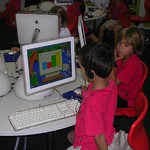 Professor Diana Laurillard has informed me of a new course that is going to be run for teachers and others with an interest in how ICT is being used in primary education in various countries. I think it sounds very interesting. Here’s the official blurb:
This is to announce a new course on ICT in Primary Education, to run as a MOOC (a massive open online course), hosted by the University of London.
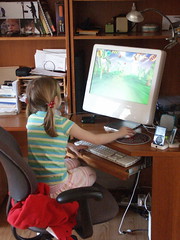 I have had an interest in programming and creating games since I purchased a BBC Model A in the 80’s (the good old days!). However, it was only recently that I have actively promoted the introduction of games making into the ICT curriculum.
Two factors prompted my decision. Firstly, the introduction of the renewed ICT framework in spring 2008, which introduced learning objectives around ‘sequencing instructions’ and opened up options other than control. Secondly, the availability of easy to use games making software, which had the capacity to build games with a very professional feel.
 In 1981 the then Conservative government announced that the Department of Trade and Industry would provide funding for one microcomputer in every school. Throughout the ensuing three decades there has hardly ever been a year when there has not been some earmarked or ring-fenced funding for ICT in schools in England. But in 2014 we are in new territory. The Harnessing Technology Grant, which for several years was the main source of devolved funding to support ICT in schools, is no more and many schools will have to make do with the ICT equipment they already have rather than spending on the latest technology. Yet teachers should still aim to make the very best use of the resources available to them and aspire to excellent teaching with ICT.
 There was an interesting article in the UK’s Daily Telegraph about the film The Bling Ring. Entitled “Is the Facebook generation anti-social?”, the article presents what I think is a fairly balanced view of how teens seem obsessed with recording every moment of their lives. Well, balanced in the sense that the writer, Tim Stanley, attempts to present it as something we have always done. He cites the example of people in years gone by insisting on showing their (boring) holiday snaps to their friends and family. Now they upload them to Facebook instead (thank goodness!).
 It’s amazing what you can achieve with a paintbrush and a fork. Yesterday morning I watched in helpless horror as the lid of something fell down the plug hole in the bathroom sink. I could see it, just about, using the flashlight app on my smartphone (I knew there was more to smartphones than just being connected), but couldn’t reach it.
 Here is an interesting case study of how a small school has successfully introduced BYOD with a particular group of pupils.
Finborough School is an independent, ie private, all-through school, ie age range 2-18, in a rural English setting. It has 274 pupils.
 The early experience of Copland Community School in introducing iPod Touches to all new pupils.
 The school is moving towards a totally cloud-based system using mostly mobile technology. Therefore BYOD will become another facet of this by allowing students to use mobiles when appropriate, in addition to the kit provided by the school.
 Are boys addicted to games, and does it matter if they are? (And what is addiction anyway?) Online Graduates has sent me an infographic on the subject. Have a look at it,and maybe discuss it with your students. I’ve decided to be a bit of a devil’s advocate in my response to it!
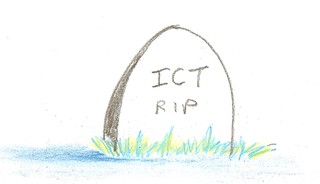 The phrase “May you live in interesting times” is usually cited as a sort of curse, but can you imagine the opposite, ie living in boring times? Fortunately, especially here in England there is no danger of that for a while, at least in the world of ICT. Here are a few snippets of news which I won’t comment on at the moment because I like to cogitate, reflect, and then cogitate some more before pontificating. As I said in a previous article (10 Obligations of Bloggers), quoting Salvator Rosa, I believe in the adage “Be silent, unless what you have to say is better than silence”.
(c) Terry Freedman All Rights Reserved