
 I don’t think statistics relating to the number of visitors to a website or blog are the be all and end all, but they’re important for at least three reasons.
E-Moderation
It is a matter very much to be regretted that, over the years, management types have usurped perfectly innocuous phrases and converted them to euphemisms or, worse, their precise opposites.
Read MoreConference Concessions and Other Goodies
As last year’s Handheld Learning Conference drew to a close, I wrote one word in the notebook I carry with me at all times: “Exhilarating”. I’m therefore delighted that Graham Brown-Martin has kindly offered subscribers to Computers in Classrooms a 10% discount on the booking fee –
Read MoreIs ICT in Schools Damaging to the UK’s Economic Health?
 This is the gist of the question posed by the Royal Society, which, as promised in a previous article, has just launched a call for evidence.
10 Ways to Evaluate Blogs
Now that the new school year has started, or is about to start, we all want to have fresh insights into how to do the things we’re paid to do.
Read MoreInterview with Melendy Lovett
 I recently interviewed Melendy Lovett, President of Texas Instruments’ worldwide education technology business, about the state of STEM – Science, Technology, Engineering and Mathematics education. I put it to her that in the UK there are fewer and fewer people taking up Computer Science at university, because of the emphasis on 21st century skills and ICT, ie the study of how to use programs rather than how to create them in the first place.
Discreet ICT?
 The BT Tower in London is being opened again for the first time in thirty years.
Industrious Waste
 I spent the day clearing out paper related to educational technology. Erm, exactly. So how many black sacks do you think I managed to fill?
Also on the web: 08/06/2010 (a.m.)
Stuff I came across and thought interesting and useful.
Read MoreAlso on the web: 08/05/2010 (p.m.)
-
Let’s Say No to Inappropriate Use of Technology
Another timely, thought-provoking (and somewhat long) post, about the inappropriate use of technology in education. In my view, it's essential that people know when NOT to use technology. Read the post, decide for yourself.
Posted from Diigo. The rest of my favorite links are here.
The Reform Symposium Conference
What a weekend! From Friday to Sunday, the Reform Symposium Conference was in full swing (apart from the scheduled breaks, of course). A truly international conference, it not only featured presenters and enjoyed participation from all over the world, the organisers planned it such that events started at convenient times for people all over the globe. That made a nice change from having to stay up half the night to catch every session!
 The Reform Symposium
Unfortunately, I was able to attend only a few sessions, because a malignant Fate, to use a phrase much-loved by Dornford Yates, decreed that my plans to work on Monday and Tuesday had to be brought forward to Sunday instead. The sessions I did attend were interesting. I especially liked one by Nicholas Provenzano called Everything I Learned About Tech Integration I Learned From Movies. I had to leave part of the way through, but it looked like an innovative approach to talking about educational technology, taking quotations from films and applying them in a new context.
Lisa Dabbs and Joan Young gave a practical talk called New Teacher Survival Kit, which I think should be essential viewing for anyone working with new teachers. I was slightly concerned when the whole focus seemed to be on being positive in a positive kind of way. What I mean is, I sometimes think that the most positive thing you can do is tell someone they’re mistaken, and in my experience there are some people who don’t get the key message if you package it up with lots of nice fluffy compliments. So I was pleased that Joan’s response, when I raised it as an issue, was to pretty much agree.
Steve Hargadon opened the conference with an interesting keynote about social media in education, and this was followed by a talk by George Couros called Identity Day: Revealing the Passions of Our Students, which basically said that in order to teach effectively you have to know your students. Absolutely. Teaching, like business and any other human transaction, is ultimately based on relationships.
I was honoured to have been invited to give a keynote, and spoke about using a project management approach to introducing Web 2.0 into your classroom.
The sessions were all recorded, and should eventually be available for viewing – some are there already, but others may take around a week. Go here for the schedule, and click on the link in the column called Webinar Link for the session you wish to view. I intend to look at all of them.
Top marks to the organisers Shelly Terrell, Christopher Rogers, Jason Bedell and Kelly Tenkely and their team of moderators for their tireless efforts, advanced planning and attention to detail. The odd glitch was handled deftly and virtually without anyone noticing. I was especially gratified when Phil Hart got my slides going despite some horrible error messages I kept getting whilst trying to upload the PowerPoint. Thanks also to my friend Peggy George, who took time out to show me some of the functionality of Elluminate, as it had been a while since I’d used it.
Finally, it was a nice touch to give presenters a certificate. You can see mine here.
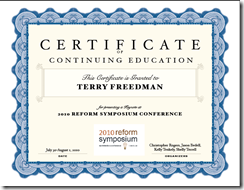
Remember: check out the presentations! Whilst looking at them, think about whether they could be useful for you when running a CPD session. Don’t ignore the chat window: as is often the case, what’s going on in the chat is an interesting complement to the presentation proper.

Online Conference This Weekend
The tireless Shelly Terrell has invited me to give a talk at next weekend’s 2010 Reform Symposium conference, which takes place online. According to the website, the Reform Symposium is a free online conference for educators, administrators, parents and students.
This year the conference is focused on innovative practices in education and what role these practices can play in educational reform. Check out the list of speakers. The programme looks really good. My own presentation is at 12 noon on Saturday 31st July, UK time, and will be on the subject of using a project management approach to introduce Web 2.0 use into your classroom. My slot lasts for about an hour, and what I’m intending is that I’ll speak for about 10 minutes and then throw it open for discussion, and then speak for about another 20 minutes. Hope you can join us.
This is an update of an article which first appeared in Computers in Classrooms, the free e-newsletter for ICT/ed tech people.
From Little Acorns…
Who remembers the Acorn? From the mid-80s to the late 90s, this computer was the technology of choice for legions of primary schools across the UK. With a graphical interface, three-button mouse, and applications which all used more or less the same menus (much like Mac and Windows computers today), the Acorn was both easy and satisfying to use.
It’s gratifying to learn that in a sense the Acorn has not gone away. The RISC chip, which lay at the heart of the Acorn computer, was developed by a company called ARM Holdings. According to a report in the UK’s Daily Telegraph today, ARM is still going strong, thanks to the fact that it developed the technology that drives many of the world’s smartphones.
So, as far as the Acorn is concerned, it’s a case of gone, but certainly not forgotten.
Computers in Classrooms July Edition Out Now!
Because of pressures of work, together with wanting to make sure that contributors' articles were read by as many people as possible, I decided to defer the special games-based learning issue and bring out a short newsletter to give people something to read quickly as they're winding down for the summer.
Unfortunately, one of the links given is incorrect. It worked for me, but that's because, I realise now, I was logged in to the website. The mobile phones article is here. Thanks to Jonathan Thomson of BLI Education for emailing me about the broken link.
Here is what was covered in this issue:
Marxio Out, TimeLeft In (Maybe)
Those links will take you to the individual articles, but if you wish to read the whole newsletter, you'll find it here. You can also subscribe, by going to the newsletter page -- it's free! -- where you will also find an archive of past issues.
Please feel free to pass on this information to your friends and colleagues. Thank you.
It’s About The Kids, Isn’t It?
GraphicaGirl is absolutely right when she says, referring to my article about Mission Statements (or see this Anglicised version):
We, in education, are in the kid business, and too often we get caught up in the day-to-day operations of the school and forget that bit.
 They're what it's all about!She goes on to say:
Our business is kids, no matter how trite that may sound!
Exactly right: it is true (and it does sound trite, but what can one do?)
If you ever have occasion to visit a great bastion of education, not necessarily a school, have a look at the displays. Are there any pictures of youngsters? I think the answer can tell you quite a lot about the organisation.
See also:
What I look for in a conference
Games-Based Learning Newsletter: 2 Great Prizes
Thanks to the generosity of Immersion and SeriousGames, I am able to offer two wonderful prizes to subscribers of Computers in Classrooms. The prizes on offer are a copy of Immersion’s MissionMaker, the games authoring software, and a one year school license for SeriousGames Global Conflicts: portal. The two winners will be chosen in a random draw on Thursday 11pm UK time. For terms and conditions please see the newsletter page, where you can sign up too if you wish (it’s free!). In this case, each prize is available to non-UK residents as well as Brits!


More information on the contents of the games education special issue will be posted here as soon as I’ve finalised the list of articles that will be included.
Update on 2010-07-21 05:25 by Terry Freedman, Educational ICT Consultant
I've also been offered two premium Xobni licences to give away, as a "thank you" for the review I wrote. I will pull two winners out of a digital hat for these as well.
Disclaimer: I was not expecting anything like this. The review was genuinely independent, and not wrtten for any reward from Xobni.
Unfair Copyright Clauses
With any luck and a fair wind, unfair copyright clauses could one day be a thing of the past -- in the UK at least. One thing which especially galls me is the insertion of a clause which deprives authors of their moral right to be identified as the author of the work.
Interestingly enough, I was looking at one of these only a couple of days ago. It was one of these article repositories that pay you a proportion of the advertising revenue of the ads which appear on your article page. I have grave doubts about all that, which I'll write about separately, but for now the issue is as follows.
When I delved into the "small print" there was not only the usual clause which states that you hand over the copyright in your work -- which is an insane thing for anyone to do voluntarily in my opinion -- but also one which stated that they reserve the right to continue to use your work ad infinitum without having to give you credit as the author. Um, no thanks.
A recently-published report (which I haven't read yet) apparently calls for a review of contract law in this respect. It states:
Contractual waivers of moral rights are inserted frequently into copyright contracts. If these rights were made unwaivable by statute, such a persisting link between author and work might improve the author’s bargaining power.
At first glance it sounds like a reasonable idea to me, although, of course, a change in UK contract law would have no "clout" outside the UK. Still, it would put down a marker, as it were, about what is, and is not, morally acceptable in this complex area.
Reference
The Importance of Mobile Phones in Education
Teenager Ethan Davids describes how essential his phone is to him.

EthanFrom listening to music, to taking and editing pictures of teachers, the young community have found various ways to misuse the new technology being made available to them in such small and compact mobile phones. Obviously, anything that can disrupt learning, or teaching, cannot be accepted in a classroom environment and should be dealt with accordingly. It is my opinion that as technology advances at such a blistering pace, policies such as ‘mobile phones should be switched off and in your bag’, can be modified to benefit not only students, but teachers and schools alike.
As a student who has experienced some very rowdy and distracting classes, I know that mobile phones can cause huge distractions for not only students, but teachers as well. I am also aware that mobile phones can be a danger to the school environment; however I believe they can still have their benefits in the classroom.
As a very proud owner of an Apple iPhone 3G, I could rave all day about the importance of my mobile phone. It keeps me in contact wherever I go, which not only gives me peace of mind, but also my parents! An argument I have never understood is that youngsters have become too reliant on their mobiles. Nowadays mobile phones can be as useful to people as a pencil and paper, and I have never come across an argument that adults have become too reliant on those!
The ability to download ‘apps’ to phones such as the iPhone can also make it not only personalised, but useful for people in most situations. From word processing software to a program that keeps an eye on the stock market, the range of potential uses can just not be argued with. For example, instead of waking up tired and grumpy, I use an advanced alarm clock to measure my sleeping patterns which also wakes me up when I am sleeping at my lightest. Not entirely necessary, but this could still be beneficial to anybody!
So if this level of technology can benefit from city workers to journalists, why can it not be taken advantage of at school? I have numerously thought to myself in lessons such as Spanish and English that if it was accepted for me to use my phone, my learning could be improved. Instead of taking out a dictionary, I could simply use my translator, and instead of trawling through books for a piece of literature, I could find the book online and be directed to a specific word, and so on. The fact is that these phones are really just computers, yet I am unaware of a school that is reluctant to allow the use of these.
I'm not naïve; firstly not everybody has such an advanced phone and secondly, there are bound to be people who will take advantage. But as technology becomes cheaper, more people will invest in this equipment, and surely the people who take advantage of the leniency would use their phone regardless of new measures?
Schools themselves are modernising greatly. My present school, for instance, is in the process of becoming an academy. This means that from September 2010 it will no longer be classed as a ‘school’, and by 2013 it hopes to have established completely new buildings. I am part of a group of students who have listened to the new plans, and I was impressed with the new technology being considered. Ideas such as giving each student a laptop and registering attendance online are being planned already. I think it is fantastic that schools are finally ‘getting with the times’ and are understanding the importance of ICT in education! Eventually I hope mobile phones will be looked upon in a much more reasonable way and take a more important role in education. After all, there’s only so much fun you can have with editing teachers’ faces!
Ethan is a Year 11 (17 years old) student who is currently preparing for his final GCSE (High School graduation) exams. He is a huge lover of football, and Manchester United. He hopes to carry on his education to university where he hopes to study Law and French.
This is a slightly amended version of an article which first appeared in Computers in Classrooms, the free e-newsletter. The next issue is a games-based learning special, and we're running a prize draw to give away 2 marvellous prizes. More on that later today.

Your newsletter editor is hard at work sifting through the submissions for Digital Education, the free newsletter for education professionals. Have you subscribed yet?
Read more about it, and subscribe, on the Newsletter page of the ICT in Education website.
We use a double opt-in system, and you won’t get spammed.
ICT: A Whole New World
It is so unusual to find a young person who not only likes ICT lessons but will actually admit to it, that when I heard that Maddi fell into that category, I just had to ask her to write about it for me. Here’s what she says…
 Maddi
MaddiHi, I am Maddi, a Year 10 student from Australia. I am 15 and really enjoy ICT. I am currently considering a career requiring ICT skills. Apart from ICT, I enjoy sport, playing and listening to music, writing songs, drawing and dancing.
When I finish school I plan to study to be a journalist or magazine editor. My dream goal is to own my own magazine that supports my own charity – big goals I know but better a big goal than no goal! As I said I have a passion for ICT and this article explains why everyone should learn at least the basics of ICT.
The internet, something one could have lived without many, many years ago but now one can really only just last a week without somehow using or coming into contact with it. I hear people say technology such as computers has destroyed society or is killing normal communication. But I consider these comments as naive sniggers, for I believe that anyone who has discovered the incredible uses for the internet would not say such a thing. The web is an extraordinary invention and has given me the chance to communicate with people and civilisations that pen and paper could never offer me.
Last year with video link up, I and three fellow class mates were able to give a presentation to thousands of teachers, students and educators who attended the Flat Classroom Conference in Qatar. This was an unreal experience and it was one of the first times I realised how phenomenal the internet is.
I was also a participant in a large international project which helped me learn that understanding the internet isn't just about learning what buttons to press or how to navigate through it. I learnt how to behave on the web, how to be safe, the manners and language that are appropriate and many other social and cultural aspects of the internet. On the internet you really have to watch what you say because something 'funny' you say could be offensive or misinterpreted by other people. To me, talking to someone face to face is a lot easier and quicker, but I find talking to people over the internet is an adventure in itself. I think it is a great way for school students to make friends.
I guess there is more to ICT than just internet though. I would confidently say that I would use my laptop everyday to type up school work or edit photos. I think one of the reasons ICT is so appealing to me is because you can take something simple like a photo and transform it into something beautiful in seconds, and it is so easy and the programs available today open so many doors for your creative minds to step right into.
I would definitely encourage ICT as a compulsory subject up to at least year 9 because ICT is a subject just waiting to be truly discovered and explored. As I write this I know that the internet is continuing to grow in fabulous ways and I really want people my age to go and explore.
This is a slightly amended version of an article which first appeared in Computers in Classrooms, the free e-newsletter. The next issue is a games-based learning special, and we're running a prize draw to give away 2 marvellous prizes. More on that tomorrow.
How To Start Blogging
 Get writing!You know when a theme is developing in your life when the same sort of thing keeps cropping up. Well, I don’t know if twice in succession qualifies, but I’m going to go with it anyway. Yesterday I was catching up on my podcasts, and listened to a Grammar Girl episode entitled “How to get started blogging”. Then today I ran my blogarizer spreadsheet and was directed to an article entitled “10 must-use tips for beginning bloggers”. OK, enough already: I can take a hint.
Both articles are pretty good, in a general sense. Mignon Fogarty, the “Grammar Girl”, deals with knowing your audience, finding good, and reliable, information, and how to build your audience. Melissa Tamura, author of the 10 tips post, also talks about knowing your audience and, in essence, how to grow it.
I’d like to come at this from a different angle or, to be more precise, to emphasise different aspects of blogging. Here goes:
- Start blogging. That’s right, just start. Stop navel-gazing, second-guessing the universe and playing “what-if?” games. Just start. Creating a new blog in something like Blogger takes all of five minutes. In fact, the most difficult part is thinking of a witty and memorable name.
- Definitely define your audience, but start with yourself. What I mean by that is, write the kind of articles that you would find most interesting/enjoyable/useful to read. Then your blog will probably go one of two ways: either extremely eclectic, which stands a good chance of attracting a wide variety of people, or extremely focussed. Those two are not mutually exclusive, by the way. I think that latter possibility warrants a bullet point of its own…
- Be extremely focussed. I mean extremely focussed. From time to time I receive comments from people along the lines of they have nothing unique to blog about. That’s plain wrong, because everyone is unique in some way. For example, you might be the only art teacher in your town who takes their class on a virtual art gallery tour every week. How does that work? How does a virtual gallery visit stack up against a real life one? I don’t know from first-hand experience what the answers to these questions are. But you do.
- Put your audience first. I think if you’re going to write for an audience, you should at least try to make reading your work a pleasant experience. This is all highly personal and subjective, of course, but for me the two things I really can’t abide is swearing or implied swearing, and writing which is about as interesting as the list of ingredients on a packet of cornflakes. There’s no need for the former, and you can improve on the latter by analysing what it is you like about the writing of the blogs, magazines, newspapers, authors you read on a regular basis.
But the most important one of these, if you’ve decided or almost decided to start your own blog is the first one: just do it!
Related articles by Zemanta
