
Many people in the educational ICT field in England are busy working on a new ICT Programme of Study to replace the current (disapplied) one. Here are my thoughts on what the ideal Programme of Study would be.
Read MoreArticles you may have missed
The articles referenced here cover:
- Bring Your Own Technology
- Blogging
- Using a search engine
- Creating a stimulating classroom environment
- A forthcoming conference from Dyslexia Action (Load2Learn)
- Helping new staff
- Games Addiction
Lessons from the world of sports: #6 The rule of practice
 What lessons can we in the field of educational ICT learn from sports? In this, the sixth part of this mini-series, we look at the issue of practice.
The stimulating classroom
 It seems paradoxical, but the most boring classrooms tend to be the ones that are full of technology – and little else. The worst ones I’ve been into are those in which 30 or more computers are crammed into rows, allowing no room for note-taking, let alone collaboration. But even the ones with wall-to-wall interactive display screens, visualisers, graphic tablets etc etc are often, to be frank, Tedium City. How come?
Helping new staff
 I’ve come across a couple of instances recently where a website has great resources, but either people don’t know about them, or don’t know where to find them even if they do. For example, apparently the Department for Education website has some brilliant resources for teaching children with complex needs, but they’re all but impossible to find. So that got me thinking: how will teachers starting in your school next term fare when it comes to accessing ICT-related information? Here are some ideas I’ve had, which I hope may be useful. They do not have to apply only to ICT.
Interesting times in ICT
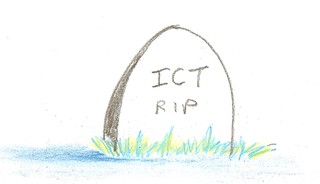 The phrase “May you live in interesting times” is usually cited as a sort of curse, but can you imagine the opposite, ie living in boring times? Fortunately, especially here in England there is no danger of that for a while, at least in the world of ICT. Here are a few snippets of news which I won’t comment on at the moment because I like to cogitate, reflect, and then cogitate some more before pontificating. As I said in a previous article (10 Obligations of Bloggers), quoting Salvator Rosa, I believe in the adage “Be silent, unless what you have to say is better than silence”.
3 reasons to have trainee teachers, and how to manage them
 You’d think that you could get the best results (however measured) by having only experienced staff to teach ICT, and that managing a trainee teacher would be a diversion. But my experience, as well as a consideration of principles, suggests to me that such a view is mistaken.
Mobile phones in education revisited
 The most popular article on the ICT in Education website is one by a 17 year-old student called The Importance Of Mobile Phones In Education. To give you an idea of its popularity, I would estimate that it has been viewed at least 30,000 times since it was published back in July 2010. So the question is, why is it so popular?
Is it because it was written by a student? Well, there is no doubt that student articles receive a lot of attention, but not usually this much.
Is it because it is about mobile phones? I don’t think so: I have written about mobile phones before, and again, the articles haven’t attracted 30,000 views as far as I know.
I think the answer lies in the combination: an article about mobile phones written by a student who appears to be surgically attached to one.
The joy of not knowing
 What teachers and other educators do best is, by and large, tell people stuff. It can be unsettling to not know things, so it’s no doubt natural to assume that if we don’t like it, then neither will others. So we tell people. But is it OK to not know the answers if you’re an ICT teacher? Here are a few thoughts about that, followed by a video featuring Kate Russell.
ICT Conferences (again)
Just in case you hadn’t realised I’ve updated my original post about this several times, here is a list of the conferences I mentioned, in alphabetical order.
Read MoreConferences coming up
There are a few conferences coming up in England which you may find useful. Note that this is by no means an exhaustive list!
Read MoreInternet safety report
 Concentrating purely on web filtering to keep kids safe online is a bit like looking for your keys under a lamp post because, although you lost them somewhere else, it’s lighter there. A third of children in Europe access the internet from a mobile device, according a new report:
33 % of 9 to 16 year-olds who go online say they do so using a mobile phone or other handheld device.
Computers in Classrooms
The latest issue of Computers in Classrooms has just gone out. Here’s why you should subscribe…
Read MoreWhat makes a good ICT role model?
 In England we have a weekly soap set in a school called Waterloo Road. This has everything you would hope not to find in a school: inappropriate behaviour, theft, even attempted murder – and that’s just the staff. The kids are pretty OK by comparison: teenaged pregnancy, illegal drug-taking and gangs. Strangely enough, there doesn’t seem to be more than 30 kids on roll, judging by the number of people who attend whole-school assemblies. But my main interest is this: what (good) use of technology is shown in this programme?
ICT: Irrelevant Curriculum Today?
 ICT teacher Nigel Willetts discusses ICT qualifications and their associated syllabuses. This is a longer-than-usual article, but it's a great rant read. Enjoy!
I apologise in advance. What follows is a rant! Terry was forewarned! However, the purpose of such a rant is to instigate a debate with regard to what we, as ICT teachers/specialists are expected to deliver and examine our pupils on in our schools. The focus is firmly on the GCSE/AS and A2 ICT curriculum. I am not even sure if I have any tangible answers myself, but, in my experience of educationalists, we all love a good rant/debate, don’t we?
Should the ICT Programme of Study be disapplied?
 Yesterday I submitted my response to the English Government’s consultation on the issue of whether the ICT Programme of Study should be disapplied from September 2012. The consultation period ends today. I think responding is a very important thing to do, for reasons I’ll go into in a moment, but first, an explanation to readers not living in England, or a reminder to those who are.
In a nutshell, and somewhat paraphrasing, Michael Gove, Secretary of State for Education in England, said:
ICT and poor journalism
 I attended a Westminster Legal Forum event about libel reform today, and someone asked whether bloggers were “real” journalists (or something like that). That sort of question implies that bloggers are somehow inferior to genuine journalists. I have to say, however, that when it comes to reporting on education policy, “proper” journalists do not always acquit themselves well in terms of accurate reporting. This was especially true in January 2012 in response to Michael Gove’s speech at BETT.
Don’t blame the technology
Technology can help a good teacher do wondrous and wonderful things – but bad use of technology is worse than no use of technology, in my opinion. There is, possibly, one exception to this general rule, which I will get to in a moment. What has brought on this sudden dazzling insight (well, it isn’t really instant, and it probably isn’t dazzling, but this is my blog so I can say what I like). An anti-ICT dogma diatribe by the behaviour guru, aka Tom Bennett.
Read MoreBring your own technology
 If ever there was an idea whose time has come, it is surely Bring Your Own Device or, to be less restrictive, Bring Your Own Technology. There are at least two comp0elling reasons for this.
What does a good ICT school look like?
I was asked yesterday what a good ICT school looks like. The question threw me momentarily, and the fact that it threw me threw me as well: a sort of meta-throwing. Then I realised why: I don't think you can tell whether a school is good at ICT just by looking. All that looking does is help you make some working assumptions which you can then, one hopes, test out.
Read More