
This is an updated version of an article from 2011.
Teachers looking for material with which to furnish their lessons on how technology affects society need look no further than email. This form of communication has affected in at least three ways what might be called “disposable time” – the time one has left after the essentials like eating and sleeping have been taken care of.
First, the speed with which communication can be carried out is very much a mixed blessing, because the assumption – and expectation – is that as you have received an email in the twinkling of an eye, your response to it should be at least as fast. This is especially insidious because it is, I think, largely self-imposed. I worry that if I don’t send at least a holding email I will lose the opportunity of some new work or, at best, the other person will think me unconscionably rude. I am trying to resist this particular temptation because responding in what amounts to a knee-jerk fashion to every email results in achieving very little. When everything is regarded as urgent, the curious outcome is that nothing is treated as important.
The two-and-a-bit-tier systemSecond, there is the tendency for people to follow up emails with phone calls to see if you received their email. I don’t think this is actually anything new, because I recall, vaguely, that when people sent letters they would follow those up with a phone all too. At least in those days you could buy yourself some time by complaining about the sluggishness of the postal service. Nowadays, unless your choice of internet service provider was unfortunate, the most you can hope for is that the other party will believe you when you wonder aloud if their missive has gone straight into the spam folder. Sometimes, of course, this is actually the case, so when people say that to me, I tend to give them the benefit of the doubt.
Thirdly, there is the ubiquitous spam, of course. And I am not just talking about the spam you can take advance measures against: I am increasingly being pestered by people who offer me articles, but whose main aim appears to be to promote some online degree college or other. And by those offering a link exchange with an entirely inappropriate site that I would never promote – not necessarily because there is anything wrong with the content per se, but because it has nothing to do with ICT in education.
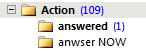
I recently had this brilliant idea: to trawl through my emails on returning from a conference or several days’ work away from home, and identify those which needed acting upon more or less immediately. These I would transfer into a folder called ‘Action’, whilst those which should be answered immediately would go into a sub-folder called ‘Answer NOW’. This has had the twin effect of making me feel that I was dealing with my inbox, whilst simultaneously not dealing with it at all. When I saw, this morning, that my ‘Action’ folder contained 131 emails which required my attention, I thought I might rename it ‘Inaction’. Instead, I got to work dealing with them, but only for an hour at a time. Otherwise, the work I actually get paid for would fall by the wayside.
It’s a difficult problem, but in a way my two-tier email system works: the ‘Action’ folder acts as a constant reminder of matters to be addressed, but they are not so numerous as to be insuperable.
Since writing all of the above I’ve discovered a really effective way of dealing with the email deluge. I’ve been unsubscribing from people who don’t give me value for my time. It’s a bit disconcerting going from receiving several hundred emails a day to a few dozen, but it’s done wonmders for my health!