
I watched an episode of that seminal contribution to English culture, Waterloo Road last week, for the first time in ages. I wrote about Waterloo Road in What makes a good ICT role model? if you’re interested, but basically it’s a soap set in a school which has to be the most dysfunctional school anyone has ever come across. The kids are alright (as some pop song said once), on the whole – but the adults…..
Read MoreTwo effects of new technology
 Here are a couple of interesting cartoon strips about the (possible) effects of new technology. Yesterday’s one is more about unintended consequences, while today’s is really about how apparently intelligent software and monitoring systems might be fooled.
Building schools for the past?
Bob Harrison, a well-known thinker and speaker on the UK’s educational technology scene, has warned against building schools that are fit for the past rather than the future. Apparently as a result of this, he has been removed from the programme of a forthcoming conference.
Read MoreAn Interview with Dominic Savage
 In this interview, Dominic Savage OBE discusses, amongst other things, the purpose of the Education World Forum, the effect of increasing access to devices, and what schools need to do as far as investing in ICT is concerned. Mr Savage has been the Director General of BESA since 1984. The following is not a verbatim account, but has been checked by Mr Savage before being published.
An Interview with Naace ICT Impact Lifetime Achievement Award Winner Dr Christina Preston
 Christina Preston was one of two people given the Lifetime Achievement Award at the 2013 Conference of Naace, the subject association for ICT. I interviewed her to find out about her and her work.
Naace ICT Impact Awards - A Profile of Penny Patterson
 Penny Patterson is on Twitter, but prefers to listen rather than talk, unless she has something of value to add to the conversation. She is active in ICT circles, though doesn’t have her own blog. And if you visit a conference she’s speaking at, you’re likely to chat to her while she serves the tea. She prefers, to use her own words, to be “one of the backroom team”.
Indirect evidence of this was seen in this year’s Naace ICT Impact Awards. When Penny was selected as one of the two people to be given a Lifetime Achievement Award, the look on her face was one of surprise, bordering on shock, and tinged with bewilderment. Typically, she told me that “other people deserve this award far more than I do.”
The Naace ICT Impact Awards
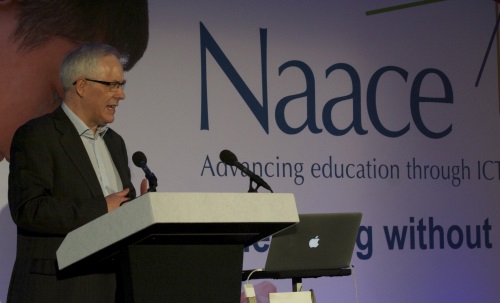 Terry Freedman considers why the Naace ICT Impact Awards are such a valuable feature of the educational ICT landscape in the UK.
Some years ago I was driving in America, and I passed a school with a massive sign which read: “Chuck Evans*: Teacher of the semester!”
S is for … Superhero costumes
When I was young I used to love reading Superman, Batman and Spider-Man comics. Oh, ok, I admit it: I still do! Anyway, I always thought their costumes looked really good: colourful, good for showing everyone your biceps and, well, different.
The trouble is, of course, is that in reality these costumes would be awful
An Interview with Charles Clarke
 Charles Clarke was Secretary of State for Education and Skills in 2002. I interviewed him at the Education World Forum, 2013.The following is not a verbatim account, but has been checked by Mr Clarke before being published.
Lessons from Reviewing the new Computing Curriculum
 This is not so much a review or even a summary of the recent Westminster Forum Conference called ‘Reviewing the new Computing Curriculum’ as a series of observations arising from it and related articles. The reason for that approach is that I’d like to make this article useful and interesting to as wide a range of people as possible, not only those concerned with the ICT or Computing Programme of Study in the National Curriculum in England and Wales.
Are acceptable use policies acceptable or of any use?
 Should schools have Acceptable Use Policies? The following article was originally published in April 2008. Apart from the references to the ‘recent’ Byron Review and to Becta, it still seems very apposite to me. If I were writing the article today, I’d bring in Responsible Use Policies, but otherwise I believe it still stands. What do you think?
One of the things recommended by the recent Byron Review into keeping children safe in a digital world was for schools to have acceptable use policies
Discussions about the curriculum
I suppose this isn't quite fair, but I couldn't resist it anyway! Is this how discussions about the curriculum must seem to people outside education?
Read MoreI was a teenage geek
 This article is a bit autobiographical, but there is an objective point to it. Actually, it’s completely autobiographical, but there is still a point to it.
One day when I was 15, I was milling around in this youth club trying to look cool, when someone came up to me and asked me if I’d be interested in joining a cinematography club he wanted to get started. He explained to me that I’d learn how to use a cine camera to shoot films, edit the films,learning about lighting and all that other technical stuff, so I said “Yes!”.
I’d never touched a cine camera in my life.
P is for … Paperless
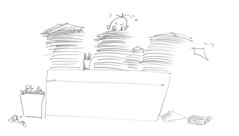 For as long as I can recall, people have been hankering after that happy state of affairs where paper is notable only by its absence. Have we reached that stage yet, or is it, at least, in sight?
The reason I ask is that a couple of schools I visited recently have made a good attempt to go paperless.
BETT 2013 Interviews: David Mitchell
 Quadblogging founder David Mitchell talks about what he saw at the BETT Show this year, and quadblogging.
BETT 2013 Interviews: Andy Black
 Edtech guru Andy Black talks about what wasn't at the BETT Show this year, and some of the trends he spotted.
BYOT Case Study: New College, Swindon
 Why has New College gone down the Bring Your Own Technology (BYOT) route? An obvious factor is cost. But there’s also another, less prosaic reason...
What is Both good and original in the world of educational technology?
 When a young man with dreams of becoming a writer sent a manuscript to Samuel Johnson for his opinion, Dr Johnson is reputed to have replied:
“My congratulations to you, Sir. Your manuscript is both good and original; but the part that is good is not original, and the part that is original is not good.”
I thought it might be interesting to look at 10 ideas that have gained popularity in the world of educational technology and ICT in recent years, to see if they meet the “good and original" test”. Here are my considered, though possibly opinionated, views.
3 General Prequisites of Bring Your Own Device
 If a school wishes to go down the Bring Your Own Device (BYOD) route, what are the conditions necessary to make this possible in a useful (ie learning enhancing) and hassle-free way?
From my research into schools which have gone down this road, or at least started to, I have come to the conclusion that there are three at least three general conditions which have to be met.
