
Now that the new school year has started, or is about to start, we all want to have fresh insights into how to do the things we’re paid to do.
Read MoreReview of Leading a Digital School
Can a book about leading a digital school be of any interest to ICT leaders? Read on and find out.
Read More21 Ideas for Getting Off to a Good Start
So, you're about to start a new job as leader or manager of educational ICT. It can be scary as well as being fun. And you know what they say: you don't get a second chance to make a first impression. It's good to have a "shopping list" of things to do, or at least get started on, as soon as you walk through the main entrance. Here are 21 suggestions you might like to consider.
Read MoreThe Reform Symposium Conference
What a weekend! From Friday to Sunday, the Reform Symposium Conference was in full swing (apart from the scheduled breaks, of course). A truly international conference, it not only featured presenters and enjoyed participation from all over the world, the organisers planned it such that events started at convenient times for people all over the globe. That made a nice change from having to stay up half the night to catch every session!
 The Reform Symposium
Unfortunately, I was able to attend only a few sessions, because a malignant Fate, to use a phrase much-loved by Dornford Yates, decreed that my plans to work on Monday and Tuesday had to be brought forward to Sunday instead. The sessions I did attend were interesting. I especially liked one by Nicholas Provenzano called Everything I Learned About Tech Integration I Learned From Movies. I had to leave part of the way through, but it looked like an innovative approach to talking about educational technology, taking quotations from films and applying them in a new context.
Lisa Dabbs and Joan Young gave a practical talk called New Teacher Survival Kit, which I think should be essential viewing for anyone working with new teachers. I was slightly concerned when the whole focus seemed to be on being positive in a positive kind of way. What I mean is, I sometimes think that the most positive thing you can do is tell someone they’re mistaken, and in my experience there are some people who don’t get the key message if you package it up with lots of nice fluffy compliments. So I was pleased that Joan’s response, when I raised it as an issue, was to pretty much agree.
Steve Hargadon opened the conference with an interesting keynote about social media in education, and this was followed by a talk by George Couros called Identity Day: Revealing the Passions of Our Students, which basically said that in order to teach effectively you have to know your students. Absolutely. Teaching, like business and any other human transaction, is ultimately based on relationships.
I was honoured to have been invited to give a keynote, and spoke about using a project management approach to introducing Web 2.0 into your classroom.
The sessions were all recorded, and should eventually be available for viewing – some are there already, but others may take around a week. Go here for the schedule, and click on the link in the column called Webinar Link for the session you wish to view. I intend to look at all of them.
Top marks to the organisers Shelly Terrell, Christopher Rogers, Jason Bedell and Kelly Tenkely and their team of moderators for their tireless efforts, advanced planning and attention to detail. The odd glitch was handled deftly and virtually without anyone noticing. I was especially gratified when Phil Hart got my slides going despite some horrible error messages I kept getting whilst trying to upload the PowerPoint. Thanks also to my friend Peggy George, who took time out to show me some of the functionality of Elluminate, as it had been a while since I’d used it.
Finally, it was a nice touch to give presenters a certificate. You can see mine here.
Remember: check out the presentations! Whilst looking at them, think about whether they could be useful for you when running a CPD session. Don’t ignore the chat window: as is often the case, what’s going on in the chat is an interesting complement to the presentation proper.

Risk Assessment
You cannot avoid risk, so you have to manage it. Whether you’re considering installing a new computer system, or trying out a new teaching approach, how can you manage the risk sensibly and effectively?
 You have to manage riskThe way to do so is to carry out a risk assessment. That sounds like it could be a lot of work, but it need not be. Or at least, it can be turned into an enjoyable professional development exercise. That way, not only do you assess the risk, you also (hopefully) bring your colleagues along with you and, into the bargain, have some mind-stretching discussions as part of the process.
The reason for that is simple: risk assessment tends to be fairly subjective. You can make it less so by doing some research and obtaining a range of facts and figures, but ultimately you have to take a decision, and that will involve a degree of conjecture.
Risk assessment involves considering, and assigning values to, three criteria:
- What can happen as a result of this course of action?
- What is the likelihood of each outcome happening?
- How bad will be the consequences of each thing happening?
Now, in some scenarios the value assigned to the last one is so great that it crowds out any other consideration. For example, what is the likelihood of your child being abducted if you allow her to go out on her own? The answer, despite what you may think from keeping up with the daily news, is quite low in the UK. However, the consequences of that happening would be so awful as to render the low likelihood irrelevant.
Thankfully, when it comes to trying out innovative teaching methods we tend not to have to countenance such extreme situations. So, let’s work through an example:
Question: What might happen if I introduce the use of social networking into my lessons?
You might set out a grid like this:
|
Outcome |
Likelihood of occurring |
Severity of consequences |
| Students will fail course | Low | High |
| Parents will complain | Medium | Medium |
| Students will come across unsavoury people | High | High |
Now, you can start to manage all this. For example, taking the last one, you can prepare the students by teaching them about keeping safe online, and you can further protect them by having an invitation-only social network. That won’t completely protect them (if only because some of the students may themselves be unsavoury characters), but it will certainly go a long way towards reducing the risks.
But the important thing to bear in mind about risk is that once you have identified an activity as potentially ‘risky’, the solution is not necessarily to simply abandon the idea. After all, keeping to ‘tried and true’ teaching methods also carries a risk.
An earlier version of this article was published on 11th June 2009.
What Are The Big Issues for Ed Tech Leaders?
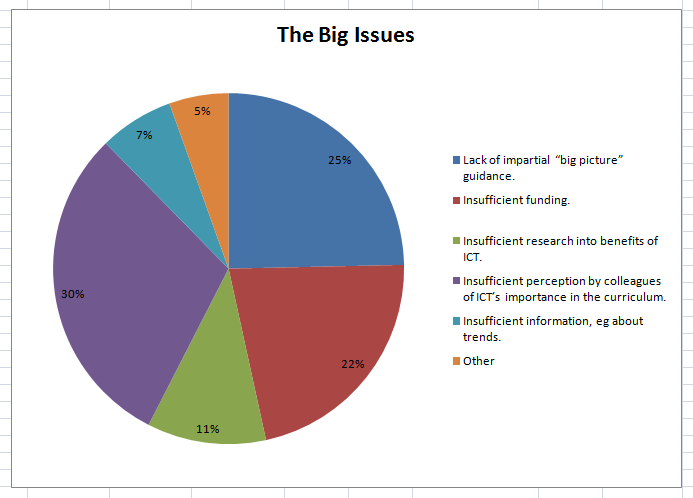
I’ve done a quick analysis of the entries received so far to my Issues for Ed Tech Leadership survey, and here are the results.
 Initial findings
As you can see, top of the list is a lack of perception by colleagues of ICT’s importance in the curriculum. So, after all these years, we don’t seem to have an unequivocally wonderful job of convincing others of how technology can be beneficial in the curriculum. It’s interesting to note that the solutions proposed to address this (not shown here) tend to be divided between those who think we should make more training available, and those who think it’s a leadership issue.
I have to say, I’m in the latter camp, and I am tempted to agree with UK ICT consultant Bill Gibbon when he says we should have compulsory courses like SLICT (Strategic Leadership in ICT) courses for senior leadership teams.
Could it be, perhaps, that there is insufficient research into the benefits of ICT? Well, a sizeable minority apparently thinks so, but I agree with ICT consultant Doug Woods’ view:
Actually NO there is plenty of evidence and research into benefits but it is generally not readily available to edtech leaders in school. We need a central resource to collate this research findings, even where contradictory, and make them easily available.
Perhaps not surprisingly, given that most of the respondents hail from the UK, where Becta and the QDCA have been given notice to close down, a lack of impartial big picture guidance is the second-most frequently cited issue facing ICT leaders. I think a lot of people will agree with ICT Co-ordinator Steff Rooney that the Becta self-review framework can (should?) be used to highlight weaknesses in a school’s ICT provision. Let’s hope it’s eventually mothballed rather than disposed of altogether.
This is literally just a quick snapshot. I’ll spend more time on it over the summer break. That gives you time to complete the Issues for Ed Tech Leadership survey if you haven’t already done so  -- it should take you only a few minutes.
Mission Statement
I don’t have too much time for mission statements. To be honest, I regard them as being unnecessary. Actually, I’d go further: if an organisation is so hung up on its image that it wastes time and resources on thrashing out a mission statement, what does that tell you about its priorities? More to the point, why should any organisation even need a mission statement? Its mission statement should be implicit in the way it goes about its business.
How about this as an example. A couple of months ago my computer started playing up. Unfortunately, it started to get really bad about two days after the year’s money-back guarantee had run out. Fortunately, there was a free maintenance package thrown in, which meant that for two years I could get it repaired free of charge, on a return to base basis. Not ideal, but still, better than nothing. So I decided to avail myself of this service, and the retailer I purchased the computer from arranged for a courier company to pick it up the next day. The following conversation ensued when the courier arrived:
Me: Ah, I think there’s going to be a problem because --
Courier: Look, mate, I’m not here to repair it, I’m just the courier. Just give me the computer.
Me: Well, what I was about to say, was that I don’t think it’s going to fit into that container you’ve brought.
Courier: OK I’ll be off then.
Me: Wait a minute, let me just measure it. Come in for a cup of tea while I do that.
Courier: I don’t want a cup of tea, I’ve got to get on.
Me: Well let me just measure the container you’ve brought.
Courier: I ain’t got time for that. Phone the company.
Me: Can’t you just hang on for two minutes? I need this computer for my work.
Courier (driving off): That ain’t my problem, mate.
I think that statement, “That ain’t my problem, mate”, sounded like the company’s mission statement. Was I right?
Well, I phoned the company up right away, having to use an 0845 number which, here in the UK, is charged for at a premium rate. I was then subjected to 12 minutes of awful music, and advertisements. When I finally managed to speak to someone, she said she’d try and arrange collection for the following afternoon.
“I’ll let you know if that’s not possible”, she said.
“No, could you let me know either way, please?”
“OK”.
When, by 4 pm, I had heard nothing, I phoned the company again, and spent 8 minutes listening to “music” and advertisements. The girl I finally managed to speak to was not the same one as I’d spoken to in the morning. There was no record of my phone call, and no collection booked in. She assured me that she would call me to let me know what was happening. (Incidentally, that was 2 months ago. I am still waiting.)
I phoned the company I bought the computer from to see if they could help, and they told me they would phone the courier company. Fifteen minutes later, she phoned back to say that she hadn’t managed to speak to anyone yet, because she’d been listening to music and advertisements, but would try again.
A few minutes later she phoned me back, and told me that she’d spoken to her manager, and he decided I’d been treated so badly that I could bring the computer in and obtain a full refund. (What do you think that retailer’s mission statement is?) I did so, and immediately purchased a new one, of a different manufacturer.
There have been several outcomes of this episode:
- That was the first time I had any dealings with that courier company. It will be the last.
- So committed am I to that last statement that, having found out that the manufacturer of my original computer uses that courier exclusively, I have decided to never buy that make again, so I never have to deal with that courier company again.
- I got a new computer out of it.
Just to finish the story, the following morning (not afternoon, as requested) there was a ring at the door. A (different) courier had come to collect my computer.
If you think about the behaviour of the courier company, what conclusion could you draw other than that the leadership must be at best incompetent, and at worst actively contemptuous of its customers? Because this is my contention: that the service an organisation provides –- whether it’s a corner store, a department store, a government department or an ICT department in a school – is a direct reflection on the quality and priorities of its leadership. How else could an organisation provide such appalling service, at various levels?
The story also illustrates another point which for some reason is often not as obvious to service providers as it should be: everyone in the organisation is a representative of the organisation. They may not think of themselves in that way, but the bottom line is that if they upset enough people to the extent that the organisation has to reduce its operations or even fold altogether, their jobs could be on the line.
But in that case, all I have to say is: it ain’t my problem, mate.
Upcoming Article on Mission Statements
I have a thing about mission statements: basically, I think they're a waste of time, effort and resources. But there's always an implied mission statement, which is always a reflection on leadership in my opinion.
An article will be appearing about this tomorrow morning at 8 am, but if you want to read it now, you can, at the Technology and Learning Blog, where there's a slightly different version of it.
If you're an ICT or Ed Tech Leader, do take a few minutes (literally, just around five minutes) to complete a survey on what issues ICT leaders face today. The initial results will be published soon. Thanks.
The Big Issues for ICT Leaders Forthcoming Initial Results Announcement
This is just a quick heads-up to say that in the next day or so I aim to publish a snapshot of the results so far of a survey I set up about a week ago. If you haven't already done so, take the survey now -- it takes only about 5 minutes.
Read the original article about it if you missed it: The Big Issues for ICT Leaders
If Your ICT Provision Were a Restaurant...
 Presentation is important tooA lot of restaurants provide free 'extras' that help to make the experience enjoyable. So, as an interesting little exercise, if you're an ICT co-ordinator or ICT subject leader, what do you do to make people's experience of ICT more pleasant?
The kind of things restaurants do, depending on the type of cuisine, and the individuality of the owner, include:
- Placing fresh iced water on the table without your having to ask for it.
- Placing bread on the table.
- Placing bread sticks on the table.
- Putting a plate of olives on the table.
- Supplying you with 'bottomless' coffee.
- Supplying you with 'bottomless' fresh orange juice.
- Giving you a square of chocolate when the bill is presented (as a sweetener?).
- Giving you a complementary drink along with your bill.
- Opening the door for you as you leave.
- Shaking hands with you as you leave.
- Presenting ladies with a rose.
What do all of these have in common?
- They are 'extras'. One could argue that good food and service are to be expected and therefore, in a sense, need not be commented upon. However, extras are, by definition, things you were not expecting, and therefore nice to receive.
- They do not involve huge effort or cost on the part of staff.
- They are the kinds of thing that are most likely to generate word-of-mouth recommendations.
So, if you were to adopt this philosophy, what kind of 'extras' might you provide to other teachers wanting to make use of the educational technology facilities? Remember, this could be quite important in encouraging reluctant teachers to use the technology in the future. Here are a few of my suggestions.My philosophy is that someone ought to be able to use the facilities from scratch, and walk out with a print-out of their work five minutes later. Therefore, these first suggestions are all geared towards that (although that is not the only consideration).
- There should be guest log-ins available, with the details on a card that is attached to the computer or laptop.
- Printing should be easy: no need to have to think about which printer to use, for instance, unless the choice is blindingly simple, eg between monochrome and colour.
- Instructions should be available -- on the walls, on the desks, perhaps even on the computer itself.
- Assistance should be available if needed, perhaps from a classroom assistant or a technician.
I also believe that your working environment should be pleasant and welcoming, so I should recommend one or more of the following:
- Get rid of all those notices telling people what they can't do. It just creates a depressing, negative atmosphere.
- Make sure the keyboards are clean. When I use the tech facilities in a school, I don't expect to have to use an alcohol-based hand wash afterwards.
- Make sure the monitors are dust-free, as far as they can be. Why should people have to risk eye or skin irritation?
- Make sure the environment is clean and pleasant. When I work at home I am not surrounded by screwed up print-outs on my desk and floor, so why should I have to be in that environment in a school?
You might say that these things aren't your job, and I'd agree. But I'd argue that it is your job to make sure they get done. Your role may be that of a 'technology evangelist', working alongside teachers and encouraging them to use the technology rather than having a direct part to play in the provision of such facilities. Even so, your job is going to be that much harder to do if the physical environment is deeply unpleasant.Incidentally, in case this post seems predicated on the existence of a computer lab, pretty much the same arguments apply in other circumstances. If, for example, you have banks of laptops and no computer room at all, you would still want to make sure that, for example:
- The laptops are clean.
- They are fully charged.
- They come with instructions for using the laptop itself, including log-in details...
- ... and instructions for using common programs like the word processor on your system.
- A number to call if assistance is needed.
Of course, none of these are 'extras' as such. So extras might include, say:
- A private area where staff can work at computers without having to worry about students looking over their shoulder.
- Providing staff with the most up-to-date and/or advanced facilities.
- Making tea, coffee and biscuits available.
- Having USB sticks to give to staff on which to save their work, security considerations permitting.
If none of these appeal, perhaps the 'extra' is simply a pleasant and friendly attitude. If staff feel that they are in a sharing, collegiate environment, rather than invading someone's private domain, they are much more likely to return.
For more ideas, read the series called 31 Days to Become a Better Ed Tech Leader.
An earlier version of this article was originally published on 15 September 2009.
Professional Development in Technology
I recently came across a blog by a Head of English in a school. It’s interesting to hear the views of a non-ICT specialist about what works or might work in getting teachers engaged. There are some very useful points made in the post entitled Professional Development in Schools:
Listening to staff after PD, their number one complaint is about not getting time to play and make stuff with what they just learned
This is absolutely correct in my experience. In fact, one of the most successful training sessions I ever ran was one where I allowed the teachers to spend three hours playing and experimenting, with myself and a technician on hand to give advice and guidance when asked. Teachers often think that they have to be doing and speaking all the time. You don’t.
Make sure the project is based on something that can actually be used in the classroom (not just an excuse to try new tools) following a sound curriculum planning process.
Something which ought not need to be said, but it’s all too often the case that people fall into the trap of pursuing gadgets and widgets for their own sake. The key question to ask about anything in education is “So what?”. If you can’t answer that question truthfully and convincingly in terms of students learning outcomes, then why are you undertaking that activity?
 Are lunch and learns the answer?Another idea is that of “Lunch and Learns”, taken from Bianca Hewes’ blog. The idea is that you run short lunchtime sessions which teachers may attend in order to refresh their knowledge of, or be introduced to, an application. I have to say that although I can see the attractiveness of this, I have an ambivalence towards it, for the following reasons.
Firstly, I have come to the conclusion, rightly or wrongly, that the best thing to do at lunchtime is have lunch, followed by doing the crossword, chatting with friends, going for a walk or staring into space. I can’t see how working at lunchtime can be effective or even healthy – which is why for the past eight years I have eschewed breakfast meetings whenever possible.
On the other hand, I can see that lunch and learns are an attractive alternative to twilights and learns. Perhaps the important thing is to experiment and find out what appeals most to your colleagues.
The author of the blog, M Giddins, surprised me by saying that she avidly followed my 31 Days to Become a Better Ed Tech Leader series -- “surprised” because I’d written the series for ed tech leaders rather than other subject leaders, and it hadn’t occurred to me that others might find it useful. I put this to her, and she responded by saying:
I think now that any leader in education also falls into the role of educational technology leader in some ways. I have a faculty that need to be guided in their quest for technology integration and I need to be both the one who models, leads and inspires as well as the solver of the practical problems sometimes inherent in the integration of technology. Your series was very clear about the WHY behind the practical solutions that you offered, which made it possible to apply different solutions to suit my situation.
Finally, there is a link to a list of tools which is definitely worth exploring. The ones I know about already have a rightful place on the list, and I’m looking forward to exploring the others.
This précis of the article hardly does it justice, so do take the time to read the original, which is as inspiring as it is engagingly written.
Other articles you may find useful
31 Days to Become a Better Ed Tech Leader: Are You REALLY an Ed Tech Leader (ictineducation.org)
31 Days to Become a Better Ed Tech Leader -- Day 22: Organise In-Service Training
What are the big issues facing ed tech leaders today?
Please take five minutes to complete a survey about this:

The Big Issues for ICT Leaders
 QuestionsIn the series called 31 Days to Become a Better Ed Tech Leader, I covered a range of issues that I believe are key ones for Ed Tech/ICT Leaders.
But what do you think?
I've created a very short survey which seeks to determine the three most important issues as far as ICT leaders are concerned.
Please take a few moments to complete it. You will find it here:
Thank you!
Benchmarking and Customer Satisfaction
If part of the purpose of your job is to spread the use of information and communications technology, it's a good idea to start collecting statistics in order to benchmark your performance.
This article looks at a fairly simple approach to benchmarking which does not take long to implement, but which can be extremely useful.
It is true that you could content yourself with collecting statistics on how many people are using the educational technology facilities, but I regard that as necessary but not sufficient. For a start, it tells you nothing about the quality of what people are doing, and it is more than likely that if you start to insist on high standards of work, or even merely that colleagues do not use the computer facilities as a fall-back when they don't have a lesson planned, you will start to see a fall in the amount of usage -- at least in the short term.
Furthermore, there is little you can do about increasing the usage until you know why people use or don't use the facilities. Hence, some deeper probing is required.
A very good "way in" is the customer satisfaction survey. If your school or organisation has a history of poor performance and bad experiences in this area, you may feel that to carry out customer surveys would lay yourself wide open to criticism, and therefore be the last thing you'd want to do. In fact, in those circumstances finding out what people like and dislike about the service on offer is even more essential.
There is another dimension to this as well. In general, although people are often happy to criticise someone or something when in a crowd, and anonymous, they are usually much more considered when asked to do so in writing, and with their name attached to it. In one of my jobs, the IT service was constantly being criticised by Headteachers: not directly to me, but to my boss. As well as being upsetting for me, it was also upsetting for my team, who tried to do a good job and, from feedback they received whilst in school, thought that they were. Once I'd implemented the customer survey regime, my boss and I had a couple of the following sorts of conversation before the unwarranted criticisms stopped altogether:
Boss: At the meeting today, the Headteachers were complaining that your team take ages to respond to a call for assistance, and never complete the work properly.
Me: That's strange, because according to the customer satisfaction records we've been keeping, 95% of the schools rated our service as excellent, and the rest rated it as very good. Was there anyone in particular who was leading the complaints?
Boss: Yes, Fred Bloggs.
Me: Hmm, that's a bit odd. Looking at his last completed customer survey sheet, he said "An excellent service. The technician was really helpful and fixed the problem with no interruption to the school's computer network at all." Would you like a copy?
Now, there was no intention on my part to stifle criticism. However, I think that if you are going to criticise someone, especially when potentially people's jobs are at stake, you need to be very specific about what was wrong. The trouble with educational technology is that people have come to expect the same level of service as they enjoy from the electricity board. And so they should, but they do not always understand the wider forces at work. Thus it was that when an internet worm knocked out computer systems all over the world, my team got the blame! When things like that happened, the Headteachers would complain in their meetings with the boss that the IT service is useless, not realising what the real causes were. Given that on no occasion, as far as I know, did any of them contact him out of the blue to say "The IT service is fantastic today!", the impression the boss had was that we were not doing our jobs properly. The implementation of the customer survey approach counteracted that by being very specific, and by providing hard evidence of how Headteachers found the service in general over the long term, as opposed to how they felt immediately after the most recent virus alert.
OK, so how do you conduct a customer survey? I would suggest that you ask people to complete a very simple form, and sign and date it. Then transfer the details to a spreadsheet, which won't take long once you have created the spreadsheet in the first place. You will then be able to generate useful statistics.
The questions themselves will differ according to the nature of the service you are running, of course, but if you are an ICT Co-ordinator (Technology Co-ordinator) I would suggest the following items be put on the form:
- Name of teacher
- Class
- Date
- Subject
- Was the room tidy when you entered it?
- Was the system too slow/fine?
- How easy was it to achieve what you set out to achieve? Very easy/very hard
- Please add a brief explanatory note, especially if it was very hard.
- Any suggestions as to how the facilities or service could be improved?
As you can see, a very simple form, which not only helps you to obtain some information in a consistent manner, but also indicates pretty clearly what your own concerns are -- the room being left tidy, for example.
I’d strongly suggest you assign numerical values to the responses (EG 1 = Very Good) and use a spreadsheet to collate and analyse the responses, because it is easier to calculate averages where necessary.
Run this for half a term, and see if you can spot a pattern emerging. If so, it will help you to prioritise future developments.
How helpful did you find this article? Please leave a comment. If you like the customer focus approach, you will probably find this article interesting too, and this one on the Framework for ICT Support.
An earlier version of this article was published on 16th September 2008.
Is the Venue the Message?
I raced into the #futurising conference room 20 minutes late, having arrived 10 minutes early. Except that I wasn’t late because the organisers had thoughtfully put the talk back 10 minutes, and the presenter was still trying to get something to work. I turned to a fella behind me. “That was the slowest moving queue I’ve ever been in.”, I said. “And I’m still early!”

I could see what he meant. The officials were amiably efficient, but in an other-worldly sort of way. I’m used to conferences where there are people in power suits holding clipboards, timing everything to the second and then flapping when there is a delay. This was more like being part of one of those runny water colours you see in the Tate Gallery or along the Bayswater Road.
But despite that, or probably because of it, the conference worked. It was interesting, “edgy” and, by all accounts from looking at the tweets, useful. But I think a large part of its success was down to the venue.
The Nicholls & Clarke Building in London used to be a Victorian warehouse, which was used as a workplace until just a few years ago. One of the buildings used to be two separate ones, with a narrow alley between them. This is known as “Ripper Alley”, as it was thought to be one of the routes used by Jack the Ripper. You can see how dark and terrifying London once was: look at the pictures and shudder. This was once an external window
The thing about buildings, as anyone involved in designing learning spaces will tell you, is that the nature of the design affects the nature and quality of the activities that go on inside it. We all know this, intuitively if nothing else, and yet we keep insisting on holding ICT conferences in ordinary, traditional venues. How can you think out of the box if you’re sitting in one?
Most of us are familiar with Marshall McLuhan’s "The Medium is the Message". Might it not also be the case that the venue is the message too?
There are more photos on Flickr.
A Commercial Approach to Promoting Educational Technology
I do believe there is a lot we can learn from the commercial world when it comes to promoting the use of educational technology in schools. In this article I draw on the example of how one company's approach to getting repeat business may hold lessons for the ICT leader.
The company in question is one called Viking Direct, a huge office supplies company in the UK. We tend to buy quite a bit of our stationery from there because (a) it's usually cheaper than other places and (b) you can often get same day or next day delivery.
We recently received a catalogue from them which had this printed -- not merely stuck on -- the front cover:
"Mr T Freedman
On 3 February 2008 you ordered a pack of folders at £7.49 per pack. We have a special private sale price for you! Just £6.29 per pack. Just quote reference number ..."
Now think about that for a moment. What has Viking actually done?
- They have kept a record of what I bought and when, and at what price.
- They have printed an individual catalogue for me, obviously through the magic of mail-merge.
- They have used their knowledge of me to try and tempt me back.
So imagine a message like this in a colleague's inbox:
"Dear Joanne
On 3 February 2008 you took a group of Y9 pupils into the computer room, where they used KoolFX to help design posters. We've now upgraded to KoolFX 2.0, which has 30 more wizards and is even easier to use. If you'd like to bring your class in again, just click here to go straight to the online room-booking system."
If you think such a thing might work, the mail-merge bit is pretty easy. The hard part would be collecting the information in the first place, because if you ask some people to give you too much detail when they want to book the use of a computer room, you may just put them off bothering. I would suggest doing one of the following:
- Have a very simple electronic booking system, where very few questions are asked, and most of the answers or even all of them can be answered with drop-down menus. The information you need is teacher's name, age or year of group, the software to be used, the purpose of the session, and the date.
- Install network monitoring software that will capture much of the information required automatically.
- At a pinch, ask for the information and enter it into a spreadsheet, say, yourself.
You may also need to "sell" the idea, otherwise it can seem very Big Brother-ish. There are two good reasons to monitor how the system is being used:
- To ensure that the software you purchase is actually the software that teachers want to use.
- To ensure that the system is being used cost-effectively, ie that you haven't wasted lots of money on resources that people don't use.
I know both of those reasons sound the same, and in fact they are alternate sides of the same coin. But there is a subtle change of emphasis. In the first case, the issue is, to get commercial again, customer satisfaction. In the second, it is about best value.
The example given here is quite simple: you are asking for what is known in the business world as a "repeat order". Repeat business is a very good thing to have, as any business person will tell you. A key thing to bear in mind is that if you set your sights on repeat business, you have to invest time and effort into the customer's very first experience of using your services.
Otherwise it could well be their last.
This is a slightly amended version of an article first published on 14 May 2008.
31 Days to Become a Better Ed Tech Leader – Delegation Case Study
 When I suggested that one of the key things a leader must do is delegate, particularly units of work, ICT consultant and blogger Doug Woods rounded on me. “Hey”, he said. “You can’t just go around delegating stuff you don’t fancy doing yourself. Other people are busy too!”. He expressed it far more eloquently and fulsomely, but that was pretty much the gist of it. (For his actual comments, go here.) Of course, he is quite right, so I thought it might be useful to explain what I did, when I delegated the writing of units of work to my team, in a little more detail.
There are three key things to bear in mind about delegation, which in my view are crucial to its success.
Firstly, as I said in the original article, you have to delegate responsibility, not just tasks. That is pretty difficult for some people to do, because it means letting go of control. But you have to bite the bullet and do it, otherwise you may as well simply go out and hire a load of unqualified, inexperienced assistants – although even there I’d say you ought to delegate responsibilities and not just tasks as far as you can. When you delegate responsibilities, you gain the benefit of ideas that are different to your own, and you help to nurture future team leaders who could, if needs be, take on some of your work if you become ill or need to take leave of absence for some other reason.
Secondly, people need to see what you are doing. A few weeks ago I watched an episode of a programme called Junior Apprentice. The team leader spent some time saying “Bob, I want you to do X, Mary, you work with Jane on Y”. There was something especially obnoxious about his style of management in my opinion, and I know I wasn’t alone because after a minute or two of this one of the team members said “And what are you going to be doing?”, to which he replied something like “managing the team”, if I remember correctly. Wrong! Personally, I like to work for people who roll their sleeves up and get on with it. When I was teaching, I’d always look at the Headteacher’s car parking space when I arrived and left. I admired those Heads who got in early and left late; the ones who did things like consistently leave at 3 in the afternoon every day, or the Deputy Head who left early to get her hair done and do some ironing, I thought were a waste of space. It was, in my opinion, an abuse of position and power, and nobody can respect that.
Thirdly, everyone has to feel that they gain more than they lose from the arrangement, otherwise they will just feel resentful at being used.
With those principles in mind, here is how I approached the delegation of units of work.
The scheme of work that the school used when I arrived was pretty dreadful in my opinion, as it was Office-based: word-processing in term one, databases in term two and spreadsheets in term three. Knowing that, before I arrived I worked on my own variation of a scheme of work, Informatics, which I had helped to create for ACITT, The Association for ICT in Education. Unlike the Office-type curriculum, this was a problem-based curriculum with interesting contexts and including several aspects, such as the technical side of computing.
Of course, implementing this would have been a challenge for the teachers in my team, because they were not ICT experts, and they were not used to teaching in this manner, ie one I described as “learning on a need to know basis”. In other words, rather than spend a term learning a whole load of commands in Word that you may or may not ever use – and which the students will probably have forgotten when they do want to use them – teach them only the features which are relevant in a particular context. After all, isn’t that how we learn in everyday life?
So what I did was write all of the lesson plans and resources for the first two units of work, which covered the whole of the first term. My colleagues were perfectly free to customise them if they so wished, but the point is that they didn’t have to if they didn’t want to or didn’t have the time. So this, in effect, pre-empted the question, “And what are you doing?” – because I’d already done it.
Now for some arithmetic. Each member of my team taught several classes in several year groups, and within each lesson they needed materials and strategies to facilitate the teaching of a wide range of ability, including children with learning difficulties and those who might be classified as “gifted and talented”. As the new scheme of work was being introduced in all three year groups at the same time, each unit would have to have, in effect, nine versions or, to be more accurate perhaps, three versions with two variations of each, ie:
Year 7 main materials, support materials and extension materials
Year 8 main materials, support materials and extension materials
Year 9 main materials, support materials and extension materials
So, to cover six units per year, each teacher would have to create over 50 sets of resources. My proposal was quite simple: each teacher would take responsibility for only one unit of work. This is what that meant:
- Make sure the unit covered the concept(s) listed on a matrix: the idea was that by the end of each year, students would have covered a number of key concepts. The teacher could use the context already suggested in the scheme of work or, i they preferred, devise their own.
- Write the lesson plans.
- Write the mainstream resources.
- Write the support resources for youngsters with learning difficulties.
- Write the extension resources for gifted and talented students.
- Write the teachers’ notes.
- Run some in-service training for the rest of the team, taking us through their unit and showing us how to use the computer applications involved.
By the way, the reason that there is such an emphasis on writing resources rather than finding them, is that there wasn’t the volume of free resources that are available now, and also the scheme of work represented quite advanced thinking for its time, so there didn’t seem to be that much available in the way of resources that took a problem-solving approach.
As far as delegating responsibilities rather than tasks is concerned, this approach did that. The only thing not negotiable was the concepts to be covered, and that was because it would have taken a lot of time and effort to change that. As the idea of a matrix implies, changing the concepts covered in one unit would entail making changes elsewhere to ensure that all the concepts were covered by the end of the course.
And in answer to the third issue, that people have to feel that they’re gaining more than they’re losing, I think the arithmetic here speaks for itself. Rather than have to create 50 sets of resources, each teacher had to create around 9, because they had to address only one unit of work – except me, of course: I’d addressed two.
There were other benefits too. Firstly, it was good professional development for some members of the team who did not regard themselves as ICT experts and who were therefore unconfident in their ability to deliver (which described more or less all of them, in fact).
Secondly, each teacher could really have fun with their unit, deciding on the context and working on their own, innovative approach – a marked contrast to the kind of teaching schemes which provide what almost amounts to a minute by minute script, and which I describe pejoratively as “painting by numbers”.
Thirdly, because I had done the first term’s work, the others in the team didn’t even have to start thinking about their unit for at least several weeks, an in some cases several months.
So I hope this short case study has provided some insight and background to my recommendation of delegating a unit of work and, by extension, other aspects of the work as well. Do let me know your thoughts and/or your own example of successful (or unsuccessful) delegation in the context of ICT leadership.
When To Procrastinate
Procrastination, n. The action or habit of postponing or putting something off; delay, dilatoriness. Often with the sense of deferring though indecision, when early action would have been preferable. Oxford English Dictionary.
 My intention was to arise from the settee and take the tea things into the kitchen. I’d managed to reach Stage two of the three stage procedure (Stage one is thinking about it, Stage two is announcing it, Stage three is doing it). Having discovered that thinking about it had no effect, I made a dynamic and bold statement that I was going to do the deed. (I think what I actually said was something along the lines of, “I suppose I ought to drag my carcass into an upright position so I can take all this detritus away”, but let’s not split hairs.)
In response, my father-in-law, whose name is Frank, came out with a statement that really ought to be immortalised as “Frank’s Law of Procrastination”. He said:
If you're slow enough, someone else will do it.
Sound advice, and so true, generally speaking. But after laughing, I started to think that there are times when procrastination is, actually, the most sensible course of action. Or inaction. And although procrastination usually has negative and unflattering connotations, if you look at the OED’s definition (above), you’ll notice that it says “Often with the sense of indecision…”. Often, not always. There is, it seems, nothing oxymoronic about the phrase “planned procrastination”.
So when would procrastination be a good strategy to adopt? I can think of a number of situations.
Freedman’s Variation of Frank’s Law of Procrastination
If you wait long enough, someone else will beta test it.
There are those of us who, whilst liking the sense of exhilaration one gets from trying out something completely new, have become rather fed up with having trashed computer systems, security holes, and other unforeseen consequences. These days, I never buy anything until it’s on at least version 3.
Freedman’s Law of Intemperate Emails
We all know this one, and I’m surprised that as far as I can find out, nobody else has so egotistically given their name to it (my excuse is that I needed a snappy heading to this bit). When you hammer out an email reply telling your correspondent to do something to themselves which is anatomically impossible, that’s when you hit the Send key when you meant to hit the Delete key. Having done something like that myself once, I now draft a response in my word processor, or as an email reply but with the name(s) of the recipient(s) removed, so that even if I do accidentally hit the Send key nothing will happen.
Freedman’s Law of Decision-Taking
(You can tell that I’m on a roll here, can’t you?). I’m very good at taking decisions, but I’d not be the right person to have commanding you on a battlefield. I like to look at the situation from different angles, seek other people’s opinions and then sleep on it. Obviously there are exceptions to every rule (I wonder if that rule has an exception?), but I usually find that if I resist my urge to respond straight away I end up thinking of nuances and issues which had previously escaped me.
A good example of how planned procrastination is a useful device is when a client says they would like the bid, or case study, or vision document or whatever I’m writing for them to include X. It seems a good idea at first, until I think about it and realise that including X will mean also including Y and Z in order to explain and contextualise X, and doing all that would put us way over the word limit. But after sitting on it for a day, I realise that if I said W (do keep up at the back), it would get across the whole idea of X but without going into so much detail.
Bottom line
We live in an age when instantaneous responses are possible, expected and, furthermore, highly valued. But I think we need to ensure that youngsters are taught the value of waiting and thinking, in spite of all the pressures to do otherwise.

If you enjoyed reading this article, you’ll probably also like 21 rules for computer users.
31 Days to Become a Better Ed Tech Leader: Are You REALLY an Ed Tech Leader
 Here’s a great idea, which I am humbly proud (is that an oxymoron, or merely an unfortunate juxtaposition?) to say was inspired by my series 31 Days to Become a Better Ed Tech Leader. Written by Michael, the CEO of Simple K12, the article entitled “Are You REALLY an EdTech Leader in Your School/District/State/Country?” makes a simple but powerful suggestion: create a (paper-based) course called “31 Days to Using Technology in Your Classroom.”. Michael explains:
The entire course will be 31 pages long (okay, maybe 32 if you want a cover sheet), with each page devoted to a specific technology tool and how it can be used in the core curriculum (language arts, science, math, and social studies) courses.
Michael suggests getting different teachers to contribute a page each. That’s what I think makes this such a great idea. Most teachers will be able and happy to write a sentence or two about how you can use such and such a program in your subject. Everyone loves to share what they just found out.
The ICT Co-ordinator of a primary (elementary) school I visited once had come up with an effective solution for creating a trouble-shooting guide to the school’s computer network. She placed a ring-binder containing a whole load of blank templates (containing headings like “Program”, “Problem”, “Solution”, and invited everyone to fill in one of the sheets when they came up against a problem and subsequently found a way of solving it. The rate at which she was grabbed in the corridor to sort out some technical issue or other went from several a day to just one or two a week.
These kind of approaches work because they’re based on the observation that “many hands make light work”, which is why wikis are such a useful tool when it comes to planning in educational technology (or any other field). (See my review of Wikified Schools, by Stephanie Sandifer, to find out more about a brilliant book on this subject.
And do try out Michael’s idea and share the results with the rest of us
31 Days to Become a Better Ed Tech Leader – Day 31: Get a Grip
 Keep an overview of your domain!
Image by Terry Freedman via Flickr
 Each day, farmers walk or drive around their properties to see what’s going on, and what needs doing. Is there a broken fence that needs mending? Has one of the animals got itself into a ditch? Is everything in order? This practice is known as “farmer’s footing”, and the purpose of it is to nip problems in the bud, to catch them and do something about them before they become insuperable.
I adopt the same practice myself, albeit in a different kind of way, because my circumstances are different. Each morning, no matter how much work I’ve got on, or how urgent it is, I check my email to see if anything has come up which I really ought to attend to, run a quick virus check, and verify that last night’s backup worked. When any of these things do require more attention, it’s infuriating because I’d rather be getting on with the stuff that I’m being paid for. But the truth of the matter is that if I didn’t pay attention to those sorts of things I could end up spending a lot more time on them in the future. It is, you might say, a necessary evil.
If you think about it, what the farmer and I have in common is that we gather information about our situation, and update it on a daily basis. By extension, I think that in order to keep on top of their game, the ICT leader has to know what is going on.
Now, I know that aspects of this have already been covered, in the form of asking the pupils, doing lesson observations, looking at pupils’ work, analysing data, and seeking other people’s opinions. Moreover, one of the first tasks I set was to walk around the school, but that was to get a general picture of what’s happening ICT-wise around the school before actually doing very much. What I’m talking about here is what you might call keeping your finger on the pulse, and it’s an ongoing process which brings together several aspects of what we’ve covered in this series. Not all of it involves actual physically walking about, as we’ll see.
I think the best approach to doing the following is what I do occasionally when I’m in London. I’m very familiar with London, but every so often I’ll try to imagine what it must be like seeing it for the first time, as a tourist. It’s quite astonishing how much more you start to notice: has that statue always been there? When did that building acquire a new lick of paint? Are people considerate?
I wouldn’t suggest doing everything on the list below every day, which I think would be impossible, but to try to make sure you cover everything on the list every week or ten days, say. For today, your task is to look at the list and see if there is anything more you could add, and if there is anything on the list that you haven’t checked for a while.
And so, with no further ado, here is my list of 9 things to do for the ICT leader’s version of “farmer’s footing”.
Look at the wall displays
Are there any posters with the corners missing or curled up? I know it sounds pretty trivial, and I know I was rather taken aback by the way one senior management team prepared for an inspection: by checking that posters were looking OK, but when such things are not right people pick up on it. There’s a café near me where the all the menus are grubby and have their corners torn off. It really puts me off going there, and I’m sure I can’t be the only one who is affected by it in that way. It gives the impression that the owner just doesn’t care.
Walk into lessons
I always liked to encourage an ethos of staff walking in and out of each other’s lessons. Not to check up on people as such, but in order to get a feel for what’s going on, sit with a group of youngsters discussing things relating to their work, finding out if the teacher is happy with everything.
Look at the usage statistics
I would say that having some kind of statistical package on your system which tells you what software is being used and which computers are being used and so on is an absolute must. Apart from being possibly necessary for licence management, the information is needed in order to allow the resources to be distributed as efficiently and effectively as possible, to help you argue the case for more resources, and to enable you to spend money on things which are in demand rather than things which aren’t (notwithstanding the fact that you will ant to spend some money, if possible, on things just to see if they will be taken up).
Check the equipment
You don’t necessarily have to do this yourself, of course. Asking a technician how many laptops are currently being repaired, or if any projector lamps have needed replacing in the past half-term, and if all the computers in the computer labs are fully up and running are all useful things to know about. Being attentive to such details sends out a signal that you’re on the case and will, hopefully, help to avoid the situation I came across in a primary (elementary) school a few years ago in which one of the classrooms was being used as a repository of broken down computers which nobody was even attempting to repair.
Check the disk usage on the school’s network…
Again, it doesn’t have to be carried out by you personally, but you ought to know. Please don’t get into the situation of the Local Authority whose Corporate IT department sent an urgent message round to everyone saying “We’re running out of server space; please backup all essential files to a CD by 3pm today, because we’re going to erase all the data on the drive.” OK, you say, but in our school we store everything online. The same applies. If, for example, your school uses a learning platform, you will have been allocated a certain amount of storage space; going over that could incur extra cost.
… And check what’s being stored on it
This is another area where a usage statistics program comes into its own. Are people storing lots of videos and pictures, for example? If so, perhaps in the longer term a dedicated video server is required, but in the short term it’s no bad thing to expect everyone to do some “spring cleaning” every so often. By the way, what I’m advocating here is getting information on the types of files stored across the board. I’m not suggesting looking into people’s areas to see what they’ve got there, which I should imagine would break privacy laws.
Ask probing questions
Ask at team meetings: how are students doing? Are any giving cause for concern? Is any of the equipment flakey all of a sudden? Are there any lessons which looked great on paper but which are not really working too well in practice?
Walk around the school
Yes, this is still necessary to do on a regular basis, not just as a one-off activity when you first take up the post of ICT leader. It’s also important to try and walk around at different times of the day and week, to avoid this type of conversation arising:
Head of another subject: Every time I walk past the computer rooms there’s nobody in them. What a waste of money.
Me: Presumably you walk past them only when you’re free?
HOAS: Yes.
Me: Which is at the same time every week.
HOAS: Yes.
Me: Has it occurred to you that the rooms may be fully in use at times when you’re not free?
The point is, if the only time you walk around is when most people are or are not using ICT (well), you may get a completely false impression.
Listen to people
What are people saying about educational technology? Is there a buzz? Or just a whimper?

Can you think of anything I’ve left out?
Although that brings us to 31 days, I’m not done yet! Look out for a few more articles on the subject of ICT leadership which will supplement what has been published so far. I hope you’ve enjoyed the series and found it useful. Do let me know what you think.
Further reading
I think this forum Q & A is quite interesting, about Freedom of Information. At the very least, it highlights the kind of things an ICT leader ought to know about.
http://www.edugeek.net/forums/physical-security/58092-freedom-information-act-request.html
31 Days to Become a Better Ed Tech Leader -- Day 30: 31 indicators of a good ICT leader
 Another way of thinking about this is to pose another question: how will you a good ICT leader if you see one? Much of what follows – perhaps all of it – is generic, ie what you’d expect to find in any field of endeavour. The issue is, what does it all look like in the context of educational technology in a school?
A good ICT leader…
Has vision
Say to an ICT leader “what would you like to see in the school in the next five years?” A good leader will have some ideas, and not just come out with some trite comment like “It depends who is in Government” or “Don’t ask me, I don’t dictate policy around here”. Both of those may be true, of course, but a good leader will look and think beyond them. And if you really are in a school where your vision is not shared and your enthusiasm dampened by people who wouldn’t recognise creative thinking if it leapt out and went “Boo!”, then it’s probably time to look around for another job.
Has influence
This is a natural follow-on from the attribute above, with which it overlaps. Influence is where, if the leader says “X ought to happen”, others say “That’s right, X ought to happen. What a great idea!”. So if you have some good ideas, and your colleagues are more conservative, then how will you carry them with you? Assuming they’re not right to be cautious, of course.
Has the ear of the senior leadership/management team
This is similar to the preceding point, but in an upward direction. The ideal Principal, I think, is one who recognises you as the expert, and accordingly takes your advice.
Is able to secure funding
This is a special case of the foregoing point. A good leader is able to convince others of the desirability of funding technology properly, and in a way which enables you to plan a few years ahead.
Is focused on learning and achievement
That’s right: not the technology, but the learning. And not only the learning, but pupils’ achievement over time as well.
Has a grip on the data
A natural extension and corollary of the last point, this recognises that in order to maximise each individual pupil’s achievement, you must know how they’re doing. Same applies to groups of pupils. What you really don’t want to be is the Head of Department in the following conversation I had in a school:
Me: How do you account for the differences in attainment in ICT of boys and girls?
HoD: What difference? I didn’t realise there was one.
Knows what’s going on in their own area
I’m using the word “area” in two ways: metaphorically, to refer to the taught subject of ICT, the ICT teaching team, and the students who are studying ICT; and the physical area where you teach.
Knows what’s going on around the school
I’ve visited only one school in which there was good practice in ICT going on around the school, which the Head of ICT didn’t know about. A rather disconcerting experience it was too! I think generally speaking it’s a good idea to know what’s going on. If nothing else, it may help in planning. It will certainly help when talking to people and showing visitors around.
Knows what’s going on in the local area
Going to ICT meetings called by the Local Authority (increasingly rare these days, as ICT advisors get laid off) is tremendously important. As well as enabling you to pick up useful tips and examples of others’ good practice, attending them can furnish you with knowledge which may prove useful at a later date. Like the time I was castigated because my results were not as good as those of a school down the road. Fortunately, I happened to know, from a meeting a few weeks previously, that the school down the road assigned a mark to the students on the basis of a one hour written test at the end of the three year course of study, whereas I based my grades on a project lasting six weeks. My approach was much more robust and almost certainly more accurate, and I was able to successfully argue my case.
Knows what’s going on in the country
Do not be like the Head of ICT in this conversation I had recently:
HoD: Hey, Terry, wait a minute! Has the ICT Programme of Study changed then?
Me: Yes, five years ago.
Knows what’s going on in the world
Believe it or not, other countries face the same challenges as we do when it comes to issues like what a 21st century education should comprise, online safety and all the rest of it. We can learn from them, and their good practice in various areas like assessment or using Web 2.0 in education. We can share ideas and have discussions with our counterparts in those countries through online communities.
Is innovative…
I’m a great believer in trying things out, whether it’s new software, new hardware or a new teaching approach. If you can, try and get an innovation fund going. When I worked in a Local Authority, I set aside £1,000 each year for buying stuff and trying it out. We bought a visualiser, an electronic voting system and a tablet laptop when these devices were in their infancy. We did so not because it was a case of toys for the boys (half my team were female anyway) but in order to be able to advise schools and other departments in the LA whether they were worth investing in and what they could be used for.
… But not recklessly so
I don’t believe in taking risks with people’s education or the school’s reputation. One way to avoid such pitfalls whilst still being innovative is to set up small-scale and time-limited pilot studies. Sometimes, however, because things are not good as they should be, there is nothing to lose by trying a new, more radical, approach.
Listens to his/her team
If colleagues have concerns, they know they will be listened to and taken seriously. Consequently, they don’t mind coming along with their own ideas (see below).
Enjoys the success of others…
I mean, genuinely enjoys seeing them succeed, and so gives them opportunities to do so (see point about responsibilities, below).
… And so is approached with ideas
I’ve never understood the mentality of those people who take other people’s ideas and pass them off as their own. They can only get away with it once per person, so apart from the sheer immorality of it, it’s a pretty short-term strategy. It’s much better to give people credit for their own ideas, because they’ll be more likely to share them in the future. And besides, if the team is successful, that’s a reflection of the leadership in intself.
Lao Tzu, author of the Tao Te Ching (Way of Life), said this about leadership:
A leader is best when people barely know he exists, not so good when people obey and acclaim him, worse when they despise him....But of a good leader who talks little when his work is done, his aim fulfilled, they will say, "We did it ourselves." (Taken from http://www.heartquotes.net/Leadership.html)
Gives team members responsibilities
I firmly believe this is necessary in order to help people gain the experience they need for the next phase in their careers. I think they also achieve more for the team and school as a whole if they are allowed to take real decisions and to be creative. One good place to start is by asking them to take the lead with a new idea they presented to you and which, after discussion, is going to be put in place.
Has team members leave (1)
You can always tell when a new leader is being effective: at least one person starts looking for work elsewhere because they don’t like the new challenges or expectations. Note that I’m assuming these are genuine and reasonable, and not merely a form of bullying or only being promoted because the new team leader wishes to make their mark.
Has team members leave (2)
Much nicer, of course, is where people leave because they have obtained a better job elsewhere – thanks to the opportunities you gave them to gain the right sort of experience.
Enjoys a high level of achievement…
… Amongst ALL pupils
ie no gender or race bias, or at least such issues are being addressed. Another area to look out for is lack of provision for pupils with special educational needs, such as learning difficulties. I’ve always thought that if you start by addressing special educational needs you’re more likely to meet everyone else’s needs too. Another thing to watch is provision for youngsters who need to be stretched (mentally, I mean, not on the rack!)
Enjoys a high take-up of options by students
In secondary (high) schools.
Enjoys a high take-up of lunchtime or after-school clubs
Is approached by outside people who want to get involved
I’m referring to parents, school governors, members of the local community, who may wish to lend their expertise, come to the school to learn about technology, help to raise money, or give talks to the pupils.
Is approached by staff who want to get involved
It’s nice when a teacher from another subject area asks if she can teach one or two lessons of ICT a week, or when a classroom assistant asks if they can be part of the team. The thinking behind this and the previous point is that good leaders attract good people who want to work for and with them.
Sees a high usage of technology by staff
Equipment is always out on loan; the staff-only area is usually packed.
Sees a high usage of technology across the curriculum
Staff have the confidence to use it with their students. Again, equipment is always out on loan; computer labs are fully booked.
Gets good outcomes from external scrutiny
EG from inspections, the ICT Mark assessment, or any other set of criteria.
Sees equipment respected by the students…
… And staff
Is passionate about ICT
Perhaps this is the most important of all in a way. I don’t see leadership in ICT as being a form of painting by numbers. Nor do I think the context is unimportant. In education, I think good leaders are characterised by having a real passion for their chosen area, whatever that happens to be.
Over to you
I regard this list as a starting point. Please feel free to add your own insights and observations in the comments.
Further reading
- The other articles in this series, which cover such issues as room booking, equipment loans, and setting up a staff-only area.
- 99 Ways to become a better leader
- 50 tips to make you a better leader