
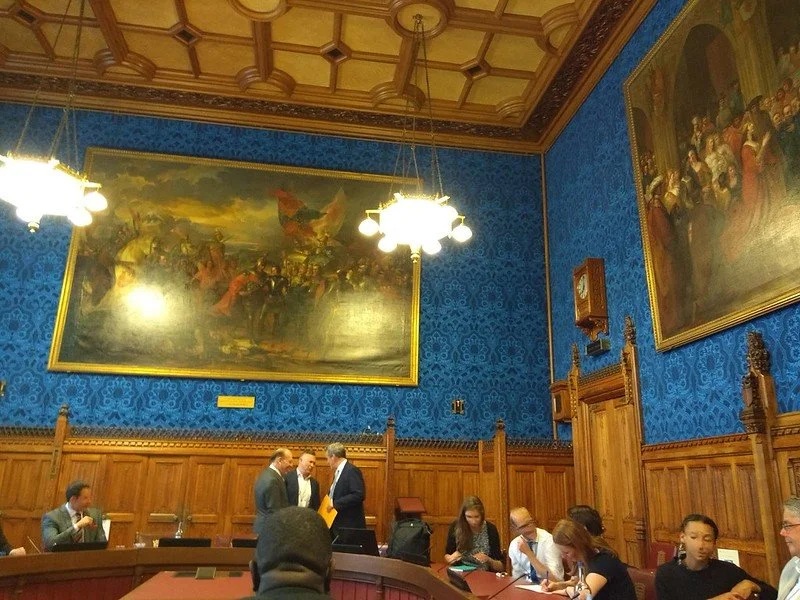

An e-learning committee can prevent fighting over limited resources. Picture by Terry Freedman
Advantages
This first section is an updated version of 6 Reasons To Have An E-Learning Committee In A School, which was published on 13 August 2015. I thought it might be interesting to revisit what I wrote back then, to see how far I agree with it now, especially in the light of Covid-19. My comments are in italics.
In my past roles as ICT Co-ordinator or e-learning co-ordinator, I have formed and chaired an ICT or e-learning committee. What are the pros and cons of having such a body?
The terms used differ from country to country and even from school to school. Just so we’re all on the same page here, by "e-learning co-ordinator” I mean someone in the school who has the responsibility for encouraging other teachers to use technology in their subjects. I think the “co-ordinator” part of the title is an expression of hope, except perhaps in the sense that the e-learning co-ordinator will try to ensure that all the facilities are not in demand all at once. In my experience, though things are changing slowly I think, that is a problem it would be wonderful to have. The co-ordinator is likely to spend a great deal of time encouraging, cajoling or bribing teachers to try it out rather than juggling excessive demand!
Had it not been for Covid-19, I’d have probably still agreed with my conjecture that the term “co-ordinator” is an expression of hope. After all, there has to be activity to co-ordinate! But Covid has chained that. It’s true that many teachers, tutors and lecturers had to be dragged kicking and screaming into using technology for teaching online, and it’s true that (at the moment) schools and some adult education classes are planned to revert to face-to-face teaching. However, not everyone will want or be able to go back to physical classrooms.
One of the things that can assist the co-ordinator is an e-learning committee. Here are 6 good reasons to have one:
Find out what subjects’ needs are
Rather than undertaking surveys, seeing teachers individually or just plain guessing, by having a committee you can find out very quickly what the technology needs are in each area. You can also discover what the frustrations are, such as the laptop trolleys always being booked out.
These days, there are additional things to consider, such as:
Who will train teachers in using Zoom etc in their subject area? Or doesn’t that matter anyway?
Are there enough licences for all staff to be able to host an online class?
Do online classes in Zoom need to be timetabled ? I ask this because a college I teach at has only a limited number of Zoom rooms. Therefore someone has to timetable staff to use them, otherwise when someone with hosting rights creates a meeting at the same time as a lesson is in progress, the teacher of that less can be booted out of her own room. Teachers could use their own Zoom accounts, but there are considerations for that approach too:
Online safety considerations.
Free accounts don’t have the full functionality of paid accounts.
Who will pay for the paid accounts?
Plan spending
This follows on from the first point. To follow through with the example given there, it may become obvious that money needs to be spent on a new set of laptops or tablets.
A propos what I wrote above, money needs to be set aside for purchasing more Zoom licences (for example).
Avoid double buying
In one school I worked in, I discovered soon after arriving that the heads of both the science and the languages departments had bought the same software. Worse than that, they had both had it installed on the (same) school network. Had someone co-ordinated such purchases, they could each have contributed half the cost instead of all of it.
I believe that this is still a possibility. Imagine, in a secondary school, several departments purchasing Zoom licences. It may be the case that, if their lessons are not timetabled at the same time, or if they can get together and plan not to have their classes at the same time, fewer licences will be required.
Shared ownership
One of the problems with making decisions on behalf of the whole school is that there is bound to be at least one person who complains that they were not consulted. Having a committee, on which every subject area is represented, means that the onus is on the representatives on the committee to sound out their colleagues rather than on you. It is much easier to talk to one or two colleagues than everyone on the staff.
This still applies.
Find out common technical problems
If your school is too small to have its own technical support team on site (a lot of primary (elementary) schools are in this position, the e-learning co-ordinator can keep track of the techie problems that arise so that they can all be dealt with when a technician is called in. Also, the co-ordinator will be in a position to spot any patterns, and deal with them, or have them dealt with, accordingly.
I’m not sure the principle behind this still applies, or at least there’s another factor to consider. Given the number of people who have become expert at using Skype, Zoom and a host of other online video conferencing applications, in order to keep in touch with friends and family during lockdown, schools are more than likely to have on their staff people who are able to troubleshoot common problems in Zoom etc.
Keep up with developments
I asked members of my committees to report back on areas in which they had a particular interest. Thus in every meeting we would have a few minutes in which someone would tell us about some interesting developments, whether in hardware, software or educational initiatives. It meant that we were all a lot more informed than we otherwise would have been.
Definitely still applies.
Concluding remarks
It seems to me that the benefits of having an e-learning committee as I suggested in 2015 still apply. However, the nature of the challenges and the technology has been changed because of Covid-19.
There is also the possibility that schools and colleges will lean towards a hybrid model, in which some classes take place online and others face-to-face. I used to have two one hour Computing lessons a week with each of my groups. I can imagine that today I might have one of those classes in school, and the other one as an online class. In that scenario, it may make sense to have two e-learning co-ordinators: one solely concerned with the online issues.
However, there is the potential for conflict there, as the two co-ordinators vie for limited resources. It’s one of the problems with having an e-learning committee….
Disadvantages
With all these great reasons to have a committee, what could possibly be wrong with having one?
In my last post I suggested 6 reasons to have an e-learning committee in a school. But not everything in the garden is rosy. Based on my experience as ICT co-ordinator in several secondary (high) schools, here are what I see as the downsides.
This committee is a bit too big for a school! Photo by Matthias Ripp https://www.flickr.com/photos/56218409@N03/
Feeding frenzy
Maybe I have been rather unlucky, but I have found that some subjects want to be represented on the e-learning committee purely in the hope of getting extra money to spend. I even experienced one meeting in which one of the teachers said that if I wasn’t earning such a high salary there would be more money to spend on technology. I have no idea how he knew, or thought he knew, what I was earning, but I told him that as I hadn’t determined my own salary level he should take his complaint to the headteacher. I can deal with such crass statements, but spending an hour a week (or whatever) in the company of such people is not exactly pleasant. Fortunately, not everyone on the committee was so bold in stating what they were really there for; if they had been, I’d have probably disbanded the committee on the grounds that its members had lost the plot, as we say in England. The purpose of the committee was to discuss whole school issues, not to try and grab resources or take pot shots at the Chair!
It may not be prioritised
I found in one school (the same school I cited above, in fact) that heads of subjects appointed their most junior member of staff to sit on the committee. These people were often new teachers as well, so they had very little influence with their immediate colleagues, and didn’t necessarily know the priorities of their own subject area let alone those of the school. It would be much better to have subject leaders on the committee.
Lack of time
That last wish, of having subject leaders on the committee, is more of a dream than a real possibility. Subject leaders tend to be extremely busy, and none more so than in primary schools, where the subject leader for e-learning is also likely to be the special educational needs co-ordinator. And probably the literacy co-ordinator, just for good measure! Indeed, in a primary school, it may simply not be feasible to have a committee at all because of the unlikelihood of people having the time to attend meetings.
Horses and camels
Finally, the old saying, that a camel is a horse designed by a committee, is very apposite. I would very much suggest making the committee an advisory body rather than a decision-making one. An advisory body advises, and you can either act on its suggestions or decide that it is wrong, and be prepared to argue your case. But if the committee is a decision-making one, you are very likely to end up with outcomes that satisfy nobody.
If you found this article useful, why not sign up to the Digital Education ezine, for more articles like this, guest articles, freebies and other good stuff.