
• Front Page
  • Search
    • Digital Education
    • Terry Freedman's Books Bulletin
  • RSS
    • Welcome
    • The "About" Page
    • Testimonials
    • CV/Resumé
    • My Writing
    • Published articles
  • Corrections Policy
Menu

ICT & Computing in Education

Articles on education technology and related topics
  • Front Page
  • Search
  • Newsletters
    • Digital Education
    • Terry Freedman's Books Bulletin
  • RSS
  • Info
    • Welcome
    • The "About" Page
    • Testimonials
    • CV/Resumé
    • My Writing
    • Published articles
  • Corrections Policy

SOLE destroying: an advantage of analogue over digital

November 23, 2015

Every so often someone comes out with the idea that we don't need knowledge (or teachers or even schools). For example, Sugata Mitra, writing in the Times Education Supplement, says:

If we make the curriculum not of things we know but of things we don't know, there will be little to teach and much to learn. We call this a self-organised learning environment (SOLE).

Now, I was thinking of responding to this, but as I think Tom Bennett did a pretty good job in SOLE: Snake oil learning experience?, I don't think I'll bother. After all, I have a lot on my to-do list, and if I responded to every example of this sort of thing I'd never get anything done at all.

I think Bennett got one thing wrong in his article though. He says that "we're the turkeys who voted for Christmas", referring to that odd-to-say-the-least phenomenon of "teachers applauding people who have never been classroom teachers, telling them that teachers aren't necessary." It's actually worse than that: if you incur a financial cost to attend a talk by anyone who is there to tell you that teachers are surplus to requirements, or that all we need are "facilitators", or whatever, then you're a turkey who has paid to vote for Christmas. That's nothing less than insane.

I was going to write a post along the lines of "What do African school children -- you know, the ones who walk for miles and miles to get to school -- know that Mitra doesn't? But Bennett covered that, in a way, in his regular column, when he describes how one of his pupils walked for three hours to get to school during a train strike and bad weather, because:

education was very important to him and his family because it was so hard to access in his native country.

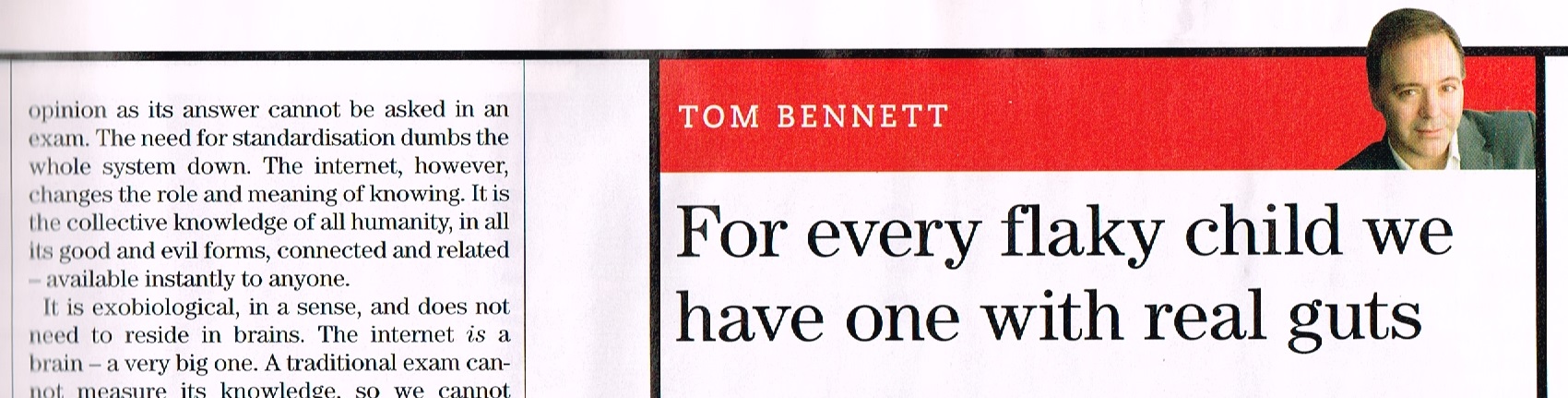
And this brings me to what I wanted to point out, something that you don't get to see when you read articles individually online, taken out of the context of the periodical in which they originally appeared. Whether by accident or design, Mitra's article saying that kids can do it for themselves, and Bennett's article citing an example of a pupil walking six hours to school and back, are placed next to each other!

A bit of devious positioning, or an unfortunate juxtaposition?

A bit of devious positioning, or an unfortunate juxtaposition?

I think this is a real example of delicious irony, and an example of where paper beats digital hands down!

In News & views Tags Sugata Mitra, Tom Bennett, SOLE, juxtaposition, journalism, analogue, paper
← Fiction and computational thinkingTeens, technology and friendships →
Recent book reviews
digital culture shock.jpg
Quick look: Digital Culture Shock: Who Creates Technology and Why This Matters

Chapters look at how technology is used around the world, online communities, and building a culturally just infrastucture, amongst other topics.

Read More →
Artificially Gifted Notes from a Post-Genius World.jpg
Quick look: Artificially Gifted: Notes from a Post-Genius World

The author, Mechelle Gilford, explores how AI may render our usual way of interpreting the concept of “gifted” obsolete.

Read More →
dr bot.jpg
Quick look: Dr. Bot: Why Doctors Can Fail Us―and How AI Could Save Lives

Dr Bot discusses something I hadn’t really considered…

Read More →
seven lessons 2.jpg
Review: Seven Brief Lessons on Physics: Anniversary Edition

Rovelli draws readers into his world by describing the development of theories that scientists have posited to try and explain our world and the universe beyond.

Read More →
dear data.jpg
Review: Dear Data

The authors spent a year sending each other postcards on a different theme each week, with pictorial representations of the data they had collected.

Read More →
Blueprints.jpg
Review: Blueprints: How mathematics shapes creativity

What place might Blueprints merit on a teacher’s bookshelves?

Read More →
renaturing.jpg
Review: Renaturing: Small Ways to Wild the World

This book could prove useful to schools keen to cultivate their own dedicated ‘back to nature’ area.

Read More →
listen in.jpg
Review: Listen In: How Radio Changed the Home

A couple of generations before the first internet cafés were opened, someone attempted pretty much the same thing by opening a ‘radio café’.

Read More →
level up.jpg
Review: Level Up Your Lesson Plans: Ignite the Joy of Learning with Fun and Educational Materials

This book is awash with ideas.

Read More →
conversations-with-Third-Reich-Contemporaries.jpg
Review: Conversations With Third Reich Contemporaries: : From Luke Holland’s Final Account

This may be useful for the Hiostory department in your school.

Read More →
Dig+Ed+Banner.jpg

Contact us

Privacy

Cookies

Terms and conditions

This website is powered by Squarespace

(c) Terry Freedman All Rights Reserved