
Psychology, Not Technology

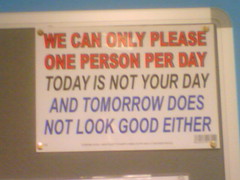
Don't try to be TOO helpful (photo of a sign in Queen's Hospital, Essex, UK)Are you an evangelist? No? Think again. Most of the people in this educational technology game have a quasi-religious zeal that is almost palpable. You don't even have to go very far to see it -- no further than your desk, in fact. Just look at the latest posts of any blogger, and it's odds on that at some point in the last week he or she has waxed lyrical about some new application they've discovered, or a new website that will change the world.

In fact, it's arguably even worse than usual at the moment because of people going on about the best developments of the entire decade. Give me strength!

Leaving aside the fact that, in my opinion at least, these flights of fancy are rarely thought through properly, they are likely to succeed in convincing only those who don't need convincing. The real challenge is this: how do we convince others of the benefits of educational technology, and get them to the point where they will at least entertain the idea of trying it out, even if an act of conversion (there's that religious talk again) is a bridge too far.

The first thing that we need to do is select our target, for want of a better term. There are three groups of people, broadly speaking: those who are convinced of the benefits of technology, those who have no real opinion one way or the other, but who are getting good results and therefore see no urgent reason to change, and those who won't touch technology with a bargepole.

You can ignore the first and third groups, and concentrate on the middle one. Then what you have to do is hone in on individuals, and here is where people make the classic mistake. They try to convince the teacher concerned that technology will allow them to do what they already are doing, but more effectively.

Even if you're not already wary of technology, that sounds suspiciously like a coded message:

"You're not doing as good a job as you could be doing, but don't worry, I can help."

Patronising, or what? And if you happen to be younger than the teacher concerned, the message is likely to be even less warmly received. So what is the answer?

Firstly, forget about doing the same stuff better. What is really interesting is doing stuff that you simply can't do at all with the 'old' technology.  It isn't only technology that can widen horizons, of course. One way of making children aware of what schools were like a hundred years ago is to arrange a trip in which they are immersed in a school environment of a hundred years ago, even down to the clothes and the curriculum.

Technology can help you widen children's horizons too, and thereby enrich their educational experience.

But there is another aspect too, and that is the psychological one. Stephen Potter, author of the one-upmanship books over fifty years ago, understood this very well. His books, whilst humorous, had a serious side to them too. Predicated on the axiom that if you're not "one up" then you're "one down", the books are full of psychological insights into human behaviour, and quite often recommend a course of action that is the exact opposite of that which one might naturally adopt.

To give you a quick idea of what I am talking about, take just one idea from Gamesmanship (subtitled: The art of winning games without actually cheating"). Potter says:

"... it is unsporting, and therefore not gamesmanship, to go in, eg, for a loud nose blow, say, at billiards, or to chalk your cue squeakingly, when [your adversary] is either making or considering a shot."

He goes on to say, however, that it is perfectly legitimate to whistle a tune whilst taking your own shot -- especially if you keep getting the same note wrong. That would be virtually guaranteed to get your opponent so agitated that he or she would start to make silly mistakes.

(Unfortunately, most of the 'Upmanship' books are out of print, although it's worth looking on Amazon for used copies. I've placed a link to one called 'One Upmanship' on my Amazon Books page.)

So, back to the subject in hand, and I think that a pertinent section from Lifemanship (the application of the principles of Gamesmanship to everyday life) is Woomanship, which is about how to attract a member of the opposite sex. There's a section called "Triangulation, or Third Person Play", which recommends the following, if you are in a situation in which the person in whom you are interested is being suited by another:

"The wooman if he knows his business will, as soon as he knows the identity of this Second Man, leave the girl almost unattended, if necessary for days on end, and make a thorough examination of this person, observe, make discreet enquiries at his place of employment. And then, once he is thoroughly acquainted with the Second Man's character, he can woo with a clear mind and heart. For he will know what to do. He must be sure that his character, habits, hobbies, tastes and mannerisms are the precise opposite of his rival's."

Now, if you stop to think about it, this is brilliant psychology. What's the point of trying to be like the girl's current suitor or boyfriend? She already has him! The only sensible course of action (assuming you accept the basic premises of this situation in the first place, of course!) is to be the complete opposite.

I would contend that the same applies when it comes to winning someone over to the joys of technology. There is little point in trying to convince them that they will get better grades, if the grades they are getting are already good. There is no point in being incredibly exuberant, because that just turns people off: there is nothing worse than a friend who has just discovered a new religion/holiday resort/musician/health food, because they just never stop going on about it. In the end, they achieve the reverse of what they intended.

A far better approach would be to adopt the opposite attitude, which in this case would be almost complete indifference. Yes, be available to help people, lower the barriers to entry, as it were, but don't go overboard. For example, rather than say:

"I've seen this fantastic new program that will transform your teaching of geography overnight",

say:

"I don't know if you're interested, but I've come across this geography program. I don't even know if it's any good. I was wondering if you could look at it and let me know what you think, like is it worth getting? But if you're a bit busy, it doesn't matter."

In other words, place him/her in the position of the expert (which they are, actually) whose advice you are seeking. Most people respond well to being approached in that sort of way.

Although this is not ostensibly the same as the romantic situation described above, there are similarities. The teacher already has an attachment (to traditional ways of teaching). You are trying to woo them away from all that. It's a clear case of needing to understand a little bit of human psychology, rather than a great deal about educational technology.
Authorised Madness

I offer this rant partly to get things off my chest -- I think I now officially qualify for the title "grumpy old man", even though I don't much care for the "old" part -- but even more so as a topic which teachers may like to raise with their students. The basic question is, I think, is technology being used inappropriately, or intrusively or even, ultimately, ridiculously?

I visited my local supermarket yesterday and decided to use the self-service check-out. This is a very advanced service which seems to require there to be at least two members of staff on hand at all times in order to sort out the problems it comes up with. If I tell you that I, of all people, have developed what amounts to a phobia about using it you may get a sense of how awful I think it is most of the time.

It isn't that the problems which arise are terrible in themselves, just that it's so embarrassing when a line of people is building up behind you. And that's another thing: it works perfectly when nobody else is around....

Just to put the positive side to the equation, I will admit to having found it much faster, sometimes, than the normal check-out, and it is undoubtedly more fun. There is a video game-type display showing you what to do, and a voice which guides you though the process.  That voice is female and was chosen, I am certain, to sooth the nerves of people such as myself and thereby prevent acts of vandalism directed towards the machinery.

But yesterday even I was floored by a message that appeared on the screen.

Before going any further, I have to inform non-UK residents that we in England have reached the point where anyone who sells anything is scared to death of being sued. Thus it is that if you buy a drink from a fast food outlet you'll see a notice on the cup informing you that the contents may be hot -- even if you've purchased an iced tea. On foodstuffs, just about everything contains the warning, "May contain nuts". Bizarrely, bags of nuts do not come with such a warning. I must contact my attorney....

Even food which could not possibly contain anything even resembling a nut comes with the caution that it may contain traces of nuts, or that it was processed on machinery that may once have been used to process nuts.

Medicine packets list every single possible side effect of the contents therein. So, if 3 years ago someone took one of these tablets and then 2 weeks later his left leg dropped off, one of the possible side effects listed will be "May cause leg to drop off."

Back to the supermarket. The way it works is that you scan the item, then drop it into a plastic bag. The item shows up on the screen, then you're ready to put the next one on. One of the items last night was a box of painkillers. I scanned it, dropped it in the bag, and then had a warning message appear reading something like: "You have bought painkillers. You cannot buy any more unless you are authorised to do so. Are you authorised to do so? Yes/No"

Authorised? By whom? My mother? The store manager? I pressed "Yes" and it let me continue. In discussion with my wife we decided that it must be the store's way of protecting itself against prosecution by the families of people who decide to end it all by taking an overdose of painkillers. Presumably such people are too depressed to think about buying one huge box, buying several small boxes in several shops, or just to press "Yes". Perhaps there is some law that states that nobody is allowed to sell anyone more than one box of painkillers at a time.

Perhaps this idea could be extended to other areas of modern life? How about this: when you press the button on a traffic light, suppose a message came up: "Crossing the road is dangerous. Have you been authorised to do so?"

Homes could be fitted with such a system, so that as you go out of the house you're warned that "There are muggers and drunk drivers out there. Don't do it!" And when you put your key in the door to come in: "You do realise, I hope, that most accidents happen in the home? Do yourself a favour and head to the nearest hotel. Here's a list of the nearest ones which have vacancies..."

And by the way, I do hope you've printed this out to read. Computers use electricity, and electricity is dangerous. Make sure you've been authorised.


A Touch of Humanity

It is a sad but incontrovertible fact that one of the unfortunate effects of technology is that it provides some people with the excuse they need to abrogate all sense of personal responsibility or discretion. Note that I don't say the rise of technology causes people to behave in particular ways, just that it creates conditions in which such people can thrive.

This was epitomised and satirised by the Little Britain sketches on the theme of 'The computer says 'no'!" (See below for an example.)

Automated menus are another manifestation of this phenomenon. The worst ones are the ones where you end up in a sort of closed time loop, in which, after ten minutes of increasingly 'niche' destinations you end up in the same menu you started at.

Possibly the absolute worst one was the one which, after ten minutes getting me to the extension I wanted, announced that the office was now closed and that I should try again in the morning. I quite like the automated answering machine script in this context.

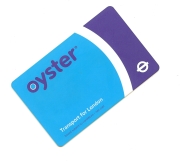
The Oyster CardYesterday I raced for a bus and placed my Oyster Card against the automated reader. The Oyster Card is a kind of cashless travel ticket that stores details of all your journeys on the Transport for London system. It probably also stores how many cups of coffee you've consumed, the point you're at on your circadian rhythm cycle and details of your DNA.

The wretched machine bleeped twice.

"What does that mean?", I asked.

"It means you haven't got any money left on the card", came the response.

"OK, how much is it then?"

"Two pounds."

"Two pounds?!" I exclaimed. "Good grief."

I rummaged around for some money, but found just a few loose coins.

"Can you change a ten pound note?" I asked.

"Where are you going?"

"The station".

"Forget it", said the driver.

"Really?", I said. "You are a gentleman, Sir."

In times gone by I would have written to the bus company, giving the time and route on which I was travelling, to thank them for such commendable service. If I did that now, he'd probably lose his job for not following some set of rules to the letter.

But it was a pleasant experience to meet someone who could exercise a bit of judgement, and show a touch of humanity.

Do you know who your 'friends' are?

In the September 2008 edition of Computers in Classrooms, I wrote an article in which I discussed how cartoons and comics could be used to stimulate discussion in a topic. A cartoon doesn't have to be side-splittingly funny to be useful. As long as it causes a smile and is pertinent to matters of concern, you're on safe ground.

The cartoon below is a case in point. You may have to explain who the Grim Reaper is, but apart from that it ticks all the boxes:

  • It's based on a pretty silly premise: I doubt that the Grim Reaper has a page on Facebook or in Twitter!
  • It's not guffaw-inducing, but it's humorous enough to take the edge off what could, if you're not careful, be a 'discussion' in which you find yourself preaching to a bunch of people who are convinced that you just don't 'get it'.
  • Humour is a good way of priming the brain to be more open to new ideas. I have absolutely no scientific basis for saying that, apart from my own experience, both personal and professional.
  • It touches a nerve which is very much raw: who exactly are  the people who ask to be your friends?
  • You can use it as the basis for further discussion, such as: is it OK to 'unfriend' someone in a social network? Is 'unfriending' enough, or should you block them too? Is blocking them enough, or should you click on the 'Report' button?
  • And, of course, you, or your RE or Citizenship colleagues (or all of you) can start to explore the meaning of the word 'friend' itself in a virtual context.


You mean, there wasn't ALWAYS IM?

This cartoon made me smile because it reminded me of a 13 year old in one of my classes who looked utterly incredulous when I mentioned how nice it was to be able to record TV programmes while you were out and watch them when you came home, or at the weekend.

"Wait!", she said. "Wasn't there always video recorders?"

And she was serious!


The Big Sweep

Jack Alibi knew how to work. He also knew how to work a scam. Sure, going legit was good, but it took time. Lack of time was something Alibi had plenty of.

The Big SweepHe knew from the wire that the local school was being rebuilt, and that they were looking to put in a heap of technology. As far as Alibi was concerned, selling computers was like a licence to print money.

He staked out the school and got to know the movements of the big cheese, a classy dish who barely looked old enough to have left school, let alone run one. One night he waited in a doorway for her to pass.

As she did he started walking and brought himself up alongside her.

"Hey, honey", he grinned. "How about a little coffee?"

She didn't respond, except maybe her pace stepped up a notch.

Alibi went into phase two of his plan.

"I hear you're looking for high tech stuff. Maybe I can cut you a sweet deal."

She ignored him, but he continued.

"That stuff costs a lot of lettuce. That means less to spend on a fancy office and all the trimmings. Maybe I can help out."

She stopped and glared at him.

"Oh yeah?", she said. "And why would you wanna be helping someone you don't even know?"

"On account that I'm community-minded. Besides, I'd hate to see a classy dame like you being taken for a ride. I can get what you need at a whole lot less."

She remained motionless, but a quick glint in her eye let Alibi know she was interested.

"OK", she said. "Let's suppose I'm interested, which I ain't. But let's be hypothetical. What are you offering, and what's your rake-off?"

Alibi was ready for that: he'd done his homework.

"I get all the tech you need, on a no questions asked basis. Hypothetically. As for me, I work on commission, 5% of the value of the merchandise. That hardly pays my rent. But Like I said, I'm community-minded."

She looked at him like he was something that was tossed out in the garbage the night before.

"Yeah, I can see you're all heart. OK, muscle head, you talk big, but maybe that's all you do? Talk, I mean. My guess is that this ‘merchandise' is old cast-off junk, right? That ain't no use to me. I just took over running this joint, see? I'm the new broom around here, and there's gonna be one hell of a big sweep. No jackass like you is gonna louse things up for me."

"OK, sister, I get the picture, but you got me all wrong. I tell ya, lady, this stuff is so new it uses technology that ain't even been invented yet."

She reached inside her bag. Alibi's hand went instinctively to inside his coat. She pulled out a packet of gaspers, put one to her lips. He lit it for her.

"I tell you what I'm gonna do", she purred. "I'm gonna think about it."

She drew on the butt and let out a plume of smoke.

"Well, I thought about it. No."

"No? How come?"

"Well, Buster, I just remembered the advice my daddy gave me when I was knee-high to a cricket."

"Oh yeah? And what might that be?"

"Never accept suites from strangers."

Thanks to William Denton for his Dictionary of Hardboiled Slang.

This story originally appeared in the September 2009 edition of Computers in Classrooms.