Summer Reading

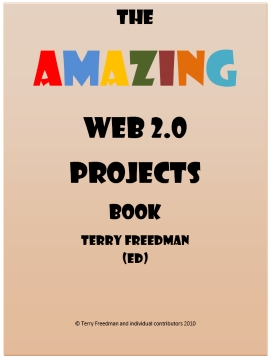
If you're worried about how to keep yourself occupied over the summer break, and are not interested in novels and suchlike, why not curl up with a copy of The Amazing Web 2.0 Projects Book?

With 87 really interesting projects featured, it's a good read. Others think so too: I've received a lot of good feedback, some of which I've included on the Free Stuff page, from where you can download it. As of about 10 minutes ago, this is how the stats are stacking up:

Downloads: 14,347

Views in SlideShare: 509

Views in Myebook: 2,742

Views in Scribd: 399

You'll find all the links to these alternatives here. There is also an HTML version over in the OU Vital community, although you'll need a (free) login to be able to access it.

I'd also highly recommend checking out Shelly Terrell's suggestions. She lists 35 professional development resources which will keep you busy for a while! (I have to declare a slight interest here, because she has included two of my own efforts.)

Whether you prefer learning through books, audio books, blogs or live seminars, you're bound to find something of interest in Shelly's list. For me, I'm hoping to check out the discussion with Howard Rheingold on 16th June 2010.

I'm also working on the next issue of Computers in Classrooms, which was delayed because of computer problems. Long story short: it's all sorted now, but in the meantime lots of stuff has piled up and so I'm in catch-up mode. But that hsould be a good read too, plus if you subscribe yu'll have a chance of winning a computer game and a year's subscription to another game. More information on all that soon.

Youth Safety on a Living Internet

Youth Safety on a Living Internet is the report of the USA’s Online Safety and Technology Working Group. I discovered it when Penny Patterson posted the link to it on Becta’s Safetynet email discussion list.

It's available as a free PDFAt 148 pages it’s quite a read but, astonishingly for an official report, engagingly written. It’s full of the sort of common sense advice that makes you go “Of course"!”, but backed up by research findings.

Although the committee’s remit covered only the USA, it cites studies from other countries, such as the UK’s Byron Review. Moreover, although the evidence base will be different between the USA and the UK, a number of things will be applicable here.

For example, the citing of different kinds of safety, which I have certainly mentioned in these pages – see, for example, The Pros and Cons and Safety Aspects of Social Networking and 11 Essential Elements of a Digital Financial Literacy Course.

Also, stating the (what ought to be) obvious point that youngsters will use the internet regardless of what sort of measures are in place to protect them, so a sensible thing to do would be to help them learn how to use it safely.

All in all, a worthwhile read, which is both well-structured (there are lots of summaries near the beginning) and, as I said, readable.

A Good Example of Bad Conclusions

Unless The Register has missed something out of its report, or I'm not thinking straight, there is a serious flaw in Hitwise's conclusion that Brits' greater use of social networking sites than search engines prove that they are  "more interested in talking about themselves than they are in learning about their world".

How does one reach that  conclusion? Perhaps there is a legitimate chain of logic, but I can't see it, and it hasn't been explained as far as I can see. It's an excellent example of the need to probe beyond the headlines and soundbites, and to teach our pupils to do the same.

Anyway, any true narcissist wouldn't bother to visit social networks to see what people are saying about them: they'd set up a few Google Alerts.

That's what I've done, anyway.

I'm back!

This is just a very quick update. Having sorted out my computer problems (fingers crossed and touch wood), reinstalled loads of software and (hopefully) not lost any data, I'm now almost ready to start writing again.

After I've done a mega backup, installed Tweetdeck and actually gone out to earn a crust, I will be back with some new articles.

In the meantime, take a look at this report by Patrick Hadfield on the 140 Meetup panel discussion I took part in last week. Some very interesting issues were raised, from a wide variety of people (mostly from outside the education profession).

What's happening here?

This is just a quick post to keep my loyal readers (hi, mum and dad!) informed of what's going on. I don't have time to go into all the gory details right now, but suffice it to say that I am currently working on a borrowed computer having expended loads of time and energy dealing with my own one, have been descended upon by relatives virtually unannounced, and just to bring the number of things up to three (things always happen in threes, so they say), my exhaust dropped off a few days ago. Well, the exhaust from my car if you are going to be pedantic about it.

So the upshot is this:

  1. I have had to focus on my work in the reduced time and energy I've had available. I am sure you understand the need to put bread on the table. Not that we eat bread, but you know what I mean.
  2. I will be writing about a visit to the RM REAL Centre soon, my experiment with setting up a newswire in Publish2, which I have been a member of for a couple of years, and of course continuing with the 31 Days to Become a Better Ed Tech Leader series.

But right now I have to drive my car to the garage to have the exhause fixed. If you live in my neck of the woods and you hear what sounds like a tank going past, it's probably me. Don't forget to wave as I crawl past.

A slight glitch....

Unfortunately, I haven't been able to get the latest '31 Days' article out today. I have been somewhat distracted by the fact that some problems I have been having with my computer have been nailed down to an impending hard drive failure! (Fortunately, the computer came with a pretty good diagnostics program that identified the fault.)

I am extremely assiduous in taking backups of data. However, before the computer goes off to be sorted out (it's still under Warranty) I wish to erase all the data off the drive, and because I know that some vital piece of information will be found to be missing after I've done that, I've been double-checking that software licence numbers have been noted down, vital emails forwarded on to my lady wife (as well as backed up) etc etc. It all takes time, and is rather distracting, as you will know if you have had this happen to you (who hasn't?).

More articles will appear soon, but in the meantime I hope you enjoy reading what's already been published here. Look down the left-hand side of the page for the last 10 articles.

Thank you for your forebearance.

Constructing Education for the Future

I've been invited by Bernie Mitchell to take part in a panel discussion at one of the #140 Conference Meetups. The topic to get us started is:

Constructing Education - Do we have a real time responsibility to future generations - NOW? (And what does that look like?)

Here are my initial thoughts.

There is a temptation to say, like Sir Boyle Roche,

What has posterity ever done for us?

I believe that would be both shortsighted and wrong, for the following reasons:

  • The future is closer than we think. The pace of change, as measured by, say, adoption rates, is so fast these days that anything we do now, or fail to do, is likely to have repercussions in our own lifetime. So from a self-interest point of view if nothing else, we'd be pretty stupid not to exercise responsibility towards future generations.
  • On moral or ethical grounds (I'm never quite sure of the difference), why would anyone go into teaching if they were not committed to the welfare of future generations? I like to think that not everyone goes into teaching as an interim measure between more lucrative forms of employment.
  • The term 'real time' is quite interesting. It suggests the idea of changing education according to needs much more quickly than is usually true. It ties in with an idea I've had for some time, which is that if you want schools to succeed you have to give them more freedom rather than less. Micromanagement stifles creativity in commercial life; surely the same is true in education?
  • That being the case, if I am right then what we need to do is construct an education system which is minimalist, rather than detailed.
  • We also need to somehow remove the risk of failure from the educational process. Many teachers/schools are so concerned about league tables that they dare not risk trying out new approaches, such us using Web 2.0 applications in the classroom. I wonder if there is a way of allowing innovation -- especially using educational technology -- without risking students' life chances or Headteachers' careers? The fact is, not innovating and not using technology are just as risky as taking risks!
  • That's because the world is changing. The world is becoming a Web 2.0 world. I may have a chance to say more about this tomorrow, but basically the point is this, and it has been made many times by many people: there is little point in educating future generations for life and work in a world that is gradually disappearing.

If you can make it to Holborn Piccadilly in London tomorrow evening, I hope you will be able to join me and a brilliant line up of other panelists and a great bunch of participants to discuss such matters. What are your  thoughts?

STOP PRESS! The venue has changed: it is now at the Grace Bar, 42-44 Great Windmill Street, London W1D 7NB.

10 Obligations of Bloggers

If you blog for an audience, as opposed to simply for yourself, what are your obligations? I’d say the following:

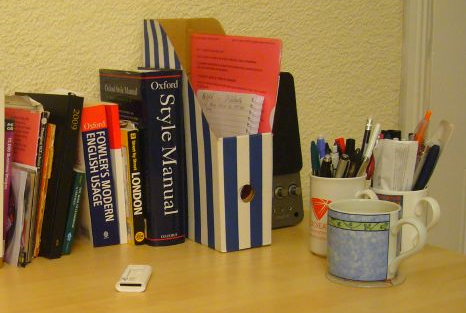
Use manuals to help with tricky or confusing words.

Write with integrity

For example, if you write about a product you have some connection with, especially if your report is positively glowing, then state that connection loud and clear. Unfortunately, the opposite is also true, ie if you don’t have any connection you should probably say so. I use the word ‘unfortunately’ simply because I think it’s a pity that some people think that if you like something, you must be getting a pay-off in some form.

Write accurately

Accuracy is another facet of integrity. Check facts, quotes and references. If you don’t have time to do that, make it clear that you’ve written what you believe to be the case, rather than present it as fact. Some people think that bloggers somehow naturally have more integrity than professional journalists, but I think integrity has to be worked at.

Write incisively

I know that one of the great thing about blogging is that it’s OK to air some half-thought-out idea, which on later reflection or in the light of further information may become regarded as less useful than it first appeared. I think that’s fine, as long you don’t try to sound as if not only do you know what you’re talking about, but that any other viewpoint is plain wrong. Why not just say: “I’ve only just seen this, so my initial thoughts are…”, or “I just had an idea that I haven’t had time to think through, but…” or “Here’s the kernel of an idea; tell me what you think.”?

Writing incisively shows through in the questions you ask as well as what you state. It’s not obligatory to always have an answer.

Write regularly

I think if you have built up a following, even if it’s only a dozen people, you owe it to them to write as regularly as you can. I don’t think you have to write every day necessarily, but reasonably often, like once a week.

(This is something of a counsel of  perfection: I have only just managed to update my My Writes blog for the first time in months, because I have been concentrating on the ICT in Education one, which I update pretty much every day).

Write well

I realise that to a large extent good writing is, like beauty, in the eye of the beholder. What you find beautiful I may regard as too florid. Writing which keeps me engaged may leave you in despair at its starkness. That sort of thing is a matter of taste, and there is little if anything to do about that. But surely it is not unreasonable to expect – to take just one example --  that those who blog at least trouble themselves to check the vocabulary they use and not, for example, confuse ‘continual’ with ‘continuous’ or ‘uninterested’ with ‘disinterested’?  Books which deal with commonly confused words are easy enough to obtain, after all.


Write for a purpose, with the reader in mind

I think if you write for yourself, you can be completely self-centred about what you write. However, in my opinion, as soon as you have an invited audience (which, by definition, you do have by making your blog URL known), you have an obligation to give them a reason to read your blog, whether that’s entertainment, enlightenment or simply stuff to think about.

Write for all your audiences as well as each of your audiences

We urge pupils to write for an audience, and to write differently for different specific audiences.  Should we not also encourage them to develop a set of over-arching principles that would apply to all writing, for all audiences?

Write with consideration

I suppose this is a personal thing, but I don’t like the idea of having swearing, or even implied swearing, on my blog, in case it offends some readers. That’s why I sometimes don’t publish comments expressing an opinion ‘robustly’. People are entitled to their opinion, and they’re entitled to express it forcefully, but if they do so by using expletives I’m afraid it won’t see the light of day here.

Be yourself

As Polonius said in Hamlet, “To thine own self be true.” I think an obligation that each blogger has is to define his or her own set of obligations. That is, I think that if you’re going to write publicly you have to develop a set of rules by which to write by. They may be very different from the ones I’ve listed here, which clearly reflect my own value system, but I think the process of thinking about them is important.

Be silent

Finally, I don’t think it’s necessary, or even wise, or useful, to pass comment on something as soon as it’s been announced. It’s good to be first with the news, but it’s also good to be among the first with well-considered reflections.

As Salvator Rosa said,


Be silent, unless what you have to say is better than silence.

What have I overlooked?

Facebook Privacy Settings -- Again

Stand by for yet more changes to the way Facebook presents your privacy settings, according to TechCrunch. According to Chris Pirillo,

Facebook currently has nearly 200 different privacy options and 50 privacy settings. It’s no wonder that the average person gets hopelessly lost when trying to figure out where they need to opt-out.

He goes on to say:

Why the hell do they have to opt-out, anyway? Shouldn’t it be more of an opt-IN scenario?

This is absolutely right. In my opinion, it is always better to err on the side of caution and assume that the average person, if asked, would prefer the default position to be privacy rather than non-privacy.

Should your private data be under lock and key?That is why I use a double opt-in system for subscribing to the newsletter, Computers in Classrooms. (That's where, after signing up, you receive an email asking you to confirm that it really was you who completed the form and you really do wish to subscribe.) As far as I'm aware, that is not a legal requirement, but is regarded as good practice. In any case, it seems to me to be safer on legal grounds, given that the advice from the UK's Information Commissioner states:

If challenged, you would need to demonstrate that the subscriber has positively opted in to receiving further information from you.

I do wonder, sometimes, whether privacy means as much to young people as it does to us oldies. But whatever their natural inclinations, they should be aware of their rights, and what their data may be used for.

Privacy rights vary according from country to country, so people really need to be encouraged -- urged, even -- to read the Terms and Conditions and/or Privacy Statement on websites before signing up to something.

Astonishingly, many people don't, as one company happily discovered when, as an April Fool wheeze, it told customers that it legally owned their souls! The news article from the Daily Telegraph states:

Almost 90 per cent of customers agreed to the terms and conditions without reading – either that or they were happy to surrender their souls. The 12 per cent of customers who refused the terms were given a £5 gift voucher.

I was intending to review some software once, when I read on the company's website that the copyright in any article which mentioned the product belonged to the company. That's a ludicrous proposition, of course, and almost certain to be kicked out of court, assuming it ever got that far. However, I took the view that (a) I don't have the time or inclination to engage in a legal tussle, and that (b) I have no desire to publice a company that would make such claims anyway. The result was that the company gained nothing from my use of its software. If you think about it, its legal staff or advisers are working at odds with its marketing staff.

As for what the data might be used for, young people need to realise that, from a marketer's point of view, it is better for people to have to opt out of receiving marketing messages than to have to opt in. That's because most people most of the time take the course of least action: it takes more thought and effort to tick a box than to not tick it.

Issues to discuss with students

  • Are you aware of your legal rights? (Whether you're in a position to enforce or defend them is another matter entirely.)
  • Where would you find out what your legal rights are?
  • Is there a case for requiring all websites to have a Terms and Conditions and/or Privacy page?
  • Should such a page be written in user-friendly language rather than legalese?
  • Does privacy matter?
  • What should the default position be for something like Facebook, given that one could argue that the whole point of it is to enable people to find you easily?

Announcement of Two Prize Draws

Win a year’s subscription to online resource bank

I’ve arranged several prize draws for subscribers to the Computers in Classrooms newsletter, starting with this one: Scholastic has kindly made available a one year subscription to their online resource bank for primary (elementary) children.

Once logged in, you can  browse through the thousands of resources by clicking “Browse our resources”, on the right hand side of the page, underneath the orange “My folder” button.

The “My folder” button is where you can store all your favourite resources, features and news, allowing you to easily find what you particularly liked, for next time!

Alternatively you can search for resources using keywords.  Type in for example “Role Play” into the search field on the main page, and select “Child Ed Plus” from the drop down ‘department’ list to show the resources available.

Being a subscriber to Child Education PLUS online resource also means that visitors have full access to all the back issues of the Child Education PLUS half-termly hard copy magazine, packed with lesson ideas, advice and news.

I’ll be running the prize draw at 10pm British Summer Time on 30th April 2010. For the rules that apply to our competitions and prize draws, please see http://www.ictineducation.org/newsletter/. For this one, all subscribers are eligible regardless of place of residency.

Thanks to Alison MacGregor and Carly Wonnacott of Mango Marketing for setting this up.

PIMS competition

One of the interesting things to arise from the increasing affordability of sound recorders, digital cameras and pocket video cameras is that these devices are increasingly being used in a ‘show and tell’ way. Rather than try to describe to parents, or even yourself, what the youngsters have learnt, capture it as it happens. See, for example, my account of my visit to Grays Infants School, and my review of the Flip Video – especially my interview with Elaine on how it might be used in the classroom, and the further possible uses we came up with.

Unfortunately, all too often the level descriptors and the digital evidence are stored separately. However, an application called PIMS brings the two together. Julian Barrell, the company’s Director, took us through the system: you upload the evidence right there and assign level descriptors to a child or group of children. In fact, the child could do it too.

You can have a go yourself by  going to Http://www.simplyefficientsoftware.co.uk and playing around in the demo school. Use the school name pimsdemo, and the username and password demo.

Now there’s some great news if you look at the system, like it, and are a subscriber to Computers in Classrooms, because on 26th May 2010 one randomly-selected subscriber will be able to use the system with any two classes of approximately 30 children, for up to 6 years. All you have to do is (a) subscribe to Computers in Classrooms and (b) agree to write a brief article for the newsletter and website, on how you find it.

The price is £400 per class for up to 6 years and includes future upgrades, so with a free introduction INSET session by Julian this prize represents a potential £1000. 

I’ll be running the prize draw at 10pm British Summer Time on 30th April 2010. For the rules that apply to our competitions and prize draws, please see http://www.ictineducation.org/newsletter/. For this one, all subscribers are eligible regardless of place of residency.

More to come

Look out for other prize draws, to be announced on the ICT in Education website. Still not a subscriber? What are you waiting for? It takes just a few minutes to sign up and confirm your subscription, and it's free.

Connected Leadership Course

My friend Peggy George has sent me details of a Moodle course she is facilitating. Called 'Connected Leadership', the course is running this week (May 16-21), although all of the resources and the entire course will remain online indefinitely.Become a strong link in the leadership chain

Peggy tells me:

While Kim [Caise], Lorna [Costantini] and I created the course and organized all of the content, there are a number of co-facilitators behind the scenes who are there to contribute to the discussion forums and keep the conversation going which is a great help! They include Paul Stacey, Sharon Betts, Bruce Bearisto, Virginia Rego, Clint Surry, Randy Labonte, David LeBlanc and Wade Gemmell.

I've had a quick rummage around and it looks very good indeed, with lots of resources listed (including the 31 Days to Become a Better Ed Tech Leader series, which is most flattering) and some interesting discussions in progress. I'm looking forward to exploring further, and I suggest you might find it interesting and useful too. Here's the link:

Connected Leadership


How to Randomize Your Blog Reading

OK, I know it's ridiculous, but I am currently subscribed to 829 blogs. That means if I checked one per day it would take nearly three years to get through them all. What I ought to do is go through them, and be absolutely ruthless about weeding out the ones I don't read as often as I should. Erm, that would be all of them then.

Or perhaps I should ditch the ones I don't like too much. But I often read blogs I don't like because they are useful sometimes.

So I've decided that the only answer to a ridiculous problem is a ridiculous solution: I have decided to experiment with randomizing my blog reading. Here's how it works, using Excel.

Setting up the random blog post generator

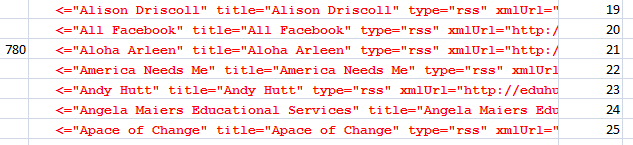
Extract from my blog list

  1. Open Excel and start a new workbook.
  2. Open your RSS feed reader.
  3. Export your subscriptions to what is called an OPML file. This option will be found somewhere in the menu system of your blog reader. In Google Reader, for example, you click on the link at the bottom of the screen called 'Manage your subscriptions', then to Import/Export.
  4. Next, open the OPML file in your web browser.
  5. Select all the text in the file.
  6. Paste it into the Excel file. You should find that each blog you subscribe to lands on a row all to itself.
  7. Get rid of any extraneous text at the top of the worksheet, ie any text which is clearly not an actual blog. Make sure that the first blog is in row 1 or, if you wish to be prim and proper and give your columns headings, row 2.
  8. Get rid of extraneous text at the beginning of each line, such as 'outline text'. Use the Find and Replace tool for this, replacing the offending text with nothing.
  9. Next, we need to assign a number to each blog. The easiest way to do so is by using the formula =row() in the column to the immediate right of your list of blogs. For example, in my spreadsheet the blogs are listed in column F, so I have placed the row formula in Column G. Don't worry about obliterating some of the text in the blog list: you can always widen the column just enough for you to be able to read the name of the blog. If you have started your list on row 2 rather than row 1, amend the formula to =row()-1. You only have to enter the formula in the very first row of data.
  10. Place the mouse pointer on the bottom right hand corner of the cell with the =row() formula in it, and double-click. This will copy the formula all the way down.
  11. Next, we need to place a random number generator somewhere near the top of the worksheet. The best formula to use is Randbetween: =randbetween(bottom,top). Thus in my case this has to be =randbetween(1,829).
  12. Save the spreadsheet with an impressive sounding name. I've saved mine as 'blogarizer'.

Using the random blog post generator

Putting this 'blogarizer' to work is simplicity itself.

  1. Just press F9, and a number will appear where the Randbetween function resides.
  2. Scroll down your blog list to find the blog to which that number has been assigned.
  3. Go to your RSS reader and go to that blog.

Some awkward questions

I'm about to start experimenting with this myself. If you decide to try it, let me know how you get on. Although this is an interesting approach to having too many blogs to read, a few questions spring to mind:

  • Does each number really have an equal chance of being generated? I have my doubts, but I think I will have to assume it does, unless someone proves to me otherwise.
  • Although each blog (we assume) has an equal chance of being chosen, is this actually a fair, in the sense of equitable, method of doing so? Would it not be more fair to weight the randomizer in some way, perhaps to reflect the fact that some people really contribute to the education community and therefore 'deserve' to have their blog posts read?
  • Is this actually a sensible way of approaching the problem? It means, in effect, that someone who writes about every aspect of his/her life, and only occasionally about educational technology, stands an equal chance of being read as someone who posts exclusively about educational technology -- and whose posts might therefore be deemed to be the more useful of the two.
  • Is it ethical? I mean, there are people whose blogs I follow because their posts never disappoint -- which is pretty good going if you think about it. Yet here am I saying, in effect, "Thanks a bunch for all the great work you are doing, but you have only a 1 in 829 chance of being read by me on any given day." Is that right?

I think it's interesting that although this approach may be fair in the purely mathematical sense, it could be grossly unfair in other ways.

So what's your opinion?

Refurbishment Isn’t The Same As Improvement

One of the places I like to go sometimes is a bar where they have free wi-fi and a relaxed attitude. You can sit there for three hours nursing a single pint (orange juice and lemonade in my case, if you’re buying) without being hassled or asked to leave.

Basically, neither the bar staff nor the owner seemed to care about such things. And as for the clientele, they were all concerned with their own affairs. I wouldn’t call them social misfits exactly but they were, shall we say, characters.

And now they’re gone.

The bar, you see, has had a make-over. It’s been ‘done up’. It’s been ‘upgraded’. It now serves ‘toasties’ and ‘skinny lattés’. It’s more light and breezy. But it’s not my bar.

I’m not, and never have been, a pub-type person. But a pub with free wi-fi and open all hours, now that’s a different matter.

But now that it’s changed so much, I doubt that I’ll be seen there too often. I may venture in there when I need to send an email urgently and I happen to be in the area. I doubt that I will again make it the point of my journey.

All of which makes me wonder: are all refurbishments improvements? Is it possible to have a brand spanking new computer suite, but none of the old atmosphere or user-friendliness?

I visited a school a few years ago in which the computer lab had nothing on the walls. No posters about how to use the equipment. No notice stating who to phone if something went wrong.

“Why’s that?”, I asked my host.

“Private Finance Initiative”, came the reply. “Not allowed to put anything on the walls.”

That should have been negotiated out of the contract before a single brick was laid, in my opinion. But that, and my bar experience, serves as a warning, I think: just because something has been refurbished, or renewed, doesn’t mean to say it’s been improved.


Amazing Web 2.0 Projects Book Update

A couple of days ago I posted a short article about this free book, and where you can find it. There is now another location. Thanks to Peter Twining and his colleagues at OU Vital, it's now available online in HTML format (though you have to register -- free -- on the Vital website to access it).


Peter informs me that people can link to individual sections of the book within the vital community by copying the link for the section in question from the menu that is visible on the left of each page when you are looking at the book.

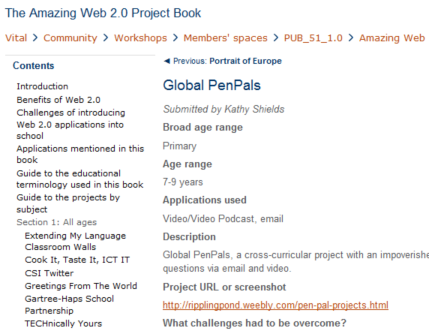
e.g. http://www.vital.ac.uk/community/mod/oucontent/view.php?id=4286&section=8.10 links to the Global Penpals case study (if you are logged into the Vital Community).
It's quite a nice, easy to use interface, with an index of projects down the left-hand side, as you can see from this screenshot.
The Amazing HTML version

The Amazing Web 2.0 Projects Book

The Amazing Web 2.0 Projects Book

Amazing projects at an amazing price

This is an updated version of a news item published on 21st April 2010.

This fantastically useful and free book has now been downloaded 12,972 13,068 times, and that only tells part of the story. Others have made it available on their own websites, and I obviously cannot know how many downloads they've enjoyed. Also, some people have passed it on to many others.

Going by the poll I set up, the 40 people who have responded so far sent it out to an average of 77 people each, which if true of everyone would mean that over a million people have seen it so far. It's rather too small a sample to draw such conclusions though, and that mean figure hides a wide range. UNESCO, for example, has sent information about to to 5,000 people as well as placing a note about it on their website.

If you have downloaded and looked through the book, please complete the survey, which comprises three questions and involves hardly any typing!

If you like, you can access the contents of the book in three other ways, and even embed it on your own website. Firstly, there is a SlideShare  option.  The links are live, ie you can click on them and they work. Also, the subject-project  list near the beginning of the book now contains hyperlinks to the projects cited. You’ll see the embed code near the top right-hand side of the screen.

Secondly, I have created a Myebook version. To obtain the embed code, you will need to open the book and then click on the Info tab. The advantage of this over the SlideShare version is that it looks and sounds like a real book, and you can zoom in to read it more clearly. Also, you can grab parts of the screen and email it to a friend. Unfortunately, though, the links don’t work, simply because I don’t have time to create them all manually - I’m waiting for a forthcoming automated version of the book builder to do that for me!

Thirdly, there is now a Scribd version. This, too, can be embedded in a web page or blog post, and shared over social networks.

You can download it from the Free Stuff page on the ICT in Education website, where you will also be able to read a sample of the nice things people have been saying about it.

The Role of Technology in Campaigning

In the UK at the moment we're in the run-up to a General Election, so we're being assailed in all sorts of different ways by various political parties. Given that some syllabuses require students to design a campaign, I think it's interesting to consider the ways in which technology could be, and sometimes have been, used.

Here is my 'back-of-an-envelope' list of ideas.

  • Website, containing essential information about policies and contact details.
  • Blog, updated daily -- not necessarily about the party or the person, but about relevant issues.
  • Twitter account, so that people can follow the person's activities and thoughts. Less maintenance than a website or blog in some respects.
  • Facebook fan page.
  • YouTube video channel.
  • Flickr group of relevant or pertinent photos.
  • Daily or weekly podcast.
  • Radio channel.
  • Emailed newsletter.
  • Digital magazine (which could be part of website).

That's a tall order for a single person, but for a political party it should not be too much trouble at all. The list is based on four principles:

  • It should be easy for people to find out what they need to know about the party or Parliamentary candidate.
  • It should be easy for people to be updated frequently, by whichever means they prefer.
  • Potential supporters should be engaged, not just talked to or, even worse, talked at.
  • What probably matters is a decent marketing strategy, to catch so-called 'floating voters' -- the people who can be persuaded to vote for one party or another if the arguments and presentation are right.

So on the subject of marketing, what is it that each political party is trying to sell? When it comes down to it, probably a set of values rather than a set of policies. Therefore, rather than try to inform the floating voter of the finer points of its manifesto, perhaps each party would be better off trying to create a viral video instead, or create a geocaching-based game of some description. Or some really great t-shirt designs with matching mugs.

So this raises at least three questions:

First, a marketing/philosophical/political question I suppose, rather than a technological one: does it make sense to try to sell a political party and its policies in the same way as you might try to sell a rock band or a can of beans? Or am I being incredibly cynical and ridiculous?

Second, in terms of the technology, what have I left out?

Three, if you're one of the people teaching a syllabus which requires students to design a campaign, what sort of things have they come up with that use technology in interesting ways?

This is an expanded version of an article published today in the Computers in Classrooms newsletter.

Review of the RM Strategic Forum

The RM Strategic Forum

Terry as matinee idol circa 1982In the early 80s I was in an amateur dramatics society, in which I trod the boards (as we say in show biz) a few times a year. In the late 80s I was in a band, in which I played blues harp (as we bluesmen call the harmonica) and sang."I guess that's why they call it 'The Blues'."

Yet despite such displays of derring-do, when David and Carrie Grant announced that we would all be singing, I experienced a range of emotions, starting and ending with "OMG!". I had awful visions of being one of a hapless few selected to sing solo, and all the negative, stiff upper lip, we-didn't-do-this-in-my-day, what's-this-got-to-do-with-ICT-strategic-planning-anyway type of thoughts came flooding in.

Well needless to say, it was a great way of starting a day that was intended to be one in which we opened our minds to other possibilities and started to think differently. There were lessons to be learnt:

  • In the hands of a good teacher, you can achieve great things very quickly. David and Carrie were excellent.
  • Furthermore, a great teacher will make you believe yourself that you can achieve great things very quickly.

    Great things? Well, I think a crowd of a couple of hundred people singing in four-part harmony within half an hour or so has to count as a 'great thing'.
  • Finally, it was a salutary reminder of the hell we put some children through every lesson of every day. I remember myself spending every lesson in some subjects being terrified that the teacher was going to pick on me to answer a question. We can do things differently now.

The activity was also a great way of loosening up and generating some energy.

With input from assorted luminaries, including Richard Gerver, Sir Ken Robinson, Ollie Bray, John Davitt and Sir Tim Brighouse, the talks and panel discussion were very good, and in some parts quite moving.

In the panel discussion David Grant did an excellent job of coming back at the panelists and saying "Yes, but what can we actually do right now or tomorrow?". Left to themselves, a lot of visionaries tend to lapse into a default position of, er, having visions smile_tongue. It's good to have someone nagging them to say something of practical value too! (And yes, I know I'm being slightly unfair, but you get the point I'm making, yes?)

It was slightly annoying that a couple of the panelists had somehow gained access to my brain and filched some of my ideas about what makes an expert teacher. I've been writing an article about that, in my head. For example, an expert teacher is not just someone who knows their stuff, but can get the students engaged. Although even there I have to say — but I'm getting ahead of myself: you'll have to wait for the article to make its way from my head to these pages.

The small group discussion was OK, and well-facilitated, but the acoustics were such that it was difficult to hear everyone. The walk around the learning spaces set up, which included lots of examples of some great technology, and in some cases some real live students using it, was excellent. I was impressed by how knowledgeable the staff were. Also, as happens every time I see anything like this, I wished I'd had this kind of kit when I was teaching.The Smart Table

One thing that RM has done is to address head-on the problem always faced in new builds, which is that the architects wade in and the educational technology is incorporated into discussions as an after-thought — by which time it is too late. RM has teamed up with firms of architects so that their contribution is part of an overall educational approach.

Receiving an iPod Touch was great, but having it ready-loaded with useful files, and having to use it in the first session with the Grants, was a very well-thought out move.

If you have a chance to go to one of these events I would say do so: it's time and money well-spent. And no, I'm not being paid by RM to say this, in case you're wondering why I'm enthusing so much about this conference.

This article was originally published as part of a news bulletin on 28th April 2010.

Leading and Managing ICT Keynote

At 2pm British Summer Time (the word 'summer' being used somewhat loosely, given the deluge we had today and yesterday) on 5th May 2010 I'm giving a keynote talk on leading and managing ICT in schools, in the OU Vital Community. OU Vital is a recently-established online professional development community for ICT educators. Run as a collaboration between the Open University and e-Skills, it is providing a range of free professional development opportunities, both offline and online. Several people whose websites I enjoy reading have run, or are about to run, sessions, including Doug Woods and Andy Hutt, to name but two. Everyone is welcome to join, even if you don't live in the UK.

I'm not getting paid to plug it, by the way. It's a genuinely exciting initiative and a vibrant-looking community. The nice thing is the absence of rivalry. For example, Peter Twining, the head honcho, kindly offered to have The Amazing Web 2.0 Projects Book converted into HTML format free of charge -- the only 'price' being that I let Vital host it within their own site as well as on my own. Must have taken me all of three nanoseconds to think about that.

Anyway, back to the present. I was approached by Malcolm Moss, of Core-Ed, to present a session on ICT leadership. (See this articleto get details about OU Vital and how Core-Ed fits in). The terms 'present' and 'keynote' are strange ones to use in this context, because there is as yet no audio or video facility, unless one creates it and links to it. Instead, what I've done is to write a short stimulus article suggesting five broad strategies for leading and managing ICT in a school.

If you log in and go to that session, you can read the article and also take part in a live discussion via a chat room. That should be fun, and will hopefully lead to some good ideas being exchanged. I've made a short audio (less than three minutes long) to give it a bit more of a context, and you can listen to that by clicking on the play button below. The session lasts for an hour. Hope to 'see' you there.


Leading ICT Keynote Preview

We Don't Need No Rules of Grammar

Steve Wheeler (@timbuckteeth)has posted a useful article reminding students that when it comes to succeeding academically, accuracy in using the language still counts.He lists a set of rules which humorously make the point, such as "Avoid clichés like the plague." My question is: do the same rules apply to bloggers?

Is it forbidden to break the rules? (Photo by Elaine Freedman)I think there are two main issues. Firstly, it's fine for bloggers or creative writers of any kind to bend or even break the rules of grammar, if that is done in a purposeful way. For example, I might wish to write a sentence consisting of just two or three words, or even a single word, for emphasis, which breaks Rule 10: "No sentence fragments.", as in:

You would think installing this application would have dire effects on your system. Not so.

Secondly, I disagree with some of the rules anyway. To be specific:

Prepositions are not words to end sentences with

As one of the commenters on Steve's post says, this isn't a rule as such, just someone's invention. Trying to obey it can lead to all sorts of grammatical gymnastics. I think Sir Winston Churchill said it best:

This is the kind of English up with which I will not put.

And don't start a sentence with a conjunction

It sounds like sound advice, yet doing so can often be used to good effect, for example:

But there was no way of knowing that.

Starting the sentence with the conjunction 'but' gives it an immediacy and impact that the acceptable alternative, "However," lacks. Indeed, the comma itself, which is grammatically correct in this context, induces a pause, as it is supposed to, thereby slowing down the pace. In my opinion, pace is just as important in non-fiction writing as in fiction or poetry. Would you not agree?

It is wrong to ever split an infinitive

Well, possibly the most famous split infinitive in the English language, "to boldly go etc", from Star Trek, is not improved by rendering it as "Boldly to go" or "To go boldly". Perhaps that's because of its familiarity, but there are lots of examples in everyday life where to not split an infinitive would come across as forced, unnatural. Usually the distinction is drawn between written and spoken language. A blog, surely, can be both.

Avoid clichés like the plague

Good advice, but hard to abide by. After all, clichés became clichés because they were deemed to be so apposite.  You could try to coin your own analogies and metaphors rather than use a cliche, but in the wrong hands that can come across as self-satisfaction at one's own cleverness. Much better to write naturally and plainly. After all, if the image conveyed by the metaphor distracts from the subject of the writing itself, the whole point of communication has been lost. Therefore a far more useful piece of advice would be to avoid metaphors and similes unless they are truly necessary. They rarely are.

No sentence fragments

Why not? Sometimes these can be used to great effect. I wrote an article in which I not only used sentence fragments, but placed each fragment on a line of its own. I thought that was quite effective in conveying the style in which I would have said the same thing had I been having a conversation with the person I was referring to. In any case, for the sake of balance, these rules ought to include one which forbids writing long, complex, sentences. See, for example, my review of The Making of a Digital World, which contains such gems as:

This process is nested in the process in what Modelski terms the active zone process, defined as the spatial locus of innovation the world system, representing the political process driving the world system evolution, and unfolding over a period of roughly two thousand years (again separated into four phases).

Don't use no double negatives

Hmm. Well I can see that doing so might not be a guarantee of examination success, but certainly in other contexts the use of a double negative can be rather effective. For example:

Badges? We ain't got no badges. We don't need no badges!

(See http://en.wikipedia.org/wiki/Stinking_badges)

You'd have a hard job trumping Elvis Presley's triple negative in the song Hard Knocks:

Nobody never gave nothing to me.

Conclusions

The point is that you want to communicate not only clearly, so that you end up saying exactly what you mean, but engagingly. No disrespect to academics, but I have the impression that engaging the reader is usually seen as very much an optional extra. Depending on the nature of what you're writing about, and your target readership, the rules of grammar in the traditional sense may or may not apply. Audience and context are key.

Of course, all this assumes that you know the rules of grammar and good writing to start with. If you don't, those quoted by Steve would be good ones to print out and stick on your wall.

Another good source of information is the Grammar Girl podcast. This is surprisingly useful — surprisingly because, as we all know, rules of grammar and syntax differ between the USA and the UK. As George Bernard Shaw observed, "England and America are two countries divided by a common language."

However, Mignon Fogarty, the 'grammar girl', makes a point of highlighting the correct versions for a British audience and for an American one, where there is a difference.

Finally, the much-maligned grammar checker in Word and other wordprocessors does a reasonable job. You don't have to accept all the suggestions, but surely it's better to have the choice than to remain ignorant to the fact that you may have got it wrong?

ICT in Education News Bulletin

Read all about it!This news bulletin contains items about a new e-safety initiative, a new Guardian website, the RM Strategic Forum conferences, and the Amazing Web 2.0 Projects Book and other important stuff.

E-Safety Competition

A great new competitionChildnet is running a film competition for young people in the UK. An educational charity founded in 1995, its work involves discussing, amongst other topics, cyberbullying, online grooming and scams. As Lindsay Bower, Childnet's Education Officer, says:

Sadly some children are exposed to risk online that offline they simply wouldn’t come in to contact with.

In "Film Challenge 2010", Childnet is inviting all schools in the UK to enter.

Two separate projects are in place for primary and secondary aged children.
They are asking secondary pupils to consider the direction that they would take the internet in, were they to have complete control -- what is their idea of an internet utopia? How can we all look to be good digital citizens and use our online presence to grow and shape the world in a safe, creative way? Primary pupils will be asked to create a film about why they love the internet and how they stay smart online. This could be done through drama, music, dance, rap, animation, puppetry or poetry for example. All films must be no longer than 60 seconds!

Sounds to me like a great project for the Creative and Media, Social Health an Development, and IT Diplomas!

All shortlisted finalists will be invited to a private screening of their film, in a London cinema, with the judging panel. Here is some more information about it, and don't forget to check Childnet's website for updates and other info. Closing date for entries is 28th May 2010.

New ICT in Education website to be launched

The Guardian will be launching a new ICT in education site at http://www.guardian.co.uk/classroom-innovation within the next couple of weeks. The idea is that whilst there are some useful websites in this area, there's nothing that brings them all together so to speak. So the idea of the new website, which is being sponsored by Asus for the first six months, is to collate the Twitter feeds of these websites, suitably filtered so that only items relating to educational technology are included. Sounds like a great idea, and I was delighted to be asked if I'd like this website to be included. So look out for that, bookmark it, blog about it and, erm, tweet about it too!

The RM Strategic Forum

Terry as matinee idol circa 1982In the early 80s I was in an amateur dramatics society, in which I trod the boards (as we say in show biz) a few times a year. In the late 80s I was in a band, in which I played blues harp (as we bluesmen call the harmonica) and sang."I guess that's why they call it 'The Blues'."

Yet despite such displays of derring-do, when David and Carrie Grant announced that we would all be singing, I experienced a range of emotions, starting and ending with "OMG!". I had awful visions of being one of a hapless few selected to sing solo, and all the negative, stiff upper lip, we-didn't-do-this-in-my-day, what's-this-got-to-do-with-ICT-strategic-planning-anyway type of thoughts came flooding in.

Well needless to say, it was a great way of starting a day that was intended to be one in which we opened our minds to other possibilities and started to think differently. There were lessons to be learnt:

  • In the hands of a good teacher, you can achieve great things very quickly. David and Carrie were excellent.
  • Furthermore, a great teacher will make you believe yourself that you can achieve great things very quickly.

    Great things? Well, I think a crowd of a couple of hundred people singing in four-part harmony within half an hour or so has to count as a 'great thing'.
  • Finally, it was a salutary reminder of the hell we put some children through every lesson of every day. I remember myself spending every lesson in some subjects being terrified that the teacher was going to pick on me to answer a question. We can do things differently now.

The activity was also a great way of loosening up and generating some energy.

With input from assorted luminaries, including Richard Gerver, Sir Ken Robinson, Ollie Bray, John Davitt and Sir Tim Brighouse, the talks and panel discussion were very good, and in some parts quite moving.

In the panel discussion David Grant did an excellent job of coming back at the panelists and saying "Yes, but what can we actually do right now or tomorrow?". Left to themselves, a lot of visionaries tend to lapse into a default position of, er, having visions smile_tongue. It's good to have someone nagging them to say something of practical value too! (And yes, I know I'm being slightly unfair, but you get the point I'm making, yes?)

It was slightly annoying that a couple of the panelists had somehow gained access to my brain and filched some of my ideas about what makes an expert teacher. I've been writing an article about that, in my head. For example, an expert teacher is not just someone who knows their stuff, but can get the students engaged. Although even there I have to say — but I'm getting ahead of myself: you'll have to wait for the article to make its way from my head to these pages.

The small group discussion was OK, and well-facilitated, but the acoustics were such that it was difficult to hear everyone. The walk around the learning spaces set up, which included lots of examples of some great technology, and in some cases some real live students using it, was excellent. I was impressed by how knowledgeable the staff were. Also, as happens every time I see anything like this, I wished I'd had this kind of kit when I was teaching.The Smart Table

One thing that RM has done is to address head-on the problem always faced in new builds, which is that the architects wade in and the educational technology is incorporated into discussions as an after-thought — by which time it is too late. RM has teamed up with firms of architects so that their contribution is part of an overall educational approach.

Receiving an iPod Touch was great, but having it ready-loaded with useful files, and having to use it in the first session with the Grants, was a very well-thought out move.

If you have a chance to go to one of these events I would say do so: it's time and money well-spent. And no, I'm not being paid by RM to say this, in case you're wondering why I'm enthusing so much about this conference.

The Amazing Web 2.0 Projects Book
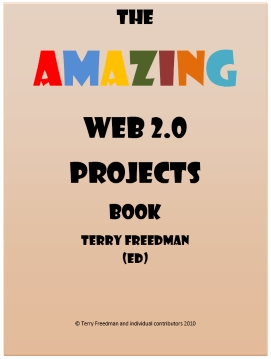
Amazing projects at an amazing priceThis fantastically useful and free book has now been downloaded 12,461 times, and that only tells part of the story. Others have made it available on their own websites, and I obviously cannot know how many downloads they've enjoyed. Also, some people have passed it on to many others.

Going by the poll I set up, the 35 people who have responded so far sent it out to an average of 81 people each, which if true of everyone would mean that over a million people have seen it so far. It's rather too small a sample to draw such conclusions though, and that mean figure hides a wide range. UNESCO, for example, has sent information about to to 5,000 people as well as placing a note about it on their website.

If you have downloaded and looked through the book, please complete the survey, which comprises three questions and involves hardly any typing!

If you like, you can access the contents of the book in two other ways, and even embed it on your own website. Firstly, there is a SlideShare  option.  The links are live, ie you can click on them and they work. Also, the subject-project  list near the beginning of the book now contains hyperlinks to the projects cited. You’ll see the embed code near the top right-hand side of the screen.

Secondly, I have created a Myebook version. To obtain the embed code, you will need to open the book and then click on the Info tab. The advantage of this over the SlideShare version is that it looks and sounds like a real book, and you can zoom in to read it more clearly. Also, you can grab parts of the screen and email it to a friend. Unfortunately, though, the links don’t work, simply because I don’t have time to create them all manually - I’m waiting for a forthcoming automated version of the book builder to do that for me!

You can download it from the Free Stuff page on the ICT in Education website, where you will also be able to read a sample of the nice things people have been saying about it.

Take part in a cool experiment

I’d like to try an experiment on my website, for which I need your help. I don’t want to go into detail now, so I’m asking you to trust me. What I need is a short article, on any aspect of educational ICT. When I say ‘short’, I mean maybe 500 words or so - in other words, just two or three paragraphs.

Have a look at the guidelines and terms and conditions, because if you were to send me an article I’ll assume you agree to them. The bottom line is that you keep the copyright in your article, and agree not to write anything that could land both of us in court!

If you’d like to take part in this experiment, and promote your own blog/website into the bargain, please send me an email suggesting a topic you’d like to write about and a sample of your writing or link to your blog.  I’d need to receive the article by 3rd May so please get in touch as soon as possible.

Snap Happy

I’ve started a group in Flickr. Called the ICT in Education group, the idea of it is to have a place where we can find photos depicting, er, ICT in education. There are other, similar, groups on Flickr, and I am not trying to outdo them in any way. I just wanted to try out the Group creation feature.

Flickr groups are quite useful, because as well as making it easy to find photos on a particular theme, you can also interact with those people who have similar photographic interests to yourself.

Setting the group up was very easy, and you are presented with several options in terms of how easily people can access it. I opted to make it open to all, subject to approval. So basically you have to apply for membership. The reason I have done this is that I get fed up with having to deal with spam and spammers all the time. I mentioned some time ago that I’d suspended the Ning communities I’d set up for that reason, and every day I have to delete spam comments from my blog (they never appear because all comments have to be approved). I didn’t want to give spammers yet one more opportunity to waste my time and that of other people.

The purpose of the group is to make it easy for people to find photos relating to educational technology that they can use to illustrate their blog posts. So I’m hoping that people will enter into the spirit of things and assign a Creative Commons licence to their pics that allows everyone to use them in that way.

If you’d like to join the group, so you can post photos there as well as your own Flickr area, go here: http://www.flickr.com/groups/1292018@N24/. There are only a few members so far, because I haven’t publicised it.

E-book section now updated
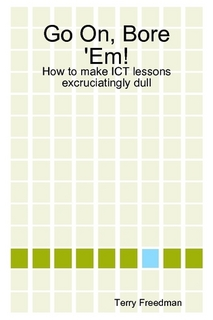
Yes, the title IS tongue-in-cheek!I've updated the e-book section of the ICT in Education website. It now includes the best-selling "Go on, bore e'm: how to make your ICT lessons excruciatingly dull", for the ridiculously low price of £1.99. It's available on Lulu too, where you can also buy a printed version for just £4.99.

Computers in Classrooms

Just in case you missed the most recent, incredibly stupendous, issue of this FREE resource (US President Richard Nixon was quoted as saying "A giant step for mankind", although he may have been referring to something else), here is what it contained:

News, views and prize draws

Information about the Amazing Web 2.0 Projects Book, two prize draws, a forthcoming e-book application for schools, free web resources and more.

Word Cloud Shoot-out

Believe it or not, Wordle isn't the only word cloud generator. Here we take an in-depth look at four such applications.

ICT- A Whole New World

Maddi is a 15 year old girl from Australia who loves ICT. Find out why.

The Importance of Mobile Phones in Education

Ethan, a 17 year-old student from England, admits that phones can be used for no good in the classroom; but the opposite is also true, as he explains.

Harnessed by Technology?

Peter Robinson strikes a slightly cynical -- but very well-informed -- tone about people's belief in the power of technology to transform.

Becta’s Leading Leaders Network: A Personal Journey

Headteacher Jeff Smith discusses his love of technology, leadership in an age of change, using technology well and wisely in school, how the Self-Review Framework helped his school transform itself in its use of ICT, and the value of the Leading Learners Network.

Interview with Melendy Lovett

I recently interviewed Melendy Lovett, President of Texas Instruments’ worldwide education technology business, about the state of STEM - Science, Technology, Engineering and Mathematics education.

Let Them Ask

Doug Woods considers how technology might be used to help youngsters ask questions.

31 Days to Become a Better Ed Tech Leader

The first two instalments of this series before it had been published! You can read the articles published so far in the series here.

If all that sounds good, join thousands of others by signing up now!