Let's Hear It For The Digital Pioneers

#gbl10 Here's a new game you can play next time you attend a conference: see how long it is before someone quotes Edison or Churchill on the meaning of success. Sooner or later someone is going to show a slide with

 "I have not failed. I've just found 10,000 ways that won't work."

(Edison)

or

"Success is the ability to go from failure to failure without losing your enthusiasm."

(Churchill)
Having visions?The Games-Based Learning Conference did not disappoint in this regard, with at least two of the speakers using these quotations to illustrate their talk.

But these quotes are not celebrating success, they are celebrating risk-taking. As a community we do not encourage risk-taking, because we do not celebrate it. We celebrate only success.

Want proof? Where are the ICT Risk-Taking Awards? Where is the Edublog Award for riskiest project undertaken? Exactly. We say we value risk-taking, but we don't live it. We should adopt the philosophy espoused in The Rocky Horror Show:

"Don't dream it; be it."

Last year, Leon Cych used the term 'Digital Pioneer' in the context of the usual sort of discussion involving digital natives and digital immigrants (another couple of expressions you might use in 'Conference Bingo'). There are those of us who are too old to be called digital natives, but are not exactly digital immigrants either. We're the people who hacked through the undergrowth of outmoded teaching methods to experiment with these new-fangled devices called 'desktop computers' and 'modems'. We were the digital pioneers of our generation.

There are digital pioneers in every generation. There are probably digital pioneers in every school. But they are acknowledged and recognised only when they have achieved success, however defined.

If we want to encourage progress, we have to find a way to encourage risk-taking. Not just in the purple haze of a conference setting, after which the keynoters ride off into the sunset to prepare for their next inspirational, feel-good, talk, but in the real world of exam grade, parental and Ofsted pressure.

When will a government agency step up to the plate and really encourage people to be digital pioneers?

Thinking About My Thinking About What Makes A Good Conference

#gbl10 I go to a lot of conferences, and get invited to attend even more, and sometimes get invited to speakCogitating on't at them. There is a fine line, I think, between attending the conferences you need to maintain your skill set and your employability, and becoming a sort of conference junkie.

And 'junkie' is a good word to use in this context because one of the effects of good conferences is that they induce a feeling of euphoria. You can tell this by what happens afterwards: there is almost nothing worse than the mild depression one starts to feel as one nears home, the train becoming less and less populated, and the remaining people looking tired, their ennui almost palpable, all brought to the fore by the post-adrenalin rush let-down.

The problem is, that feeling of euphoria can just as easily be brought on by conferences which, when all said and done, don't amount to a hill of beans, to use that wonderful quote from Casablanca. The fact is, although I added it as a follow-up to my original blog post on the subject of what makes a good conference, the issue of whether you can actually do anything practical as a result of attending is very important to me. You know, if all I want is a feeling of euphoria, there are all sorts of meetings I can go to, and come out feeling high, without spending a penny. But what would that achieve?

That's one of the reasons I thought about what makes a good conference: as well as attending several bad ones, I've also attended lots that make me feel good. The question is: is feeling 'good' enough?

Another reason is that I wanted to find a way of evaluating conferences that made comparison meaningful. I realise that not all conferences can be compared with others, because they are so different. But in economic terms, they are all goods competing for the same resources of time and money. From that point of view, I feel it my duty, both to myself and others, to start a record of how conferences fare against my criteria, in order to help me make choices in the future. (Although I acknowledge that Conference X next year will not be the same as Conference X this year; as Heraclitus said, you cannot jump into the same river twice.)

So yesterday I started the ball rolling by evaluating the Games-Based Learning 2010 Conference according to these criteria, and was quite surprised by the result. I really did enjoy the conference, but looking at the event in the cold light of those 14 points, I can see more clearly the not-so-great aspects of it.

I will need to think about this. Using those quasi-objective criteria forced me to think about the conference in a very detached way, as far as that's possible. As a result, the conference no longer shines quite so brightly to me. That will not deter me from attending next year's, or from recommending that others do so too. But it has made me think that in future conferences I shall be more 'robust' in my criticism of poor speakers, and more effusive in my praise of good ones, to take just one of the criteria. To some extent this year I allowed the 'euphoria' to blunt my edginess when it came to completing the evaluation form.

Yet at the same time, I wonder whether I am simply being too demanding. Does it even matter if some aspects of a conference 'suck', to borrow an American colloquialism? In these dark grey recessionary days, is not a glimpse of enlightenment to be welcomed, even if it is merely transitory?

I'd value your opinion on these matters, whether in the form of comments on this post using the facility here, or in Twitter or Facebook, or even by email.


Reflections on Games-Based Learning 2010

#gbl10 The word that popped into my mind at the end of the conference was 'inspiring'. That's good. There's a chance that when you've believed in and seen the efficacy of games for learning, for many years, that you can become harder and harder to please until you reach the point where nothing excites you. The technology is exciting, obviously, but more exciting than that is what people are doing with it.

Screenshot from Patient Rescue, a game for trainee doctorsI took the opportunity to look at so-called 'serious games', as I'm familiar with the school-based work that's going on, so my viewpoint will reflect that a certain extent.

How did the conference stack up against my 14 criteria for conferences ?

#1 Fresh air and daylight

Not much of that, I'm afraid. I spent most of the time in artificial light and in darkened rooms. At least the breaks were long enough to be able to nip out and get some oxygen. But this, of course, is more a reflection on the venue than the conference itself. The Brewery, where the event was held, is a very pleasant environment. Just no daylight in several rooms.

#2 Can we move now?

Some of the sessions did seem a little long, but the long breaks compensated for that I think. At least, I didn't feel that my blood had stopped circulating!

#3 Where are the kids?

There were 10 year-olds showing off their programming skills at the 2Simple stand, and at least one person I know brought his son along. However, as far as I can see there were no children physically in evidence as part of the programme. Fortunately, two or three speakers included video clips of youngsters playing and reflecting on games. I think that's important.

#4 Plenty of 'down' time

This was an excellent aspect of the conference. For example, the lunch break was so long that it was possible to go for a walk and still have time to eat lunch and talk to people. The terminology used was good as well: 'socialising' and 'reflecting'. At many conferences, there is a relentless torrent of 'stuff', and hardly any time for reflection. This was different.

#5 Good speakers, on good topics

No complaints about the topics, but some of the speakers could do with a few lessons in presentation. For example, why did two speakers assume the audience could read print and diagrams that had obviously been designed to be read on paper? Or were we expected to bring telescopes? And since when has it been acceptable for speakers to address the audience with not just one hand in their pocket, but both hands in their pockets? Is that how you speak to people you respect?

Fortunately, some speakers were excellent, in terms of both content and style of delivery, and all speakers had great content to share. I've come away with a lot of information to process, and a lot of information that will be useful in my work, which is what I'd hoped for. So overall, I'm pretty satisfied.

#6 Let the people speak

As well as plenty of time for networking there was usually time for questions after a talk. Also, the seating was 'wedding style' with gorups of tables so people could converse with each other. There were two ' unconference ' sessions, Mirandamod   (# mmgbl in Twitter) and Teachmeet . Unfortunately, they were both on at the same time, which I thought was a great pity.

#7 I wanna be connected

The wi-fi was excellent, and the Twitter stream great fun. There was a Twitter game too, which I didn't take part in, and the tag to be used was made clear (#gbl10).

#8 Who else is here?

It was nice to meet lots of people I know and quite a few I didn't. I was not able to find a delegate list, but in these days of data protection legalities perhaps conference organisers are reluctant to take chances. The Twitter stream is always a good way of finding out who else is around too!

#9 Decent accommodation

Well, I can't complain because I stayed at home and commuted each day. Someone I know stayed in a new hotel for half-price. There are always good deals around throughout the UK.

#10 Lots of choice

There were three main strands, and you could mix and match, on each of the two days. The only time I thought choice inappropriate was that between Mirandamod and Teachmeet , as I've already said.

#11 Post-conference information

Well, the Twitter stream is still going strong at the time of writing (#gbl10), and the conference website should have links to lots of videos of the talks next week.

#12 If you're going to advertise, tell us

Well, I suppose that if, as I did, you go to sessions on serious games you have to expect advertising. I have to say, though, that one or two talks felt like just one long TV advert. Happily, there was plenty of good content too, so perhaps we can regard the talks as ' advertorials '. I'm not complaining, just observing.

#13 No text please

There was a lot of printed material for the taking. I just wrote down their website addresses. There were CDs available on some stands too.

#14 Start and end on a high

Well, the conference got off to a good start with a nice video and thumping music; the talks were good too! The closing keynote, by Jesse Schell was superb. And it was great to have the prize draws afterwards, even if I didn't win anything! Graham Brown-Martin certainly knows how to organise a conference.


Over to you

I'd be interesting in learning how you found the conference, and the 'wow' moments for you. If you like, contribute a paragraph or two to a forthcoming newsletter, described in the next paragraph.

I'll be writing about the conference, or certain aspects of it, in greater depth in the special Games issues of the Computers in Classrooms newsletter , due out in April. It has a great line-up of contributors and lots of interesting information and reviews.


Pupil and Parent Guarantees, and ICT

#GBL10 The consultation about pupil and parent guarantees is under way. This consultation seeks views on the full text of the pupil and parent guarantees and whether the requirements for pupils, parents, schools and local authorities are clear and understandable, whether all the ‘musts' and ‘shoulds' detailed in the guarantees are correct and whether the responsibilities and entitlements for schools, pupils and parents are correctly balanced.

I've looked through the Pupil and Parent Guarantees document, and what strikes me is how minimalist are the requirements for ICT education. Yes, it's there, as an entitlement and an expectation, which is good. However, it's there in the context of a life skill (Functional Skill). What a pity that there seems to be no setting down of an expectation that ICT lessons should be exciting, and ICT education more than just the basics one needs to get by in life.

I suppose you could say the same thing about any subject. So I looked through the document, and nowhere is the mention of that all-important 'e' word: 'exciting'. Derek Robertson, at the Mirandamod at the Games-Based Learning Conference yesterday expressed it really well, albeit in a different context:

We should be making schools the kind of places where learners want to be.

Exactly.

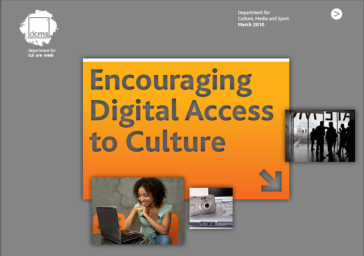
Encouraging Digital Access to Culture

well worth readingThis looks like an interesting document. I've literally just skimmed through it in nanoseconds, but it contains nuggets like:

A culture of playful, rapid small-scale experimentation needs to be fostered, complementing the desire for quality and integrity which already exists. Inappropriate governance is often stifling innovation and rapid expansion of digital access. Encouraging digital access means a radically different approach to managing technology from the way that large-scale legacy systems have been managed. Technology needs to be better integrated into creative processes.

Hear hear to that! That's exactly what we need in education too: a culture in which experimentation is encouraged, without fear of punishment if it doesn't quite pan out. Obviously there needs to be standards, and kids shouldn't be used as guinea pigs for every new half-baked idea that pops into people's heads. But hasn't it gone too far the other way?

That's what's so refreshing about the projects described in The Amazing Web 2.0 Projects Book (8,895 downloads at least, by the way, as of 5 minutes ago; and that's in just over two weeks!). They are small-scale, and driven by educational aims rather than technological ones. They were experimental; and they were undertaken in a spirit of playfulness.

Read the 10 Essential Things To Do. It's excellent advice, and transfers easily to an educational context.

You can download this free publication from here:

http://www.culture.gov.uk/images/publications/DCMS_Encouraging_Digital_Access_to_Culture.pdf


Technology and the Budget

I haven't looked into these claims, but according to the Department for Children, Schools and Families, there's a lot of money to be saved through the use of technology:

  • £650 million from greater use of collaborative procurement in schools. DCSF will provide support to schools through its procurement programme, enabling schools to use secure electronic procurement through the Educational Procurement Centre. DCSF will also support up to 250 groups of mainly primary schools each year to benefit from a shared schools business manager.
  • £50 million through schools lowering energy usage, using energy display meters which will be available to all schools that want them, enabling schools to typically reduce energy consumption by between 5 and 15 per cent.

On the first point, there has been quite a lot said recently about Gordon Brown, the Pime Minister, wanting to increase the facilities offered by government departments to enable people to conduct their business with officialdom over the internet. Again, I haven't delved into it, but at first glance it seems like a welcome development to me. There is little more depressing and time-consuming than waiting in line in a government building, trying to get something done: doing it online is a far better prospect.

I have serious doubts about the idea of energy meters. I can imagine kids (especially boys) wanting to see how far they can make the number rise! I can see such things working in a domestic environment, where the effect of doing X on energy consumption is fairly immediately apparent, and where everyone has a personal interest in using the information to reduce energy consumption. But in a school environment? I have my doubts.

I'd be interested to hear what others think of this idea.

Further Thoughts on Conferences

My ruminations on what makes a good conference seems to have sparked quite a bit of interest. Hardly surprising, if you think about it, given the inordinate amount of time a lot of us spend at these things! I thought I'd write a separate post about it in order to draw your attention to some other people's thoughts on the subject, especially as they may be currently buried in the comments on the original article.

Jim Buckingham expands on the comments he made about my article, in a blog post in its own right. In Conferences, My Definition of a Great One, Jim comes up with some brilliant suggestions, including this one:

Ultimately the perfect conference, is not a one off or something that works in isolation. By that I mean, it is hopefully part of a broader picture… namely supporting a “community of practice” and is clearly seen to be doing so.

Absolutely!

I loved reading Kim Cofino's recipe for a better conference, in her Next Generation Conference. She takes the view that conferences ought to be more practical, ie result in the actual creation of something. That certainly ties in with my own tendency to ask myself, whilst sitting in many conference sessions,

Yes, but how would this help me with Year 11 on Monday morning?

One thing I agree with, though it worries me a bit, is Kim's asking:

Why, oh why do we still see the same presenters at every conference? I don’t mean the same individual people (although that can be a problem too). I mean the same older, white, males. Where’s the diversity? Gender, race, age, experience? How did we get trapped in this model where we think only older white men have something to offer?

I think we should have more diversity, but as an older white male I feel I am being unfairly picked on here: I didn't select myself, and I can't help my age, gender or colour!

Actually, I was thinking at the Naace 2010 conference recently how many presenters were men, but also how thrilled I was that two of the keynoters were Martha Lane Fox and Keri Facer. These are two of the brightest people you could ever have the pleasure of listening to. I would also venture to suggest, at the risk of being castigated for generalising and/or sexism, that on the whole it's less likely to find a female ego-tripper on a conference podium than a male one. But maybe that's because there are fewer of them to be  ego-trippers!

Finally, Doug Woods asks:

Is the conference relevant to me and my work?

He also mentions the issue of cost.

Both points are well taken. One thing which Doug does not mention is the opportunity cost of lost earnings. For example, a conference that costs, say, £300 is actually costing you £300 plus the money you could have earned had you not gone.

A big thank you to Jim, Kim and Doug for their helpful comments, and for forcing me to deepen my own thinking in this area.

A Great Reading Video

One of the planned special editions of the Computers in Classrooms newsletter is about books, so I was pleased to come across this video by Science Girl Em. Em is a 2nd grader, which I guess means 7 to 8 years old, and she is taking part in the Student Blogging Challenge, run by Sue Walters.I discovered it through Stephen Downes.

This is a delightful response to another video about reading, which I hadn't come across. If you like it, please leave comments on Em's blog; I'm sure she'd appreciate it.

Also on her blog is a wonderful description of a trip to Kansas University. Em writes:

We saw a big giant classroom. I thought it was a theater.

Here is the video. Enjoy!

What I Look For in a Conference

There is an updated version. of this article.

I attend a lot of conferences, and over the years I've developed a useful set of criteria by which to evaluate them. Here, then, in no particular order, are my top 14 characteristics of a good conference.

#1 Fresh air and daylight

I shouldn't have to say this, but air and natural lighting are pretty fundamental for our existence. We all know that, so how come half the conference sessions I attend don't make the grade in these respects? Worst of all were the National Strategies' training days. They were pretty dire anyway, for the most part, but what made them even worse was they always seemed to be held in a basement room with no windows and no air. As the day wore on, especially after lunch, half the delegates would be falling asleep. Not good.

#2 Can we move now?

That raises another issue. A lot of conferences involve a lot of sitting around and listening. After a while, you feel like your blood has stopped circulating -- which it probably has. Now, I don't go along with ideas like getting the audience to do some sort of physical workout, which I have seen advocated in self-styled 'cutting edge' texts. But I think a variety of different kinds of session, together with making each one no longer than an hour -- and preferably less -- helps a lot.

#3 Where are the kids?

Seesaw

Like I said in an article called But where are the kids?, you would never know, walking into a lot of educational conferences, that the conference is about education at all. At best, some of them have a few token young people around to remind us all what they look like, but that's about it. I have to say that this is where conferences like ISTE(previously known as NECC) and iCTLTdo well. Kids not only start the conference off, but are seen at the exhibitors' stands, and even speak!

I like the increasing presence of young people as reporters at some conferences. This was the case at the BETT show in January 2010, and a curriculum conference in March 2009 (see the 'kids' link, above). We need more of this sort of thing.

#4 Plenty of 'down' time

Some conference organisers feel that they have to pack every waking moment -- and half our sleeping moments too! -- with activities. This is justified on the grounds that would-be delegates have to have their applications approved by bean counters who equate more stuff with better value. In fact, after a certain point has been reached, the opposite is likely to be the case.

My own view is that the best part of any conference is the conversations you have. I won't even say 'networking', because although you're 'supposed' to go to conferences to network and make connections, I find it really hard to do. The reason is that whenever people unleash their 'elevator speech' on to me, I feel like I am being sold to -- which, of course, I am. Far more interesting is having a normal, honest conversation. And if that leads to some business in the future, that's all wonderful and marvellous. And if it doesn't, well that's fine too because at least you had a good social time.

#5 Good speakers, on good topics

For me, given my views on the importance of #4, if the sessions are good too then that's a bonus. By 'good speakers' I do not mean people who shout, jump up and down, try and gee us up, and regard themselves as primarily entertainers (unless, of course, it's in the context of an after-dinner speech). I mean people who are at the top of their game, who have a deep knowledge of their subject, and who are going to give me some information and insights which I would either not be able to obtain at all otherwise, or which it would take a fair bit of time and effort to get otherwise. And up-to-date insights too, not the ones they came up with five years ago and have been trotting out ever since. Ever heard of blogs and YouTube, guys?

By 'good topics', I do not mean stuff I am interested in, because that's taken as read. I mean stuff that I should  be interested in but which I didn't know I need to know about!

#6 Let the people speak

I think there's a place for 'unconference' elements in the conference programme, like a Teachmeet or opportunities for groups of people to get together to discuss topics of mutual interest. It's not the end of the world if there isn't this option, but I think every effort should be made to provide it where possible.

#7 I wanna be connected

Connected

The best conference will have wi-fi throughout the venue, including the hotel. There must also be a conference Twitter feed, and Flickr and Technorati tags. Some conferences also have a conference blog, Facebook page,  and a social network. I think having all that is more likely to dissipate commentary, or even discourage it altogether, by making the choice too wide. What's the point anyway? Anyone who's going to write about the conference will want to do so on their own blog, wouldn't they?

#8 Who else is here?

I like to see a delegate list. Notwithstanding what I said about networking, if there is someone there whom I'd really like to meet, I'd prefer to know about it so I can look out for them and try to connect with them. Conferences provide great opportunities to meet people you have had dealings with, or need to have dealings with.

For example, at the Naace 2010 conference I was able to meet up with several people I've been having work-related conversations with. As it happens, the conference was small enough for me to see they were there. At larger conferences, you cannot rely on spotting or bumping into people, which is why a delegate list can be so handy.

#9 Decent accommodation

It's a well-known fact that people evaluate training days on the basis of whether the food was any good. The same goes for conferences, and more so if you're staying overnight. Good grub, with a proper choice for vegetarians and other diets, and a clean, well-appointed room, are what we all like.

#10 Lots of choice

It can be very frustrating when sessions you want to go to clash with each other. But I'd rather be spoilt for choice than to feel like I have almost no choice at all.

#11 Post-conference information

Presentations, and podcasts or videos of the presentations, should be available afterwards. So should supplementary material where relevant.

#12 If you're going to advertise, tell us

If you look at the ads in the paper, or this website, you'll see they have the word 'Advertisement' above them. The reason is obvious: to make sure that people don't mistakenly think they're part of the editorial. Well, I believe conference speakers should do the same. I've been to a couple of conference sessions where the presentation was an extended advertisement in all but name. If this is made clear in advance, then people are given a genuine choice. If you find out once you're in the session, not only have you had your time wasted if you didn't want to listen to an ad for 45 minutes, but you've missed the chance to go to a presentation you would have liked to have seen.

#13 No text please

Exhibitors should make their stuff available electronically, such as on a conference CD. I think it's unreasonable to expect delegates to lug tons of printed material home.

#14 Start and end on a high

I want my conference to open with a bang, and make me eager with anticipation. I want to end my conference on a high, full of adrenalin, wanting to rush back home with renewed determination to make a difference.

Over to you

What do you think are the characteristics of a great conference?

The Bug Force

It's quite obvious that there are forces at work which deny rational explanation -- at least in terms of the laws of nature as we commonly perceive them. This can be seen most readily where any kind of proofreading is required. Is there anything we can do about it?

All joking aside, should we always be encouraging students to produce perfect work? And if not, how many errors are acceptable?

P1030955.JPGNow, I don't want to detain you longer than necessary, so I'll come straight to the point: the short answer is "no". True, you can take a proofreading course, seek advice in a forum, have an extra pair of eyes, and seek advice from the experts. Nothing makes any difference, ultimately, because you're dealing with the unknown. The real  issue is this: how many errors are acceptable? I'll come back to this point shortly.

What proof do I have that proofreading is the playground of a malevolent spirit? Simply this: no matter how many times you proofread a document, there will always be one more error. This is even enshrined in a "law" of computing, albeit in a different context:

Lubarsky's Law of Cybernetic Entomology: There's always one more bug.

You, or someone else, will discover the flaw. Eventually. My research into this phenomenon over many years has led me to the inescapable conclusion that you will discover it in one of the following types of circumstance:

  • When you have printed off 400 copies.

  • When you have just mailed it in response to a job advertisement.

  • When you have just emailed the third version of it to an editor you have never worked with before.

Does this mean that you can never create a perfect copy? Not exactly, but even if you manage to thwart the forces of non-good at the proof-reading stage, the gremlins in the software you use will launch a second wave attack. How else would you explain things like:

  • A document that looks perfect on screen does not retain all the contents of the page when you print it out.

  • Page-numbering develops a mind of its own.

  • Sometimes, if you try to place a caption beneath the picture instead of above it, Word goes berserk. For example, once it caused the two paragraphs under the caption to disappear altogether.

  • Once, a colleague said that her document included a copy of a spreadsheet which looked fine on the screen, but kept printing out with most of the left hand column missing.

Is there anything you can do about it, being serious for a moment? After all, one doesn't like to be completely fatalistic. Well I do three things:

  • Run the spell-check.

  • Read through it one word at a time (and boy, is that tedious!).

  • Cajole someone else to read it.

Ultimately, none of this will make much of a difference (see Lubarsky's Rule, above), but at least you will not need to castigate yourself over it.

So, being realistic, what this really boils down to is: how many errors are acceptable? This is a serious question, and one which I don't think tends to be addressed in schools.

Students are encouraged to produce perfect work for their e-portfolios or coursework. But that is unrealistic. What we ought to be doing is encouraging them to make a judgement about the acceptable number and type of errors given the nature of the piece of work in question, the audience for whom it is intended, and the purpose of the exercise.

There are, I believe, viable alternatives to the proverbial view that if a thing is worth doing it is worth doing properly. Consider the following:

  • If you do something perfectly, there may well be an opportunity cost involved, ie the cost expressed in terms of the next best thing foregone. For instance, is it better for me to obtain a grade A in my Art exam and fail everything else, or to obtain a scattering of Bs and Cs across a range of five subjects? The answer will depend on a number of factors, such as whether I want to get into Art college or become a vet.

  • We owe it to our students, in our any time, anywhere  society, to nurture a "good enough" attitude. Don't get me wrong: I am a perfectionist, as no doubt you are too. But there comes a point (three in the morning, perhaps, or the third draft) where we all say:

    "That will have to do, and if they don't like it, they can do it themselves!"

  • In a related way, there is also the Law of Diminishing Returns. After a certain point, the benefits from continuing to work on something are outweighed by the costs in terms of fatigue or opportunity cost (see the first point).

  • Sometimes, imperfection is good. Once, for example, I completely messed up something I was doing whilst demonstrating some software to a class of teachers. They actually found it reassuring, and it gave them confidence. The logic was along the lines of:

    "Well, if an expert like Terry can make a stupid mistake like that, it's ok for me to do so too without beating myself up over it."

I don't know the answer to the question: "How many errors are acceptable?". It's a judgement call. Our job as educators, I suggest, is to help students make that judgement as part and parcel of the skill of writing and presenting for different audiences.

This article was first published on 1st August 2008.

Postscript

I received an email recently from Cate Newton of the SR Education Group. Cate says:

"The Bug Force" is an excellent article for writing, editing, and proofreading.

My interest in proofreading and writing for students sparked an article that was just published on our website, Guide to Online Schools, here: http://www.guidetoonlineschools.com/tips-and-tools/proofreading. We are trying to build up useful resources for students of all ages and this is our most recent. We’ve compiled a list of the most useful grammar, proofreading and writing style guides on the internet into one, easy-to-navigate article.

I've looked at the article and I have to say Cate has probably undersold it. It is full of links to writing and grammar guides, and looks immensely useful. The only caveat I would add is that it is mainly (though not exclusively) for a non-British audience. So whilst the processes and general principles of writing and proof-reading no doubt apply everywhere, you should exercise caution when looking at non-UK grammar texts, as there are significant differences.

In this context I should recommend Grammar Girl. This is an excellent podcast full of useful tips, and advice on common errors. And although the podcaster, Mignon Fogarty, is either American or Canadian, she usually gives the British version of grammar and sentence construction -- which is, of course, the correct one ;-).

Does any of this matter? I think so. Just because writing for the web is, arguably, less formal than other writing, and blogs are fine for publishing off-the-cuff thoughts, writing should still be error-free as far and possible, notwithstanding my comments in the article, and pleasant to read.


The internet – empowering or censoring citizens?

I attended a fascinating talk at the RSA last September. In a lecture entitled “The Internet: Empowering or Censoring Citizens”, Evgeny Morozov questioned whether the internet really is the means to inevitable freedom and democracy it is often portrayed to be.

‘So what?’, you may ask. From an educational point of view I think this is an important topic for discussion for two reasons. The first is that, in general terms, we should take every opportunity to ‘force’ students to think for themselves. When I was a teacher, I usually adopted Oscar Wilde’s stance:

“Don't say you agree with me. When people agree with me. I always feel that I must be wrong.”

Students need to be encouraged to seek questions, even if the answers are not as readily forthcoming.

Matthew Taylor and Evgeny Morozov at the RSA

Secondly, in every ICT course, apart from purely skills ones, there is a section on the effects of technology on society. By examining issues such as whether or not the internet is automatically a means of distributing power more evenly in a society, the teacher would be addressing the spirit (if not always the letter) of that section.

Morozov challenged the view of the people he refers to as ‘cyberutopians’ that connectivity + devices = democracy. Some states, he pointed out, are using the web to crack down on dissidents.

In his talk, the link to which is given below, he described a number of ways in which some countries are using the power of the web to curtail, rather than to extend, democracy and freedom. If you think about it, it is obvious that web 2.0 applications are not inherently good or bad, so why would it be so surprising to discover that countries use them for their own ends?

In this context Morozov spoke of the ‘spinternet’. The idea is that when deletion of content is, in effect, impossible, the next best approach to dealing with what we might call off-message sentiments is to use political spin to defuse the issue.

The general and simplistic view seems to be that once every young person in a country has an ipod, they will miraculously turn into democrats. This ipod liberalism, as Morozov terms it, represents a deterministic view. It seems to me to be pretty insulting too. After all, if someone gave you an ipod, would your principles and beliefs suddenly fly out of the window? I realise that that is a somewhat simplistic counter-argument, but no more so than, it seems to me, the argument itself.

In any case, a more realistic approach would be to recognise the existence of cyberhedonism: most people are not interested in politics, as shown in this illustration:
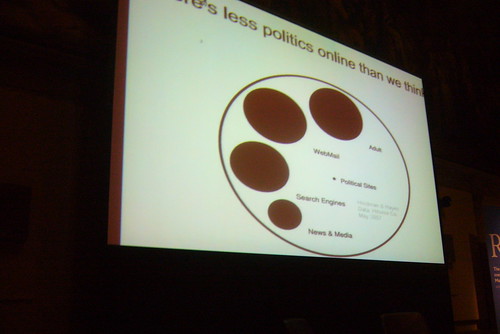
 Online politics

And perhaps we need to borrow from Maslow and draw up a hierarchy of cyberneeds (see illustration below). In this paradigm, internet users start by satisfying their basic ‘needs’ – for pornography, file-sharing and video downloading – before progressing to less self-centred activities.
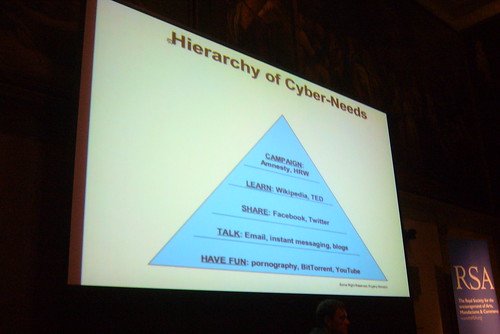
Hierarchy of internet needsTowards the end of his talk, in an almost throwaway comment, Morozov vividly illustrated the power of the web in the ‘wrong’ hands. In the past, he said, a totalitarian regime would have to torture an activist to find out the names of his associates. Now all they have to do is go on Facebook.

Of course, it’s easy to point the finger at totalitarian regimes, but even in countries like the UK and USA, power is not evenly distributed on the web. For example, half of Wikipedia’s articles are accounted for by only 10% of its users (Clay Shirky has drawn attention to this sort of thing as well). There is nothing nefarious in this, of course, but it’s salutary to bear in mind that, according to Morozov, the average person stands only a 2% chance of being mentioned on the front page of Digg. Hardly an even distribution of influence.

It seems to me that a number of questions might fruitfully be discussed with students:

What do you think of Morozov's arguments?

Is the concept of a hierarchy of cyberneeds a useful one?

Does it exist?

Where would your students place themselves in that pyramid?

Where would you and your colleagues place yourselves?

If web 2.0 applications can be manipulated by governments and even individuals, how can one guard against being taken in?

Is being digitally literate enough?

One of the key points to come out of a discussion about these issues would surely be that of identity? Morozov focused mainly on the use of Web 2.0 applications by non-democratic governments, but the truth of the matter is that you actually don’t know who you’re ‘talking’ to in any online space unless you do a bit of research and cross-checking. How do you know that the word-of-mouth recommendation you have just received is genuine?

How do you know whether or not the person ‘bad-mouthing’ a particular product is working for a rival company?

How do you know if an Amazon book review is genuine?

And is it not crucial, therefore, that we take some issues out of the ‘niche’ area of e-safety and bring them into the mainstream, or widen the definition of e-safety to include such issues?

Further reading:

Read Matthew Taylor's blog post about this (which centres on the political rather than educational implications of Morozov's address) and, especially, the comments. I especially like Taylor's conclusion:

The web is changing culture, relationships and organisations. Its effects are real and important. Sometimes they are good and sometimes not. The exaggerated claims of those who say the internet is inherently a destroyer of organisations and hierarchies or that it is bound to lead to greater democracy and collaboration are an unhelpful distraction from the important study of the internet’s real impact on real lives.

The internet society – time to get real

Listen to Morozov's talk

This article was first published on 30th September 2009.

 

Email: The Electronic Leash?

I am not sure why it is, but whereas channels such as Twitter and Facebook are pleasant and liberating, email is somehow depressing and restrictive. Perhaps it's because it is associated with work rather than pleasure, or because it is, psychologically, more demanding. Perhaps, in my case, right now, it is because I have just returned from the #Naace2010 conference (which I shall write about in due course) -- and to 3,697 emails.

No, the conference was not 3 months long, it was 3 days in total. And yes, they did have wi-fi, so in theory I could have dealt with some of the deluge whilst at the conference. Here are a few of my thoughts on the matter.My reaction to nearly 4,000 emails waiting for me

The trouble with alerts

Setting up alerts to tell you when something has been downloaded is, usually, good. In my case, I find that seeing a few downloads of something I've published, each time I check my mail, lifts my spirits. Thus it was that when I published the Amazing Web 2.0 Projects Book a few days ago, I set up an alert of this nature. I should have turned off the alert before I left for the conference, but in my naivety I assumed there would be a few hundred downloads at the most.

I could not have been more wrong.

As of a few minutes ago, it has been downloaded 4,758 times, and the majority of the 3000+ emails were the associated alerts.

So my conclusion about this is: disable any automated alerts and things of that nature before leaving home for more than a day or two!

Web mail can be slooooow

Checking my email at the hotel was a nightmare. For some reason, my main provider's web mail service is always really slow. It's cope-able with when there are just a few emails, but not when there are over 90 pages of messages. It got to the stage where each page was taking several minutes to load. I can get email on my phone, but I've learnt from past experience that if the number of messages becomes too large, the phone grinds to a halt. I found that out in Phoenix, Arizona a few years ago, when I spent a merry hour in an organic wholefood café (I don't know why I put that detail in, but I just felt the need to give the complete picture!) furiously deleting stuff and even uninstalling apps I'd never used.

Conferences are for conferencing

The other thing is that, whilst I try and keep on top of what's coming in to my email inbox whilst away, I don't want to miss the opportunities for networking and so on that a good conference provides. So unless the email is from a client, or urgent in some way, then (assuming I'd seen it at all) I would normally wait until I return and deal with it then. I constantly meet colleagues at conferences who miss entire sessions in order to deal with emails, and I can see why they would do that, but I think I am doing my clients, subscribers and readers a better service in the long run by participating in the conference as much as I can.

Sleep is important too

I know from my days of studying and teaching economics that the rarer a commodity is, the greater its value. Well, at conferences sleep tends to be placed in that category, and that has a twofold effect on my dealings with email.

Firstly, on  business grounds, I don't think answering emails late at night when you've been on the go for 19 or 20 hours is especially sensible.

Secondly, faced with the choice of grabbing 4 or 5 hours' sleep, or checking emails, surely the more sensible option is the former?

And now the deluge

And so, today and no doubt part of the weekend will involve my going through the emails, responding and, hopefully, catching up on work too. So, if you happen to be one of the people who have emailed me and have not as yet had a reply, please accept my apologies.

As it may be a bit of a wait, you might like to download that book I mentioned. Its 121 pages of good stuff, from some fantastic practitioners. And no doubt of more practical use than War and Peace, which was going to be my other reading suggestion.

But seriously, you no doubt have better things to do than wait around for responses to emails, but if you have a moment or two I'd be interested in how you deal with the inevitable email mountain we typically find on returning from a conference or vacation.

Web 2.0 For Rookies: Projects to Try Out

So far in this series we've looked at various types of application that fall under the Web 2.0 umbrella. But what does a Web 2.0 activity actually look like, and how can you go about setting one up?

Those were the kinds of questions I set out to answer when I embarked on the Amazing Web 2.0 Projects Book activity. Previously, I had compiled a list of around 60 projects that teachers had undertaken, using Web 2.0 applications. That proved to be quite popular, and it met my aim of wanting to spread ideas and practice.

A truly amazing collection of project ideasNotice that I didn't say 'spread good practice'. Clearly, it is not my intention to spread bad practice, or even mediocre practice. But it seems to me that the very terms 'good practice' and 'best practice' are value-laden. What I, in my circumstances, may regard as 'good' may, given your students and school set-up, be fairly pedestrian as far as you're concerned.

So, this updated collection of projects are largely self-selected. I invited contributions, and    quite a few came in. I asked would-be contributors for answers to specific questions, such as 'What challenges did you face in introducing this project into your school, and how did you overcome them?'

Where necessary, I emailed people individually to obtain further information. I was very clear in my mind that I wanted the projects to be replicable. So, even if providing a website for people to look was out of the question for safety reasons, I made sure that the description of the project, preferably with accompanying screenshots, made it possible for the reader to get a very good idea of what it was about, and what it looked like.

Although the book is arranged in order of student age, starting with All Ages and then from  Primary to Adult, I believe that any project can be used at any age, with a bit of tweaking obviously.

Certainly, the challenges people faced, the concerns people had, and the contributors' recommendations are not differentiated by age group.

I hope you will find this resource useful. If nothing else, it will give you a good idea of how some of the applications we've looked at in an abstract sort of way have been put to use by real teachers, in real classrooms, with real kids.

Enjoy!

You can find out more about this free resource by going to our Free Stuff page, from where you may download it.

Stop Press! At the time of writing this, the Amazing Web 2.0 Projects Book has been downloaded by 2,142 people.


Free Web 2.0 Projects Book Now Available!

At last! The Amazing Web 2.0 Projects Book!

  • 87 projects.
  • 10 further resources.
  • 52 applications.
  • 94 contributors.
  • The benefits of using Web 2.0 applications.
  • The challenges of using Web 2.0 applications.
  • How the folk who ran these projects handled the issues...
  • ... And what they recommend you do if you run them.
  • What were the learning outcomes?
  • And did I mention that this is free?!

To download it now, and to pick up a badge you can use to promote it (if you want to), please go to the Free Stuff page.

Hacking For Good Reasons

We tend to think of hacking as bad, and hackers as evil. But as well as the ones wearing white hats, ie the ones who are on our side and checking out vulnerabilities that others might exploit, there are the techno-geeks who are all dressed up and with nowhere to go.

Until now.

On the 11th March, the UK's Home Office, Cabinet Office and Ministry of Justice opened their doors to 10 technical experts from http://www.rewiredstate.com who used data.gov.uk and the web to develop tools and services that help people.

I've had a look and these are mash-ups -- the combining of two or more services -- with a difference: they are actually useful to people in helping them deal with important life issues.

At the moment, not all of the newly-created projects are working, but we are promised that they will be by the 13th March. Hmm. An IT project delivered on time? Let's see!

Some of them look very useful indeed. For example, One Click Organisations will make it possible for you to generate, at the click of a mouse, the following:

  • A constitution written in plain English
  • An official legal structure so your group can open a bank account
  • A list of group members that’s automatically kept up to date
  • A voting system to help make group decisions
  • A record of every decision that’s been made
  • Easy ways to modify the constitution as your group develops

Just those first two items alone would make it worthwhile using this app, although I think I would still want to have the legal stuff double-checked, just in case.

Moving There and other sites will prove useful to anyone looking to move into an area, in order to check crime and other stats, whilst Job Centre Pro Plus helps you find jobs in your locale. Several apps are concerned with transparency in various contexts. I especially like the sound of Voxpomp, which will collate statements made by MPs during Parliamentary debate and cross-reference them with news stories of the time. The Companies Open House ("Open 24/7, unlike Companies House") works well, allowing you to look up the details of a company unrestricted by the time of day.

There are also fun applications, such as Crime and Punishment 1707 versus 2007, described as "A slight but delightful project mashing up "The Old Bailey online - 1674-1913" and "Ministry of Justice Quarterly sentencing statistics" to compare sentencing for various types of crime." Can't wait for that one, as it will give grumpy old men like me, who think that criminals are given 32 ways of being let off, something else to rant about.

There are more of these 'Hack Days' coming up. In the meantime, to look at the apps I've mentioned in this article, and other examples of what the 'semantic web' might look like, check out the Rewired State website.

Why schools cannot ignore Web 2.0: Social Factors

#iCTLT2010 Based on my recent talk at the ICTLT2010 Conference, this short series looks at the social, technical, commercial, economic and educational factors that I think together mean that a compelling case can be made for schools to fully embrace Web 2.0 technologies.

Starting with social factors, I think we can see a number of trends at the moment.

Social networking statistics

Firstly, more and more people are online, and using Web 2.0 applications , especially social networks like Facebook. For example,

  • 400m people are on Facebook (more since I wrote this!)
  • 74.3% of Singapore’s internet population aged 15+ belong to social networks.
  • 23m Brits in social networks (1 in 3)

Social networks are used badly -- by adults. Take a look at these statistics from an article in the Sunday Times back in 2007:

  • 83% of people give their full name.
  • 38% give their Date Of Birth. Bear in mind that your name and date of birth is pretty much all anyone needs in order to steal your identity.
  • 63% make their email address public.
  • 78% of social network users are adults.

Expectations

I think we also have to consider people’s expectations. Given how widespread wireless access is, together with the trend towards people wanting to be consulted and involved in decisions that affect them, and to doing so many things online or at least in a collaborative way, it seems strange to imagine how schools could not embrace Web 2.0 in the long run.

Internationalisation

Along with this goes internationalisation, by which I mean it’s easy and almost unavoidable to interact with people in other countries when you have free and easy communications applications like Skype available.

In fact, you could argue, as Neil McLean of Becta has, that if a student is learning a foreign language, they should be able to expect to have a conversation with a native speaker of that language at least once a week, and whereas at one time that would have been unthinkable, it is now entirely feasible.

Levelling the playing field

I think there is also a sense in which the playing field has been levelled, so there is less deference to authority in the traditional sense. The obvious example of this is Wikipedia. I’m not saying this is good or bad, just that it is, and I think schools should be helping students to navigate this new world by helping them understand how to recognise authority, and how and when it is appropriate to put forward your own opinions and views, and how to evaluate information you find on the internet.

Companies are using Web 2.0

And more and more, companies are using Web 2.0 ideas to relate to, and engage, their customers. Here are some examples.

The Beano is a children’s comic in the UK, and one of its characters is Denis The Menace, who is always up to mischief and getting into trouble.

What they’ve set up is an area of their website where you can create your own Denis The Menace comic strip and save it to the website, so that other people can comment on your efforts.

Coca Cola has a fan page on Facebook, and Kodak has issued a booklet on how to use social media like Twitter to best effect, because Kodak maintains a presence on Twitter and elsewhere. So does British Telecom, which seems to have a customer services team looking out for comments about its service. A few months ago I heard of a case in which someone who had been trying, without success, for months to speak to a high level manager about a mistake on the bill she was sent, had a response within 15 minutes when she posted a comment about it in Twitter.

I had a very similar experience with another company.

Other companies like Ford, Toyota and Proctor and Gamble have entered the Web 2.0 world. In fact, Proctor and Gamble has an interactive and very engaging site called Being Girl which gives advice to teenage girls on a range of issues, and invites them to contribute, and which also promotes Proctor and Gamble products. There’s nothing wrong with that, of course – after all, I promote my own books on my website! But I think schools can help youngsters develop economic literacy and commercial awareness, as well as meeting expectations, by getting on the Web 2.0 bandwagon themselves.

Last year, Toyota worked with MySpace to launch a competition that attracted 18,000 entries, and which far exceeded the company’s hopes for brand promotion.

It’s not only big companies that are involved. There is a flower shop in London that has a Twitter account so that its followers can easily be alerted to when there are special offers. In fact, a recent survey found that in Britain, 17% of small businesses have a Twitter account.

I find it hard to believe that anyone looking at this collection of information could believe that Web 2.0 is not entirely relevant for schools today.

Since writing this I have come across Why Schools Should Learn To Use Online Services Like Facebook & YouTube Rather Than Banning Them, via Steven W. Anderson's blog.

A Reflection On The ICTLT2010 Conference

#iCTLT2010 It's interesting how people who are at the same event can have such widely differing opinions on the same thing. David Warlick and I were both at the ICTLT2010 Conference, for example, but our experiences of the penultimate keynote were not the same by a long shot.

He writes:

One of the best parts of her [Jenny Lewis'] presentation was her questioning of why we still teach safe themes in our classes, like dinosaurs, Eskimos, etc.  She then suggested that our students, within the context of curriculum, explore more important issues.

The list these 'more important issues', taken from a book called High Noon: 20 Global Problems, 20 Years to Solve Them,  includes the following:

  • Reinventing taxation for the 21st century
  • Biotechnology rules
  • Global financial architecture
  • Illegal Drugs
  • Trade, investment and competition rules
  • Intellectual property rights
  • E-commerce rules
  • International labor & migration rules

Wait a minute! Does Jenny Lewis seriously think we should tell five year olds that instead of looking at dinosaurs this year, they'll be considering global financial architecture? And does the usually sensible David Warlick seriously go along with that?

I have to say that I thought the statement a little silly, and actually detracted from what Jenny Lewis said, which for the most part was pragmatic and encouraging.In fact, until I saw that David had commented on it, I was convinced that I must have misheard it.

Here are four reasons to not jettison dinosaurs and other favourite subjects:

  • These subjects are fun. Isn't learning supposed to be fun? Global financial architecture doesn't sound like a barrel of laughs. What does it even mean?
  • These children are, erm, children. Aren't kids supposed  to be kids?
  • Let me get this straight. Our  generation totally messes up the environment, finance, world peace and 17 other problems, so we decide to steal the next generation's childhood so they can sort it all out for us? Let them grow up first! Then they can sort out our mess and create one all their own!
  • If dinosaurs etc are taught properly, kids will learn to think and ask the right questions for themselves. I'd have thought that that is exactly what we want.

Besides, call me a big kid, but I happen to like dinosaurs.

But Where Are The Kids?

This is a modified version of an article written and published in 2009. I am reproducing it because it is still relevant, and I shall be referring to it in articles in the near future.

One of the big absences at most educational conferences, as far as I'm concerned, is children and young people. Let's be honest: you would have no idea, walking into most conferences, whether you were attending an event about education or one about how to improve the market share of widgets.

Youngsters remind us why we're thereIt is hard to get this right, without a doubt -- not least because of child safety considerations -- but the more I think about it the more important I think it is to involve young people in conferences in meaningful ways. After all, it is they who, in management-speak are our clients and, in marketing-speak, our final consumer.

I've been to a few conferences recently where young people were involved to a greater or lesser extent. First, take the Naace 2009 Conference. There were children in evidence, but in my opinion in an utterly tokenistic way. I don't mean this to sound as critical as it does. When I organised the Naace conference a few years ago, it was generally regarded as being very good indeed, but there were no youngsters there. In hindsight I regard that as a mistake, and think I should have worked harder to include them (we did try, but it was logistically difficult, because of the distances involved, to liaise effectively with local schools; also, I think it requires a more imaginative mindset which is easier to nurture once you're away from all the deadlines and other headaches involved in planning a large conference).

The youngsters were there to help represent their schools, which had been invited in order to receive the ICT Mark. Traditionally, this little ceremony takes place straight after the talk by the Secretary of State for Education, so that it is he or she who is, in effect, handing over the certificate.

Alright, the fact that there are children there reminds us that this is all about them, but it seems to me that here is a golden opportunity wasted. Why not go straight into a panel discussion in which the audience can ask the youngsters what difference, if any, the process of applying for the ICT Mark has made. If it has made a difference, the session might just be the thing that's needed to convince a wavering school that it ought to take the plunge. Also, and of more immediate importance and interest, it would help us see the process from the customer's point of view (I cringe from using such terminology, by the way, but it does seem rather apt).

On the subject of a panel discussion, last year's ASPECT conference featured a panel session in which a group of students of around 17 years of age really gave the assembled educational glitterati a run for their money. For example, one of them said, in response to a rather patronising answer, to a genuine question, to the effect that it was a nonsense to say that young people were left out of decision-making, "I notice that all the people in this room have been given briefing packs. But we haven't." Stunned, embarrassed silence: after all, you can't argue with something which is so visibly true.

The Dimensions conference run by the then Qualifications and Curriculum Authority went a stage further. As you arrived at the entrance to the building, students (from a school local to me (Mayfield School), as it happened) were there to greet you and point you in the right direction. They were also involved in a workshop about the BBC School Report event (which I hope to write about separately), took part in a panel discussion, generally helped out and, crucially, went around conducting video interviews of delegates.

In the workshop, two of the students were on hand to advise us oldies of what would be best to include in a news bulletin that would fire up the interest of people of their age (15-16). They were brilliant, somehow managing to combine brutal honesty with humour and courtesy. (Perhaps we adults could learn a thing or two from them.)

Here is the video they made of the day:


There are other ways in which youngsters can be involved. A lovely way of starting a conference, for instance, can be seen in the programme of last year's Game-Based Learning conference, the second day of which was opened by a performance by children from the John Stainer school. (That was nice for me on a personal level because I worked with the school a few years ago helping it to implement its Framework for ICT Support programme).

I think what I would ultimately like to see is youngsters involved at all stages of a conference:

  1. Planning.
  2. Attending.
  3. Taking part.
  4. Evaluating.

Difficult, perhaps, but surely a goal worth striving for?

A slightly different version of this article was first published on 7th April 2009.


General Impressions of ICT in Singapore

#iCTLT2010 If I were asked to give a one-phrase description of education in Singapore, I should have to say that the overriding impression is one of faith and trust. Faith in the ability of the child to rise to challenges that we might consider beyond their years. Trust in the ability of the teacher to guide the youngsters and nurture their talents and abilities.

Faith and trust also in their ability to look at what other countries have done and experiment and come up with solutions all their own.

I am not naive. I understand that when one visits a foreign country, one will be shown the best, not the worst or even the mediocre. But seeing the best is actually what should happen: we need to see what our own students might aspire to given the right circumstances and ingredients.

Two mottos struck me as especially noteworthy. One is the Ministry of Education's ideal that teachers should teach less in order that students may learn more. Teach Less, Learn More, or TLLM, appears to be another way of stating the 'guide on the side' idea, but it seems to me to run deeper. The TLLM philosophy is not simply to leave the students to it, but to encourage and guide them in asking important questions, and then seeking the answers.

A great sentimentThe other motto is 'Every Child Ready for the World'. This strikes me as so much more positive than our own, unfortunately necessary, Every Child Matters. One of the strengths of our education system is that it considers the whole child; school is not only an educational (in the narrow sense) establishment, but the hub of the community and the locus for all sorts of services – police, social, medical – that may impinge on the individual child.

But that is also its weakness. As Michael Gove has pointed out, there is no official body in England that is solely concerned with excellence in school. We do not have a ministry of education, we have a department for children, schools and families. Even Ofsted, the inspection body, is not exclusively focused on schools, but in everything ranging from childcare provision to old age homes.

I'm not familiar enough with the Singaporean education system to be able to say whether they have cracked this dilemma, of striking the right balance between the academic and the social and emotional aspects of the child's experience. But certainly what we saw was impressive: students, even as young as 8, who were articulate about what they have done, and why; students who have worked with mentors in further education in extended projects; students who are able to work well with each other.

I don't think they have completely got it right. A teacher who has been doing very innovative work in science gives her class a pencil and paper test every six weeks. There is no slot on the curriculum for ICT, which is embedded in other subjects across the curriculum. Many will agree with this philosophically, but in my experience it's quite difficult to make it work.

Despite such doubts, for me the real issue is not whether Singaporean children are ready for the world, but whether the world is ready for them. 

Experimenting With E-Junkie

I've written several ebooks over time and am always interested in looking at different ways of selling them. The free ones are easy to deal with: I just upload them to my website and tell everyone where to get them. Ones for sale are more complicated, because you have to take into account other things, like:

  • Sales tax, in my case VAT.
  • Temporary URLs -- otherwise some people would just post the URL and effectively make the book available free of charge.
  • Shopping carts which are automatically updated as purchase requirements change.
  • A variety of payment methods.
  • An automated thank you email and/or redirect to a 'thank you' web page.
  • Bundles/deals, should one wish to offer them.

I've just started a free trial of e-Junkie. I've read a couple of articles in which people are singing its praises. One attractive thing is that, unlike many services, it doesn't take a transaction fee. Typically, that runs at a fixed amount, like one dollar, plus a percentage. That doesn't sound much, but if you want to make the books available at a fairly low cost you will find that hard to do: don't forget, PayPal, or whatever payment method you use, also takes its share.

E-Junkie was easy to set up. I only needed to look at two things in the documentation: how to enable the VAT charge for EU residents, and how to set up the API settings for PayPal to handle payments. And that was only because I didn't look at the set-up page to start with. I have to say that so far this is the easiest set-up of this kind that I've implemented.

The transaction side of things appears to be just as easy. When you make a purchase you are redirected to a page with a download link straight away, and you also receive an email with the same information plus a receipt for your records.

Now that I have set up the PayPal link, and other 'fixed-cost' items, uploading new ebooks should be easy.

Fingers crossed!

It seems to me that this sort of service could have use in a school setting too. Some schools sell DVDs of school plays and that sort of thing, to raise money for charity or to offset the cost of school trips for poorer pupils. At $5 a month for the lowest entry level, e-Junkie may be just what's needed. I notice, for instance, that you can set up tax rates for individual countries and even individual states in the USA. It may be worth giving it a whirl for a week.