 Well, the poll I was running has now closed. It was open for a week (Monday to Friday), and in that time 121 people responded. I'll be post the results here soon.
So, to coin a phrase:
Watch this space!

Well, the poll I was running has now closed. It was open for a week (Monday to Friday), and in that time 121 people responded. I'll be post the results here soon.
So, to coin a phrase:
Watch this space!
I have a lot of time for academics. Some of my best friends are academics. I used to be something of an academic myself (I studied for, and obtained, an MA, and did some ground-breaking research into adult economics education which resulted in my being invited to embark on a PhD; I declined).
The reason I mention all this is, of course, by way of a prelude to, not so much an all-out attack on, but an all-out gripe about, academic research.
Don't get me wrong: I'm all in favour of it, especially when it comes to matters to do with ICT. But in my experience, most academic researchers do not see much value in research which is not what you'd call academic. I refer, as you may have guessed, to the sort of observations made and noted down by teachers and other practitioners. What I like to refer to as 'barefoot researchers'.
There's a lot wrong with the barefoot approach, undoubtedly. Joe Nutt eloquently - and forcefully - draws our attention to that in his post The value of real scholarship. He says:
The idea that someone can scribble a few inarticulate pages online, drag and drop a few minutes of video footage showing some exploited child enthusing about the latest gadget, and call it “research” just doesn’t cut it for me I’m afraid.
I’ll come back to that in a moment, but first let’s look at academic research. Too often it is concerned with minutiae, is incomprehensible, takes a long time to say anything of any practical value, is boring and even, occasionally, badly written.
Obviously, what I’ve said may be true of some academic research but not all. By the same token. Nutt’s mini-diatribe against less academic research is itself as selective as it is partisan, a caricature.
And superficial. In the excerpt just referred to Nutt links to Stephen Heppell’s Be Very Afraid website. I’d agree that to an extent the videos are short and don’t say very much. However, I went to that event and interviewed several youngsters, and I have to say that I was very impressed by how articulate they were in discussing what they used the ICT for, and why.
There is much to be said for teacher-led classroom research. There has been some excellent work by members of Mirandanet, for example, whilst at the recent Handheld Learning Conference there were sound presentations by teachers Dawn Hallybone and Philip Griffin. Both have been experimenting with handheld technology in the primary classroom, and neither could justifiably be accused of being more concerned with the technology than its educational value (another one of Nutt’s ongoing concerns).
For me, the value of such non-academic research is that it’s quick, anyone can do it, it can provide a solution to a problem quickly and it often indicates the need for a more academic appraisal in the future. Surely that would help to explain why Becta decided to fund research into the educational value of using Web 2.0 applications in the secondary school? It made sense to do so in the light of the growing mound of anecdotal evidence.
I believe that one of the side effects of the disparagement of non-academic research is that it causes teachers to be reluctant to put themselves forward as doing something noteworthy. I think that’s a pity.
Certainly the collection of Web 2.0 project ideas I published last year has been extremely well-received by teachers. The ideas have mostly been furnished by teachers, who tried them out with their students.
The book may not stand up to academic scrutiny, but it works where it matters: in the classroom.
I’m in the process of updating the Web 2.0 Project Book. If you’d like to submit an entry, please read this article.
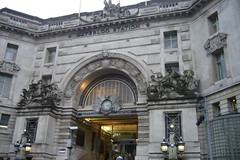
Waterloo Station, London, by Terry Freedman via Flickr
London is a sprawling place and, depending on how you define its boundaries, is home to up to around 18 million people.
So what are the chances of this happening?
Yesterday I wrote an article called Is There a Place for the Barefoot Researcher?. This was in response to an article by Joe Nutt, called The value of real scholarship.
Bear in mind that I haven't seen Joe for months. But today, as I was going down the escalator from the mainline station at Waterloo to the Underground, I passed Joe going in the opposite direction, ie he was on the 'up' escalator.
"Hi, Terry!", he said.
"Hi, Joe", I replied. "I wrote a diatribe about an article of yours last night."
"Oh yes?"
"Yes! Look on the bloggers' circle."
And that was it! I wonder what the probability is of a chance meeting like that less than 24 hours after writing a blog referring to the person?
![Reblog this post [with Zemanta]](http://img.zemanta.com/reblog_b.png?x-id=95fd0e9a-a078-4cc0-9be7-0effd941e061)
Great news: the keynotes from the first day proper of this year's Handheld Learning Conference are now available. Here are the URLs.
Set aside a few hours to watch Graham Brown-Martin's provocative introductory talk followed by four highly stimulating lectures from guest speakers, including one from Malcolm McLaren.
Graham Brown-Martin
James Paul Gee
 I've had a great response to my call for submissions to this ebook, which seeks to collate information about interesting projects involving the use of Web 2.0 applications in schools.
The original deadline was 30 September, but last night I received some news which has led me to extend it until the 31st October.
Diane Brooks, who writes the ICT in Education blog in New Zealand (no connection with this website) very kindly posted a message about the book on her blog. However, she informed me privately that schools in New Zealand are currently on holiday.
Also, and more importantly, many New Zealanders, including some of her colleagues and students, have family in Samoa. They will obviously have more pressing concerns than a book about Web 2.0, so it seemed only right and sensible to extend the deadline for everyone because of the troubles in Samoa, Indonesia and that general area of the world.
So what is the state of play so far? I've received over 60 new projects, and they all look really interesting. The applications used include e-portfolios, social networking, video Es and the 'usual suspects': blogs, wikis and a fresh-faced arrival, Twitter!
Many, if not most, of the ideas are as simple as they are exciting. For example (and it's hard to single out just one or two from this cornucopia), Nancy Raff says:
"We're creating a virtual ribbon of 6 pieces with a photo showing why a student loves the earth and a statement of why they love it and what they will do to protect it. Many schools have joined this project and people from 59 countries. Spans all grades."
Or take this one, from Tom Daccord:
"The "Great Debate of 2008" is a collaborative project providing 130+ students from 8 states with an opportunity to lead an exploration and discussion of issues and candidates surrounding the 2008 presidential election."
I think you'd agree that these ideas are not only simple but also scaleable in either direction. For example, the Great Debate wiki could be run with just one class, and the virtual ribbon project could be run with classes in the same school or neighbouring schools rather than across 59 countries.
That's the whole idea of this ebook: to share ideas, rather than to share 'best practice'. So if you have been running an educational project with Web 2.0 tools, no matter how humble you think it is, please share!
Just one thing, though: some of the URLs provided by people in their submissions are passworded, or are to a general website or blog rather than a specific post or area about the project concerned. In order to make the ebook as useful as possible to others, please provide a useful and pertinent URL. Ideally, if the site is passworded, perhaps you could provide a guest login. Alternatively, if that would be problematic in terms of e-safety concerns, send me a screenshot or two which will at least give people an idea of what's behind the firewall. Thanks for your co-operation in this!
The online form should take you only a few minutes to complete.
Thank you.
I'm really pleased: I have received over 80 submissions, which I am now going through. Some of them will be published on this website (and some already have been) each weekday at 16:30 UTC, at least until 6 November 2009.
I think it would be really nice to have 100 projects, so I've extended the deadline once again, this time to 15 November 2009. I may decide to extend it yet again at that time, if either I have not received enough submissions, or if I am so inspired by the quantity and quality of the new submissions that I won't want to cut off the flow! However, I cannot guarantee that, so if you are thinking of submitting an idea, it would be better to do so sooner rather than later.
Update: I've had over 100 submissions and I've been so inspired that I have decided to extend the invitation to submit a project until 30th November 2009.
If a sticking point for you is that you can't provide a URL for people to look at, please send a screenshot or two of the site instead.
On the basis of some of the ones I've received, I'd just like to offer some clarification:
Thanks! I look forward to receiving your submission soon!
(c) Terry Freedman All Rights Reserved