
This is the text of an unpublished article. I wrote it in 1999 and sent it off to the education editor of The Daily Telegraph. He rejected it. Oh well. The article will give you some idea of the issues we, the teachers of computing and information technology, were grappling with. The government, in the form of the department for education (DfEE back then) were dead keen on computer literacy in schools, but I wasn’t convinced that all of the initiatives were as well thought-out as they might have been.
Terry Freedman explains the benefits and drawbacks of the Government's latest initiatives.
Imagine the situation if the average teacher could hardly read or write. Parents would be scandalised, and there would be a public outcry. We demand, quite rightly, a certain standard of literacy (and numeracy) from the men and women who teach our children. Yet substitute the phrase "computer literacy" for "literacy" and this is precisely the situation that has obtained for many years. You may not like the idea of computers, you may think they have been accorded more importance than they are due. You may even believe that their presence in the classroom detracts from, rather than adds to, the quality and quantity of children's learning. Nevertheless, the fact remains that computers are playing an increasingly important role in our society. If pupils are to be taught not merely how to use a computer, but, more importantly, how to think like one – in order to be able to distinguish between human error and computer error, and to make the best use of them – they need suitably knowledgeable teachers.
Also, of course, Information Technology (IT) is an integral part of the National Curriculum, both in its own right and in the context of the other National Curriculum subjects (except for Physical Education). This situation is likely to remain substantially unaltered in the next incarnation of the National Curriculum in the year 2000.
In addition, the Office for Standards in Education has, more or less since its inception, paid very close attention to IT in its reports. With such accordance given to IT or, if you prefer, ICT – Information and Communications Technology – it is no small wonder that someone in officialdom has (at last) realised that there simply are not enough suitably qualified teachers to deliver the goods.
Consequently, there has been launched a mainly two – pronged attack on the problem.
First, on the 19th of May the Teacher Training Agency announced that, as from September, all future teachers will need to reach a high level of competence in using computers in their subject teaching. The announcement followed a period of consultation and the publishing of a draft syllabus.
Secondly, £230 million from the proceeds of the Wednesday lottery are to be used to train existing teachers in the use of ICT – about 450,000 in all.
Each of these initiatives is most welcome. Even in this day and age, few students at teacher training college seem to be given any formal training in the use of computers. In my days as a head of an IT department in a school, I sometimes had to contend with trainee business studies teachers not knowing how to use a spreadsheet or a database, applications which are commonplace in the business world. Unfortunately, my experience in this context is not unique. Therefore any attempt to raise the profile of IT in teacher training institutions is to be commended. Similarly, much time and energy is wasted in schools by a lone IT teacher trying to bring his or her colleagues up to a basic level of competence – not out of altruism, but simply in order to get to the point where the National Curriculum's Programmes of Study can be fully addressed. Training decreed by the Government, with funding to match, is to be applauded.
However, there are reasons to believe that opportunities have been missed, and that as a result these initiatives, although extremely welcome, will not be as successful as they might. In the case of teacher training, the proposed curriculum includes general skills which really ought to be part of the course entry requirements rather than part of the course itself. After all, students entering such courses are expected to be able to read and write! For example, the curriculum states that trainee teachers must be able to demonstrate that they can use the menus in programs. Also, computers will never be used properly in specific subject areas unless teachers are shown how even a single computer in a classroom can be used effectively, as this skill is far from intuitive. We are still a long way off from whole class computer access for most pupils most of the time, and this fact ought to be taken into account.
As for the training of existing teachers, the amount of money available sounds impressive but a quick bit of mental arithmetic will reveal that it equates to about £500 per teacher. Allow £150 for a day's supply cover and you're left with £350 – enough for perhaps just one day's training. Anyone who has ever been on a computer training course will know that a one day course may be better than nothing – but not much better. It may well be that as a result of this initiative, there are 400,000 more teachers who are less scared of computers than they used to be, but this is of limited value in itself. It would be better to have teachers who know when not to use a computer, rather than a legion of teachers who think they ought to be using computers at every opportunity.
The important question to ask is whether it is necessary for everyone to know a little about computers in education from the outset, or whether fewer teachers ought to know more. An alternative approach would have been to have encouraged schools to identify teachers who already have a certain level of competence in using computers, and then invested time and money into training them further. This training would not have to take the form of how to use computers per se, but how to use them to enhance children's learning, and thereby raise pupil achievement. The skills learnt could then be disseminated gradually as part of normal in – service training.
There are other initiatives which are helping to raise the profile of IT in schools, and which are helping to ease the financial burdens involved. However, although all of these put together may be a step in the right direction, one cannot help feeling that the Government has opted for quantity rather than quality.
For example, none of the initiatives has addressed the fundamental question of what is meant by IT or ICT. National Curriculum documents have appeared to use the term "Information Technology" as a synonym for computers, software, computer studies and systems analysis – but at least everyone knew that what the letters "IT" stood for. In contrast, the letters "ICT" have been used as – an abbreviation for at least five different terms – including, reportedly, three by the DfEE alone. This is not in itself a major problem, but serves to indicate the need for a debate about what exactly IT or ICT is, and how it can be best taught and used in schools.
The ultimate test of all the initiatives will be whether pupils do better, in some sense, than they would have done otherwise. Only time will tell.
Terry Freedman is an IT Advisor, and the author of Make Time With IT (Questions Publishing). He is writing here in a personal capacity.
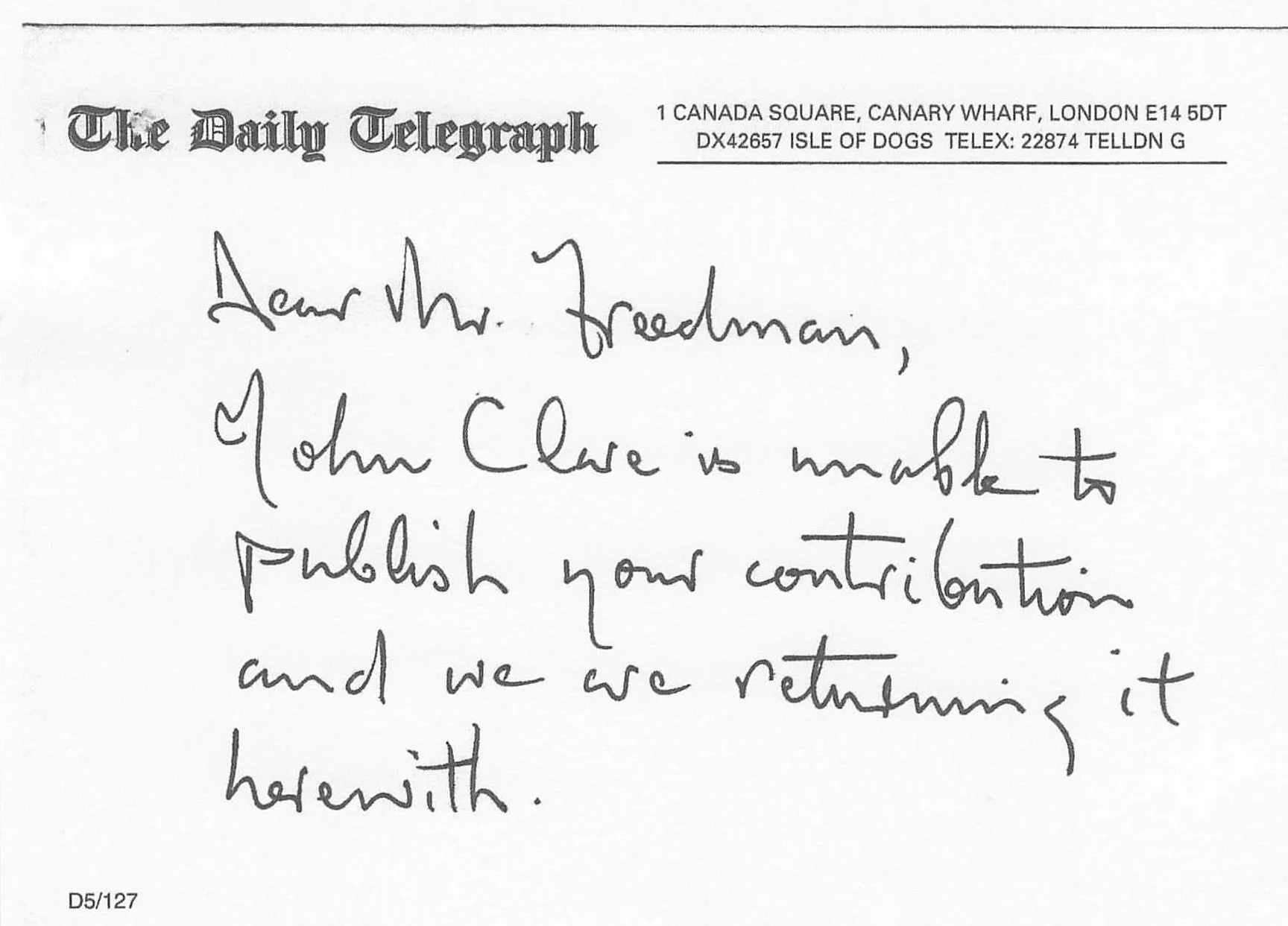
Daily Telegraph rejection slip, by Terry Freedman