
This article was originally published in, I think, 1998. I thought some people might find it interesting to read about what the department for education in England was trying to do back then in terms of providing resources for teachers, and the issues about it that I thought should be addressed.
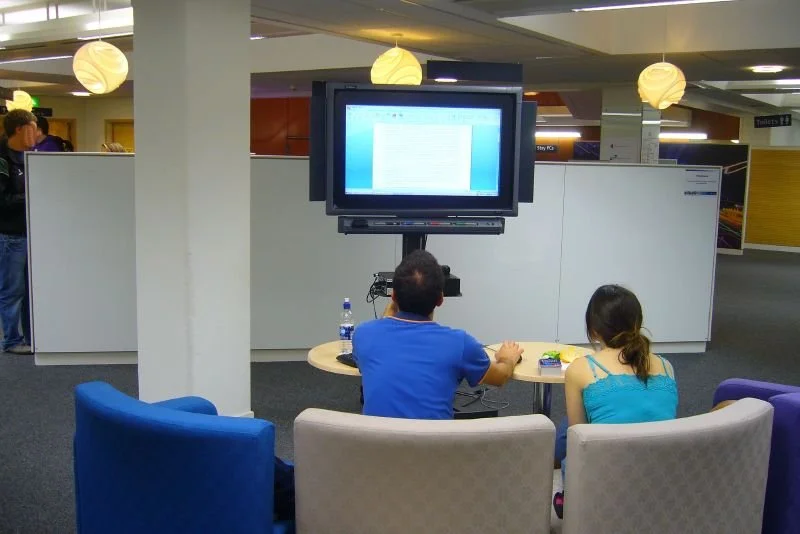
students collaborating, by Terry Freedman
At first glance, the National Grid for Learning (NGfL) is a good idea. Amongst other objectives, it aims to make available to teachers, and therefore pupils, high quality curriculum materials and other resources originating in the UK rather than the USA. This raises two questions: who is going to produce the materials, and who is going to give those materials a seal of quality assurance?
The answer to the second question is the British Educational Communications and Technology Association, or BECTa, which used to be called the National Council for Educational Technology (NCET). At least, that is the theory. Unfortunately, the practice has so far proven disappointing to the point of being depressing. You can verify this for yourself. Look at the Virtual Teachers' Web site, which is a much-vaunted aspect of the National Grid for Learning (NGfL) website - both of which are administered by BECTa
The first thing you will notice is an almost complete absence of content. The site consists almost entirely of links to other sites. Oh, and material produced by the NCET, of course. There is a section entitled Teachers' Reviews, which I presume is where teachers can post their own evaluations of hardware, software and other products. Incidentally, I can only "presume" this because the section is completely empty. Yet even apart from that, the presence of this section gives no cause for joy. Why not? Because there is a disclaimer to the effect that inclusion of a review does not imply endorsement of a product, while non-inclusion does not imply the opposite. Does this mean that the websites to which links are provided from the Virtual Teachers' Centre are approved, or not approved? What are we supposed to infer from the presence or absence of such sites? In other words, has BECTa done anything for us apart from gathering together in one place a list of useful Web sites? This may be useful, but it is not enough.
Let's return to the first question, that of who will produce the materials. It is difficult to find any clear guidance on this in the original NGfL blueprint, Connecting the Learning Society, but its underlying assumption appears to be that teachers will do so, probably because of their assumed altruism. But this raises all sorts of questions. First, will teachers be paid, and if so, who by, and on what basis? If the service providers of the NGfL are indeed consortia of companies and LEAs, as envisaged in the original document, the chances are that commercial considerations will determine what materials will get produced. Because there are relatively far fewer teachers of information technology than there are, say, of science, it is obvious that fewer IT resources will be produced than science teaching materials. Thus we are faced with the paradoxical situation that the subject least likely to benefit from all this innovation is IT itself. This is, in fact, already the case: have a look at the BECTa site, or the BBC Education site which links from it, and see if you can spot anything of direct relevance to IT teaching - despite the fact that more and more schools are starting to teach IT as a discrete subject.
In any event, how will the commercial success of the materials, and therefore their likelihood of being published, be assessed? By the projected number of "hits"? By the number of downloads? What works in the normal world of print publishing will not necessarily work in the world of web publishing. Secondly, what will happen to all those "extras", which are not really extras at all: a decent educational search engine, for example, or the regular updating of links? Someone has to undertake these tasks because they will not miraculously get done on their own. Furthermore, someone will
have to pay for them because, like all professionals, most teachers do not act from purely altruistic motives. They require fair exchange, even if that does not always take the form of hard cash. To suppose otherwise is merely patronising.
Thirdly, if teachers do contribute materials to the Virtual Teachers' Centre, who will own the intellectual copyright to them? Will it be the teachers themselves, their employers (under current UK copyright legislation this could be the case in certain circumstances), or the consortium providing the service? And can a consortium actually own intellectual rights?
The situation may therefore be summarised as follows: there is no mechanism whereby teaching resources can be produced for inclusion in the Virtual Teachers' Centre, and thereby accessible to all schools via the NGfL. And even if materials were to be produced, we cannot rely on BECTa to give their seal of approval, at least not on the evidence so far.
There is a way out of this impasse, but it requires a certain degree of political will.
Firstly, there should be a proper fund established to pay for teaching materials for the Virtual Teachers Centre independently of commercial considerations. Teachers and LEAs who wished to contribute resources would be asked to bid for funding (and, therefore, remuneration). This idea should not give anybody cause for alarm, since the approach has been used in the search for an organisation to create materials for the testing of teachers' ICT skills as a precursor to undertaking Standards Fund-based ICT training next Autumn.
Secondly, the materials should be evaluated by teachers' organisations or their representatives in BECTa. Thus, to take the earlier examples, science resources should be evaluated by the Association of Science Education, and IT materials by the National Association of Teachers and Co-ordinators of IT. This approach would remove the accreditation of resources from narrow commercial considerations, while at the same time freeing the resources of BECTa to manage the whole thing, which leads on to my third point....
Thirdly, BECTa should be given a purely managerial and administrative role in maintaining the NGfL and its most visible embodiment, the Virtual Teachers Centre. Over the years, the NCET acquired a great deal of expertise in dealing with companies, commissioning materials, organising and maintaining working parties and schools-based research. The name of the organisation may have changed, but this level and degree of expertise has not. The Government should be using it properly. In principle, the NGfL could be extremely useful to UK teachers. But there is a very real danger that the whole experiment will end in farce because of a failure to properly address these twin issues of resources and their evaluation.
Terry Freedman is an IT Advisor for a London LEA. He contributes to several periodicals, and is also the author of "Make Time With IT", published by Questions Publishing.