
Here’s a quick quiz:
Leaders and Managers are supposed to be decisive, right?
a) Yes.
b) No.
c) Not sure.
OK, that’s a light-hearted opening but there’s a serious point to be made. It’s generally thought that the more decisive a leader is, the better. But is it possible for a leader to be too decisive?
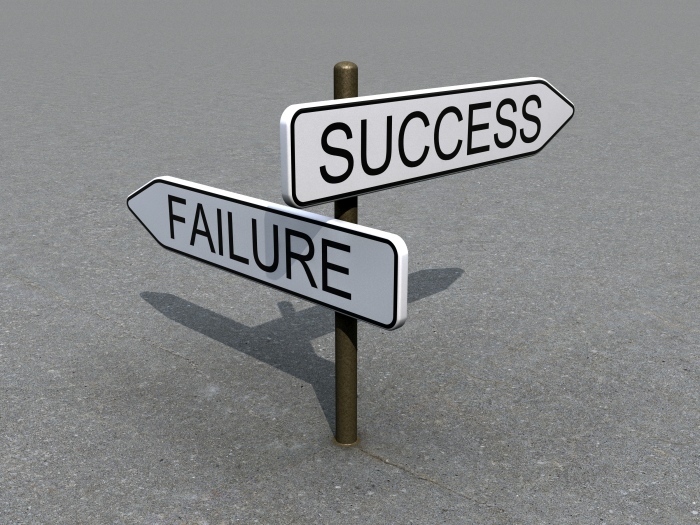 Succcess or failure: to a large extent the choice is yoursIn one place I worked, nobody would express any opinion at all on anything whatsoever. I’d ask something like, “Do you think we should buy a couple of these new tablet PCs?”, and the answer would invariably be: “Dunno.” The other thing I noticed was that team members would always come to me with their problems, and ask me for the answer. I always responded along the lines of, “Well, I trust your judgement. What do you think would be the best thing to do, and why?”
After a few weeks of this, I said to someone I’d come to trust: “How come nobody around here is prepared to express any view at all on anything? You’re all being paid a decent salary, which implies an expectation of taking some responsibility. What’s going on?”
His reply was that their previous boss had always had his own views on everything, so much so that there was never any discussion. No real discussion at least. As my colleague put it:
Geoff (not his real name) always had an opinion and knew what he wanted to do. In the end we all learnt that there was no point in thinking about different courses of action, or solutions, because they would never get discussed, so it would have been a pointless waste of time.
It seems to me that Geoff made two mistakes. The first, and most important one, was to decide on a course of action before listening to what his team members had to say. Nobody has all the facts and nuances and indeed history of all situations at their fingertips all the time, so to deny oneself access to the combined knowledge and wisdom of a group of professionals is pretty short-sighted.
The second mistake, of course, was to actually make no secret of the fact that the matter had already been decided. Surely the only thing more demoralising than having one’s opinion disregarded is to be forced into going through a farcical charade of a democratic process?
Leaders are expected to express their opinion. But not on their own. They are expected to take decisions. But at the end of the process, not the beginning.