
Search this site
Free subscriptions

What makes a good ICT role model? Please take our incredibly short survey at:
ictrolemodel


Advertisement

E-Books for Sale

Want to make your ICT lessons more interesting?

Then Go on, bore ‘em: How to make your ICT lessons excruciatingly dull is just right for you.

Clustr Map
Terry Freedman's Social Profile

You can listen to these articles! Just click the link below, or the link in each article.

If you'd like to subscribe via iTunes and other services, please visit this control panel.

Thanks to Simon Widdowson for info about this service, and to Lucas Renzi for raising the matter in the first place.

Powered by Squarespace
« Teachers and writers | Main | The Case For Bullet Points »
Wednesday
Feb172010

Sweat The Small Stuff

I think it's great that we have visionaries and big thinkers, and I enjoy working with such people. (After all, I consider myself to be one of them!) But what we appear to have a deficiency of is people who pay attention to detail. I mean real, nitty-gritty detail. The small stuff.

But that is the stuff that makes or breaks a project or an enterprise. Don't believe me? Next time you're somewhere that seems a bit grubby, though you can't quite put your finger on it, have a look at the details. In a hotel lobby, for example, that is gleaming, and yet.... Have a look in the corners. You'll probably see that it hasn't seen a broom in ages. Or the wallpaper: there's that slight nick near the light switch....

I'm sure that we pick up on all these things on a subliminal level, but it all creates an impression. For me, when it comes to projects, such as events, or publications, the small stuff really does matter:

  • I once spent two hours trying to work out why my spreadsheet covering a project of £100,000 was 57 pence out. I figured that while the 57 pence didn't matter, it could just be symptomatic of a much larger problem. I was right, in a sense. One of the formulae was rounded up, and that was compounded as its result worked its way through the spreadsheet. It wasn't a huge deal, but it was an anomaly. I don't like anomalies.
  • I wish one of my co-workers had been as assiduous. He may then not have needed to come to me as white as a sheet to tell me that he had double-counted an income stream, with the result that rather than have £30,000 to play with, we had to make up a shortfall of £30,000.
  • A student once sent me an article for publication in the Computers in Classrooms newsletter. The title of the piece was 'Article for Computer Weekly'. I had to waste time asking him if he'd sent me a recycled article or had merely put the wrong title on the top. We got that sorted out, but he blew it when he told me he hadn't had time to spellcheck it or anything. Well, if he can't be bothered to take a pride in his work, why should I be lumbered with the job? I suggested he re-send the article when he does have the time.
  • I once failed to land a contract I thought was in the bag. I asked for feedback. They sent me an email in which they said: "It was a minor thing that kinda wasn't a minor thing: you referred to the project as TCB, when it is actually GBC" (an entirely different project that was on my mind because I'd been working on it).

We're all human, we all make mistakes. But I think there are steps that we can and must take if we are to ensure that the mistakes, and their impact if they do occur, are minimised:

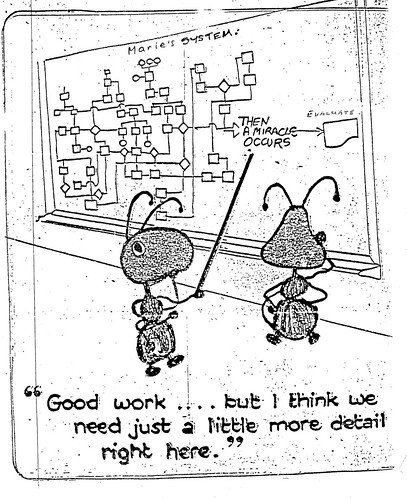
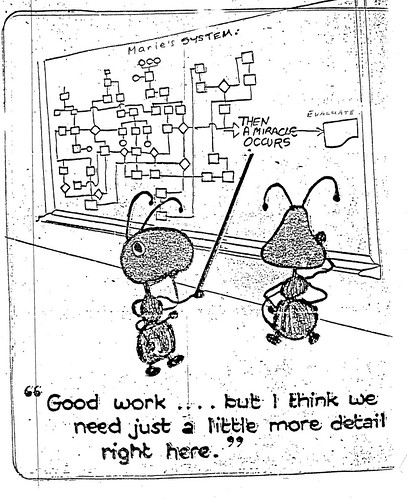
  •  Pay attention to detail. Don't make the mistake shown in the cartoon here(sorry, I don't know who the copyright owner is)
  • If it's a written piece of work, spellcheck it, proofread it, and get someone else to read it.
  • If it's a spreadsheet, run it with some numbers you can handle in your head. For example, if I am messing about with percentages, I'll insert the number 100 in the appropriate cell. If the spreadsheet tells me that 50% of 100 is 127.8, I'll know something's amiss!
  • If you're citing a website, check that it still works. OK, it may be taken offline three seconds after you've sent the email, but you can't account for that. All you can do is check and double-check as much as you can before making your statement or recommendation.
I'm not asking for perfection, just for people to sweat the small stuff. It's important.

In fact, you could say that the small stuff is pretty big.

PrintView Printer Friendly Version

EmailEmail Article to Friend

Reader Comments (5)

Happened to me when I was working (few years ago) I used to do the sales figures, used to drive me mad when I was even a penny out. However it did cost me once when the profit margin was incorrectly calculated and showed more than was actually (only a couple of per cent more) but thats all it takes made the head of place look a bit silly in front of his superiors. However on closer inspection wasnt my fault at all was my own boss who had taken over while i had a couple of days off however by the time I found out was alll blown over grrrr typical eh.
February 17, 2010 | Unregistered CommenterAmanda Wilson
I agree . I wonder how many big computer projects eg NHS (or computers in school?) etc would have fared much better if someone had asked the right questions and paid attention to details at the planning stage, at the trial stage, and throughout the implementation..
Sometimes of course the wrong person is in charge- they can't see the detail because they don't understand the detail..
February 18, 2010 | Unregistered Commenterdavid
@Amanda LOL well at least YOU did the right thing!

@David I think you're right on both counts: (a) the need for detailed checking at each stage, and (b) the comment about the wrong person being in charge -- but only to an extent. My thought is that the person in charge doesn't need to know all the details, or even to understand them, but to know enough to be able to ask the right questions.
I have to disagree with you Terry. Who is the best placed to run a hospital- someone who has gone up the ranks from nurse or doctor or someone brought in from a multinational? to run a school- a teacher or a businessperson ? obviously these are generalisations but I think a lot of problems result from people who have never encountered the detail , never dealt with the detail, not knowing what questions to ask, in fact having a whole wrong conceptual framework. This becomes tricky with ICT as not only do you have to know the detail of the social enterprise but the detail of the ICT and how these details will interact , facilitate or clash.
February 20, 2010 | Unregistered Commenterdavid
I agree with you, David, but I also disagree with you. Being devil's advocate, isa there not something to be said for having at the helm someone who has none of the 'baggage' associated with the job, and who can therefore think differently? Must write an article about this because it's an interesting issue, and I think that we are both right!

PostPost a New Comment

Enter your information below to add a new comment.

My response is on my own website »
Author Email (optional):
Author URL (optional):
Post:
 
All HTML will be escaped. Hyperlinks will be created for URLs automatically.

Web Analytics

Clicky