
Nice VLE, Shame About the Library
My visit to the Online Information Conference recently reminded me, yet again, what a marvellous bunch of people librarians are. If you really want to know about searching for information and making connections, aska librarian.
I'll be exploring such matters in the (hopefully) near future, but in the meantime I thought I'd reproduce an article I wrote this time last year. Don't worry: although the news referred to is old, the principles are still relevant, and I've updated the article.
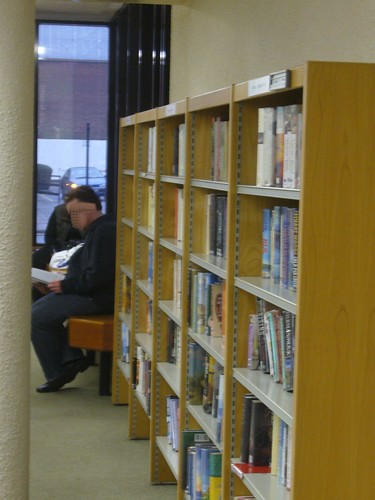
Libraries are still relevantLast week it was reported that a school in England has decided to dispense with its library, and its librarian, and have an all-encompassing virtual learning environment (VLE) instead.
It probably isn't the first school to do something like this, and no doubt will not be the last. But is the decision a good one from an educational point of view?
I have to say that, in my experience school librarians are the salt of the earth. Their role is traditionally similar to, but different from, that of their counterparts in public libraries. That is because, as well as being founts of knowledge when it comes to finding stuff, the good ones could save a teacher an incredible amount of time.
For example, in a few schools in which I've taught, the school librarian has invited staff to share their schemes of work with her (they are usually female in my experience) so that she can put together "project boxes" for the teacher.
A typical project box would contain a couple of dozen books on the topic, possibly even a few artifacts, and a list of follow-up reading. It therefore provided a very rich extra resource for the classroom for that half-term.
Now, in case you think I must be harking back to the pre-industrial age, I should tell you that I availed myself of this service several times as Head of ICT in a secondary school. I always felt it important that students know that not everything they want to find out needs to be looked for on the internet.
I also wanted them to understand the concept of triangulation, ie corroborating one set of "facts" with another set found in a different source. When you have in your classroom a box containing twelve or so very different books, as well as access to the web, this idea becomes much more transparent.
But even in traditional terms, you can't beat a good librarian. For a start, I have met very few teachers who are as good at searching for information (and finding it!) as the average librarian: librarians seem to understand the concept of "search" in a much deeper and more innate way than the rest of us.
You also cannot beat a librarian who is really at the top of his or her game. The chief librarian in my local library, some years ago now, was amazing. You could go up to him in at the desk in the reference section and say:
"I'm doing a report on butterflies in history, with particular reference to yellow butterflies in Denmark in the 16th century"
and he would say something like:
"Ah yes, you will need Cooper's History of Scandinavian Insects, but you may also like to check out the November 2001 issue of the Journal of the Moths and Butterfly Research Association".
Interestingly, one of the speakers at the conference, Paul Sonderegger, likened the traditional librarian to an interactive flow chart. This is shown in the illutsration below, which represents how the librarian responds when someone asks "Do you have anything by an Irish writer?".
What the librarian does
Finally, I happen to think that folksonomy isn't everything. Taxonomy is important too, and whilst I cannot claim to know the Dewey Decimal systems, I can claim to understand how it works, and the numbers of the type of book in which I am most interested. Where will students gain that kind of knowledge, easily, once school libraries and their custodians start to disappear.
Look at this blog for an article about the school referred to at the start of this article, along with references to newspaper reports on the matter.
See also: 7 Reasons to have an educational technology library


Terry Freedman, Educational ICT Consultant

Reader Comments (11)
Terry what might be interesting is to compare a school's library with its VLE. Are those with poorly developed VLEs in the same situation with their libraries? I guess secondaries might not have a correlation as they could have very disparate things going on with the high number of specialised staff. But there might be a correlation in primary?
Hmm, that's an interesting point, David. I don't know the answer to the question, but I shall try to find someone who does.
David - that's in interesting point in relation libraries and VLEs. In term sof my own school I think it would be fair to say that - once we converted our library into a Learning Resource Centre, with access to a bank of PCs in one area, the balance between 'book' use and PC use worked in favour of PC access - they were the reason that most pupils visited the library. I don't think there are many staff in school who would agree that was a good scenario in terms of learning. We have now reached a more balanced use of the LRC - invested more in the books available - changed the layout of the area - encouraged a more blended use of the materials and resources that are available. To be honest, there was very little link between the use of our VLE and the use of the library/LRC. We had (and would not) consider ever 'replacing' the library with VLE access - both serve very different functions. However - other schools/colleagues may have a different perception. Jim
Thanks Jim. I think the library and the VLE should be linked ideally. It all depends what is in each and the target group of pupils. For instance with young children or early stage/remedial readers the VLE might be more interesting but how are they going to find information when eg website links are to sites for adults with complex language etc. ie they might struggle with finding information from easy books but they might find searching for information much harder through a VLE. (I'm talking about those who would find the high text demands of google for instance far too hard). So as well as links to the open internet , some kind of easy to use content for the VLE would be required. So the school should teach information searching skills both in the walled garden of the vle and in the school library. Thus ideally the library contents and structure and the vle contents and structure should be designed to facilitate this . But libraries and vles can become fairly static collections of resources - sometimes both underused! how should we develop the school library and vle to meet the information searching needs of the students with low literacy skills?
David - I think the issue you raise of students with low literacy skills is a critically important one - our library has a range of differentiated support resources for these students, plus a programme to introduce them to the library, as well as a full-time librarian - I wish the VLE were in such a secure position - we are developing an understanding in school of issues relating to design for learning - but there are very few staff (teaching and support) who have a firm grasp of what e-pedagogy, e-learning looks like, or how pupils best learn online, or what an online learning opportunity should look like - despite DfES suggestions in 2005 that these pupils will be the ones who will most benefit from a learning platform - and despite the fact that many staff assume that because pupils of a certain age take to an online environment like ducks to water - all of our platform data, observations, pupil questionnaires etc suggest that pupils with low literacy levels are the ones who are least well served by the VLE and who least use it - but again, this may be down to poor design and a poor understanding of how the VLE can be designed to support these pupils. Jim
thanks Jim, I know your school is known as one of the pioneers in e-learning using a learning platform. It also sounds like your library is very well developed and supported. You mention the question "what an online learning opportunity should look like" . Getting down to the nitty gritty of what students and teachers actually do can you give an example of how tasks within school lessons can/could be structured and responded to using the VLE and the Library and any differences? David
Thanks, both, for your comments: a great discussion. David, have you seen Jim's http://www.learningplatforms.info/ website? Have a look in the Downloads section, eg at the 'Online lesson', because I think you may find the answer (or an answer) there. It would be interesting to hear if that addresses the issue
Cheers
Terry
hi Terry, yes that post was 2007 and the lesson involved downloading tasks and uploading responses. I see that in the Uniservity section the newer lessons designs are more "on-line" ,using forums, wikis, videos etc as part of the task and/or response.
Getting back to the question of library and VLE, does Jim's school have an electronic library catalogue of its books etc, and is this accessible through the VLE -like county library catalogues? ie this could be a way of extending and blending the use of the library and VLE.
Hmm, yes, interesting question. I can see the value of linking the vle and the library in that sort of way, but it seems to me to be limiting as well. To avoid the vle being a static collection of resources,wouldn't one way be to make it so that kids can add content and design their own spaces? From some correspondence with Jim in regards to a collection of Web 2.0 projects I'm putting together, Jim's students have actually done this sort of thing.
So in a sense, is your question about how can teachers plan the use of the vle limited? 'Using' the VLE may be good at first, but what if it became a collaborative publishing and discussion medium too? It strikes me that you can't or shouldn't do much to fiddle with library catalogues, but there is quite a bit you could in the VLE.
In a VLE I've been setting up for a client, I've put in a training area where teachers (for now) can fiddle and experiemnet in the knowledge that if they mess it up it doesn't matter. In fact, I WANT them to push the envelope and 'mess it up' as much as they can!
So maybe the best question is not "How have the vle and library been linked?" but "How have the VLE and the library deliberately been presented as very different entities, to be used, ultimately, in completely different ways?
Hi Terry the VLE can serve the user-generated publishing function for students (and many other functions) but should also allow access to reliable age/grade appropriate info for teaching and learning (compared to the unreliable and/or sometimes overly complex info in the open web) A library IMS accessed through a VLE would allow a single point of access to allow students to find real and electronic texts for their coursework. The teacher or student could also place key electronic texts into the VLE teaching and learning spaces. I think one american school has replaced paper text books with electronic and this will happen more and more. I haven't heard of primary schools subscribing to large scale electronic libraries where picture books and reading schemes can be downloaded or viewed online but I expect it will happen.
I agree with you that having these links could be quite useful. Joined-up information is a good concept, rarely encountered in practice!